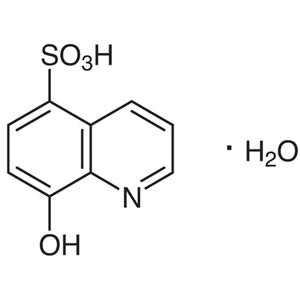
8-Hydroxyquinoline-5-sulfonic Acid Monohydrate is a chemical compound widely used in laboratory settings for its versatility in chemical reactions and molecular synthesis. As a heterocyclic building block, it plays a crucial role in the development of complex organic structures. This compound is particularly valuable in the synthesis of metal complexes due to its ability to act as a ligand. Its chemical stability and reactivity make it a reliable reagent for various synthetic pathways.
The compound’s key properties include its solubility in organic solvents and its capacity to form stable complexes with heavy metals. These characteristics make it a preferred choice for researchers working on coordination chemistry and heterocyclic synthesis. Its molecular structure also allows for functional group modifications, enhancing its utility in diverse chemical applications. The compound’s chemical stability ensures consistent performance in laboratory experiments, contributing to the reproducibility of results.
In Indonesian laboratories, 8-Hydroxyquinoline-5-sulfonic Acid Monohydrate is commonly used in chemical research, especially in the synthesis of heterocyclic compounds and the development of new chemical materials. Its availability and reliability make it a go-to reagent for chemists engaged in synthetic and analytical work. The compound’s role in supporting advanced chemical research is well-established in both academic and industrial settings.
- Heterocyclic Synthesis: This compound is ideal for constructing complex ring structures, making it essential in the development of pharmaceuticals and organic materials.
- Coordination Chemistry: Its ability to bind with heavy metals makes it a valuable reagent in the formation of metal complexes used in catalysis and analytical chemistry.
- Organic Reactions: The compound’s reactivity and solubility in organic solvents support its use in a wide range of synthetic reactions, including electrophilic substitutions.
- Analytical Chemistry: Due to its stability and reactivity, it is used in analytical methods for detecting and quantifying metal ions in solution.
- Material Science: It is employed in the synthesis of new materials with specific functional properties, such as luminescent or conductive compounds.
| Brand | TCI |
|---|---|
| CAS number | 283158-18-9 |
| Molecular formula | — |
| Purity | — |
| Category | Chemistry > Building Blocks > Heterocyclic Building Blocks |
| Pack sizes | Available in various quantities as per supplier specifications |
| Physical form | Solid, crystalline powder |
| Storage | Store in a cool, dry place away from moisture and direct light |
This compound should be stored in a cool, dry environment to maintain its chemical stability and prevent degradation. It is recommended to use airtight containers to protect it from moisture and humidity, which can affect its purity and reactivity. Due to its potential reactivity with certain substances, it should be handled in a well-ventilated area, and appropriate personal protective equipment should be worn. Avoid exposure to strong acids or bases to prevent unwanted chemical reactions. Proper labeling and safe storage practices are essential to ensure the compound remains suitable for use in laboratory applications.
—
Produk Terkait
-
5-Amino-8-hydroxyquinolineDihydrochloride TCI A1005
Regular price From Rp 3.312.750,00Regular price -
8-Hydroxyquinoline-2-carbaldehyde TCI H1713
Regular price From Rp 848.400,00Regular price -
8-Hydroxyquinoline-2-carboxylicAcid TCI H1658
Regular price From Rp 2.439.150,00Regular price -
8-HydroxyquinolineN-Oxide TCI H1272
Regular price From Rp 1.353.450,00Regular price -
2-Hydroxyquinoline-4-carboxylicAcid TCI H1016
Regular price From Rp 1.670.550,00Regular price -
8-Hydroxyquinoline-7-carboxylicAcid TCI H0877
Regular price From Rp 4.982.250,00Regular price -
Ethyl4-Hydroxyquinoline-3-carboxylate TCI E1142
Regular price From Rp 795.900,00Regular price -
6,7-Dimethoxy-4-hydroxyquinoline TCI D4695
Regular price From Rp 4.240.950,00Regular price