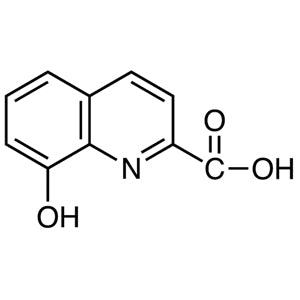
TCI H0877 8-Hydroxyquinoline-7-carboxylic Acid is an aromatic heterocyclic compound that combines a quinoline core with a hydroxyl group at the eighth position and a carboxylic acid group at the seventh position. The 8-hydroxyquinoline framework is itself one of the most classical metal-chelating motifs in coordination chemistry, and the addition of an adjacent carboxylate group enriches its binding capability. In the laboratory, this compound serves both as a heterocyclic building block and as a ligand for forming metal complexes with designable properties.
The main characteristic that makes this compound a preferred choice is the arrangement of its neighbouring donor groups, namely the quinoline nitrogen, the phenolic oxygen, and the carboxylate oxygen, which together are able to bind metal ions strongly and form stable complexes. Its conjugated aromatic core absorbs strongly in the ultraviolet region, and in many of its derivatives it exhibits fluorescence properties, making this compound attractive for the development of metal ion sensors. The carboxylate group also provides an anchoring point for constructing larger structures, for example through amide or ester formation, or as a linker within extended coordination frameworks.
In Indonesian laboratories, this compound is typically used in synthetic and coordination chemistry research groups at universities and research institutes, as well as in analytical development work. It is handled in small quantities on the bench for ligand preparation, complexation studies, and the assembly of more elaborate molecular architectures. Because it is supplied as a defined research chemical, it fits routine workflows where a well-characterised chelating building block is required as a starting point for further derivatisation.
Related TCI products
- TCI H1658 1571-30-8 8-Hydroxyquinoline-2-carboxylic Acid
- TCI H1016 15733-89-8 2-Hydroxyquinoline-4-carboxylic Acid
- TCI A1005 21302-43-2 5-Amino-8-hydroxyquinoline Dihydrochloride
- TCI H1713 14510-06-6 8-Hydroxyquinoline-2-carbaldehyde
- TCI H1272 1127-45-3 8-Hydroxyquinoline N-Oxide
- TCI H0306 283158-18-9 8-Hydroxyquinoline-5-sulfonic Acid Monohydrate
- Metal complex synthesis, where the adjacent nitrogen, phenolic oxygen, and carboxylate oxygen donors allow strong coordination to metal ions and the formation of stable, well-defined complexes.
- Ligand design for coordination chemistry studies, since the quinoline scaffold provides a rigid aromatic platform whose electronic and steric behaviour can be systematically varied by chemists.
- Development of metal ion sensors, because the conjugated aromatic core absorbs strongly in the ultraviolet region and many derivatives of this scaffold display useful fluorescence behaviour.
- Heterocyclic building block work in multistep synthesis, where the carboxylic acid group offers a convenient anchoring point for amide or ester bond formation with other fragments.
- Construction of extended coordination frameworks, in which the carboxylate group acts as a linker connecting metal centres into larger, structurally organised assemblies for materials research.
| Brand | TCI |
|---|---|
| CAS number | 19829-79-9 |
| Molecular formula | — |
| Purity | — |
| Category | Chemistry > Building Blocks > Heterocyclic Building Blocks |
| Pack sizes | available in laboratory research pack sizes; please confirm the currently offered packaging when ordering |
| Physical form | solid organic compound (aromatic heterocyclic carboxylic acid) |
| Storage | keep in a tightly closed container in a cool, dry place away from light |
- Product Code: H0877
Store this compound in its original tightly closed container in a cool, dry, and well-ventilated place, protected from direct sunlight and moisture, since prolonged exposure to light and humidity may affect an aromatic hydroxyquinoline derivative. Amber glass bottles or the manufacturer's original packaging are suitable containers, and the bottle should be resealed immediately after each use. Handle the solid in a fume hood or a well-ventilated area to avoid inhaling dust, and wear standard laboratory personal protective equipment including a lab coat, safety glasses, and chemical-resistant gloves. Use clean, dry spatulas when weighing to prevent cross-contamination, keep the material away from strong oxidising agents, and consult the manufacturer's safety data sheet before handling, waste collection, or disposal.
—
Produk Terkait
-
8-Hydroxyquinoline-2-carboxylicAcid TCI H1658
Regular price From Rp 2.439.150,00Regular price -
2-Hydroxyquinoline-4-carboxylicAcid TCI H1016
Regular price From Rp 1.670.550,00Regular price -
5-Amino-8-hydroxyquinolineDihydrochloride TCI A1005
Regular price From Rp 3.312.750,00Regular price -
8-Hydroxyquinoline-2-carbaldehyde TCI H1713
Regular price From Rp 848.400,00Regular price -
8-HydroxyquinolineN-Oxide TCI H1272
Regular price From Rp 1.353.450,00Regular price -
8-Hydroxyquinoline-5-sulfonicAcidMonohydrate TCI H0306
Regular price From Rp 1.696.800,00Regular price -
Ethyl4-Hydroxyquinoline-3-carboxylate TCI E1142
Regular price From Rp 795.900,00Regular price -
6,7-Dimethoxy-4-hydroxyquinoline TCI D4695
Regular price From Rp 4.240.950,00Regular price