
![N-Hydroxy-5-norbornene-2,3-dicarboximide [for Peptide Synthesis] (CAS 21715-90-2) - TCI H0528 - AMI Scientific](http://amiscientific.com/cdn/shop/files/TCI2510H0528.jpg?v=1771058577&width=1946)
![N-Hydroxy-5-norbornene-2,3-dicarboximide [for Peptide Synthesis] (CAS 21715-90-2) - TCI H0528 - AMI Scientific](http://amiscientific.com/cdn/shop/files/TCI2510H0528.jpg?v=1771058577&width=1445)
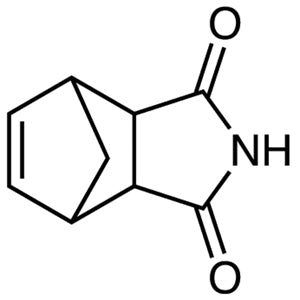
N-Hydroxy-5-norbornene-2,3-dicarboximide, frequently abbreviated in the literature as HONB, is a coupling additive reagent prepared specifically for peptide synthesis work. Structurally it is a cyclic imide fused to a norbornene framework, with the N-hydroxy group serving as its reactive centre. In a laboratory workflow, this reagent is used together with a carbodiimide or another activating reagent to convert a carboxylic acid into an active ester, which then reacts with an amine group to form the amide bond. Its role is to make the coupling reaction proceed more cleanly and under better control.
The principal reason chemists select this reagent is its ability to suppress racemisation at the alpha carbon of an amino acid during activation — a classic problem that can compromise the chiral purity of a peptide product. The active esters it forms are reactive enough to complete the coupling at a reasonable rate, yet stable enough to be isolated and stored when a workflow calls for it. The hydrophobic norbornene framework offers a practical advantage during purification, because reagent by-products are generally easier to separate than those of comparable additives.
In Indonesian laboratories the reagent is typically found in university research groups, pharmaceutical and biotechnology development units, and contract synthesis facilities engaged in peptide chemistry. It is normally handled at the bench scale alongside standard carbodiimide activators, and is ordered as a supporting reagent within a wider peptide synthesis programme rather than as a bulk consumable. Its packaging and grade designation for peptide synthesis make it suitable for work where chiral integrity of the product must be preserved.
TCI brochures (PDF)
- Condensing Agents 2025-11-18 · p. 4
- Amino Acids and Peptide Synthesis Reagents 2025-08-14 · p. 40
Related TCI products
- TCI B0249 6066-82-6 N-Hydroxysuccinimide [Coupling Reagent for Peptide]
- TCI N0634 125700-73-4 2-(5-Norbornene-2,3-dicarboximido)-1,1,3,3-tetramethyluronium Tetrafluoroborate [Coupling Reagent for Peptide]
- TCI C0793 2491-17-0 1-Cyclohexyl-3-(2-morpholinoethyl)carbodiimide Metho-p-toluenesulfonate [for Peptide Synthesis]
- TCI N0903 3647-74-3 5-Norbornene-2,3-dicarboximide
- TCI C0683 22509-74-6 N-Ethoxycarbonylphthalimide [for Peptide Synthesis]
- TCI M3572 214754-50-4 2-Hydroxy-5-methoxyisoindoline-1,3-dione
- Solution-phase peptide coupling — added with a carbodiimide to generate the active ester in situ, giving cleaner amide bond formation and reduced side reactions.
- Racemisation-sensitive fragment condensation — chosen where two peptide fragments are joined and the alpha carbon of the C-terminal residue is most vulnerable to epimerisation.
- Preparation of isolable active esters — the esters formed are stable enough to be purified and stored, allowing coupling steps to be staged across separate working sessions.
- Amide bond formation in general organic synthesis — applicable wherever a carboxylic acid must be activated toward an amine under mild and controllable conditions.
- Method development and reagent comparison studies — used as a reference additive when evaluating coupling efficiency, chiral purity, and by-product removal against alternative additives.
| Brand | TCI, catalogue number H0528 |
|---|---|
| CAS number | 21715-90-2 |
| Molecular formula | — |
| Purity | — |
| Category | Chemistry > Synthetic Reagents > Coupling [Synthetic Reagents] |
| Pack sizes | supplied in the manufacturer's standard catalogue pack sizes; please refer to the current product listing |
| Physical form | refer to the manufacturer's specification sheet and safety data sheet supplied with the product |
| Storage | — |
- Grade designation: for Peptide Synthesis
Store the reagent in its original tightly closed container in a cool, dry place, away from direct sunlight, heat sources, moisture, and incompatible materials such as strong bases and strong oxidising agents. Keep the container sealed when not in use to limit moisture uptake, and allow refrigerated stock to reach room temperature before opening so that condensation does not enter the bottle. Handle in a well-ventilated area or fume hood using a laboratory coat, chemical-resistant gloves, and eye protection. Use clean, dry spatulas and glassware when weighing to avoid contaminating the bulk material. Follow the manufacturer's safety data sheet for detailed exposure controls, spill response, and waste disposal, and observe institutional procedures for chemical waste handling.
—
Produk Terkait
-
N-Hydroxysuccinimide[CouplingReagentforPeptide] TCI B0249
Regular price From Rp 1.936.200,00Regular price -
2-(5-Norbornene-2,3-dicarboximido)-1,1,3,3-tetramethyluroniumTetrafluoroborate[CouplingReagentforPeptide] TCI N0634
Regular price From Rp 1.618.050,00Regular price -
1-Cyclohexyl-3-(2-morpholinoethyl)carbodiimideMetho-p-toluenesulfonate[forPeptideSynthesis] TCI C0793
Regular price From Rp 6.228.600,00Regular price -
5-Norbornene-2,3-dicarboximide TCI N0903
Regular price Rp 4.584.300,00Regular price -
N-Ethoxycarbonylphthalimide[forPeptideSynthesis] TCI C0683
Regular price From Rp 1.246.350,00Regular price -
2-Hydroxy-5-methoxyisoindoline-1,3-dione TCI M3572
Regular price From Rp 1.193.850,00Regular price -
2-Hydroxy-5-methylisoindoline-1,3-dione TCI M3571
Regular price From Rp 1.193.850,00Regular price -
1-Hydroxy-6-(trifluoromethyl)benzotriazole TCI H1454
Regular price From Rp 1.140.300,00Regular price
![6066-82-6 N-Hydroxysuccinimide [Coupling Reagent for Peptide] - AMI Scientific](http://amiscientific.com/cdn/shop/files/TCI2510B0249.jpg?v=1767085300&width=533)
![125700-73-4 2-(5-Norbornene-2,3-dicarboximido)-1,1,3,3-tetramethyluronium Tetrafluoroborate [Coupling Reagent for Peptide] - AMI Scientific](http://amiscientific.com/cdn/shop/files/TCI2510N0634.jpg?v=1769181097&width=533)
![1-Cyclohexyl-3-(2-morpholinoethyl)carbodiimide Metho-p-toluenesulfonate [for Peptide Synthesis] (CAS 2491-17-0) - TCI C0793 - AMI Scientific](http://amiscientific.com/cdn/shop/files/TCI2510C0793.jpg?v=1767095766&width=533)
![N-Ethoxycarbonylphthalimide [for Peptide Synthesis] (CAS 22509-74-6) - TCI C0683 - AMI Scientific](http://amiscientific.com/cdn/shop/files/TCI2510C0683.jpg?v=1767095636&width=533)


