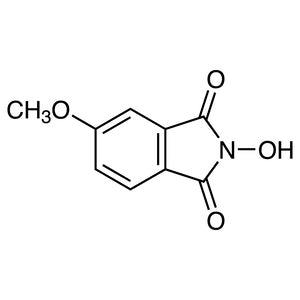
2-Hydroxy-5-methoxyisoindoline-1,3-dione is a chemical compound widely used in research applications within organic and biochemical laboratories. This compound plays a crucial role in the synthesis of complex molecules with specific biological activities, such as enzyme inhibitors and signal transduction modulators. Its unique molecular structure, featuring two hydroxyl groups and one methoxy group, contributes to its versatility in chemical reactions and molecular modifications. Due to its structural complexity, it is often utilized as a building block in the development of new compounds with potential pharmaceutical applications.
The compound’s chemical properties, including its polarity and solubility in organic solvents, make it a preferred choice for various synthetic processes. Its ability to participate in intricate chemical reactions with high precision is a key factor in its popularity among researchers. Additionally, its stability under controlled conditions allows for reliable use in laboratory settings, provided proper storage and handling protocols are followed. These characteristics make it an essential reagent for advanced chemical synthesis and molecular design.
In Indonesian laboratories, 2-Hydroxy-5-methoxyisoindoline-1,3-dione is commonly used in pharmaceutical and chemical biology research. Its role in the development of bioactive compounds aligns with the growing focus on drug discovery and molecular innovation in the region. Researchers in Indonesia rely on this compound for its chemical versatility and potential applications in creating new therapeutic agents and biochemical tools.
Advantages (TCI brochure)
- RAE reduction potential is -1.737 V vs Fc+/Fc, the most difficult to reduce in the comparison
TCI brochures (PDF)
- N-Hydroxyphthalimide Derivatives for the Synthesis of Redox Active Esters 2024-02-06 · p. 1
- Condensing Agents 2025-11-18 · p. 6
Related TCI products
- Enzyme Inhibition Studies – This compound is ideal for investigating enzyme inhibition due to its structural similarity to natural substrates and its ability to modulate enzymatic activity.
- Signal Transduction Modulation – Its molecular structure allows it to interact with cellular signaling pathways, making it useful in studying receptor-ligand interactions and pathway regulation.
- Peptide Chemistry Research – The compound’s functional groups enable it to be incorporated into peptide synthesis, supporting the development of bioactive peptides with specific biological functions.
- Organic Synthesis – Its reactivity and solubility in organic solvents make it a valuable reagent in the synthesis of complex organic molecules and heterocyclic compounds.
- Drug Discovery Programs – It serves as a starting material for the design and synthesis of novel compounds with potential pharmaceutical applications.
| Brand | TCI |
|---|---|
| CAS number | 214754-50-4 |
| Molecular formula | — |
| Purity | — |
| Category | Chemistry > Chemical Biology > Peptide Chemistry |
| Pack sizes | 50 g |
| Physical form | Powder |
| Storage | Store in a cool, dark place away from moisture and light |
Data from the TCI brochure
| Ep (vs. Fc+/Fc) of RAE | -1.737 V (RAE with R = phenylcyclopropyl group as drawn in brochure) |
|---|
Source: TCI brochure RR190 (2024-02-06)
This compound should be stored in a cool, dark place to maintain its chemical stability and prevent degradation. It is recommended to use airtight containers to protect it from exposure to moisture and air. Due to its sensitivity to light and environmental factors, it should be kept in a controlled environment with minimal temperature fluctuations. Proper ventilation is necessary when handling the compound to ensure safe laboratory practices. Always use appropriate personal protective equipment, such as gloves and safety goggles, to minimize direct contact. Regular monitoring of storage conditions ensures the compound remains viable for research applications.
References cited in the TCI brochure
- Daniel C. Salgueiro. Control of Redox‐Active Ester Reactivity Enables a General Cross‐Electrophile Approach to Access Arylated Strained Rings** Angewandte Chemie International Edition, 2022. doi:10.1002/anie.202205673
Product Categories
Produk Terkait
-
2-Hydroxy-5-methylisoindoline-1,3-dione TCI M3571
Regular price From Rp 1.246.350,00Regular priceRp 887.250,00Sale price From Rp 1.246.350,00 -
N-Hydroxysuccinimide[CouplingReagentforPeptide] TCI B0249
Regular price From Rp 1.988.700,00Regular priceRp 1.405.950,00Sale price From Rp 1.988.700,00 -
4-NitrophenylTrifluoroacetate TCI T0681
Regular price From Rp 662.550,00Regular priceRp 478.800,00Sale price From Rp 662.550,00 -
Pentafluorophenol TCI P0919
Regular price From Rp 1.590.750,00Regular priceRp 1.111.950,00Sale price From Rp 1.590.750,00 -
N-Hydroxysuccinimide TCI H0623
Regular price From Rp 1.220.100,00Regular priceRp 868.350,00Sale price From Rp 1.220.100,00 -
N-Hydroxyphthalimide TCI H0395
Regular price From Rp 717.150,00Regular priceRp 516.600,00Sale price From Rp 717.150,00 -
1-Ethoxycarbonyl-2-ethoxy-1,2-dihydroquinoline TCI E0363
Regular price Rp 2.013.900,00Regular priceRp 1.423.800,00Sale price Rp 2.013.900,00 -
Di(N-succinimidyl)Carbonate TCI D1662
Regular price From Rp 1.934.100,00Regular priceRp 1.368.150,00Sale price From Rp 1.934.100,00


![TCI B0249 6066-82-6 N-Hydroxysuccinimide [Coupling Reagent for Peptide]](http://amiscientific.com/cdn/shop/files/TCI2510B0249_940975f1-9bc1-48ca-a2d2-e366b37c2480.jpg?v=1792658848&width=533)
![6066-82-6 N-Hydroxysuccinimide [Coupling Reagent for Peptide] - AMI Scientific](http://amiscientific.com/cdn/shop/files/TCI2510B0249.jpg?v=1767085300&width=533)