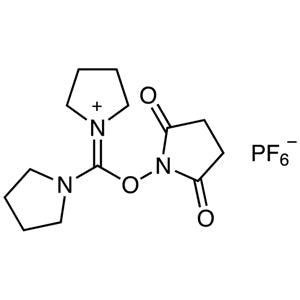
Di(N-succinimidyl) Carbonate (DSC) is a chemical reagent widely used in organic chemistry reactions, particularly in the synthesis of organic compounds and the modification of biological molecules. This compound is known for its ability to react with amino groups, making it a valuable tool in peptide and protein synthesis. Its role in activating amide bonds is critical in various biochemical processes, supporting research in chemical biology and molecular engineering. DSC is commonly employed in laboratories where efficient activation of amino groups is required, especially in the development of complex molecular structures.
The reactivity and specificity of DSC make it a preferred choice for researchers working in chemical biology and peptide chemistry. Its high reactivity ensures effective activation of amino groups, which is essential for the formation of stable amide bonds. Additionally, DSC is known for its stability under controlled conditions, although it is sensitive to moisture and air exposure. These properties make it a reliable and efficient reagent for a wide range of laboratory applications. Its versatility and effectiveness in activating functional groups have made it a standard in many research settings.
In Indonesian laboratories, DSC is frequently used in biological chemistry, pharmaceutical research, and biotechnology. It plays a key role in the modification of biological molecules and the synthesis of compounds with specific structural requirements. Its relevance in these fields is due to its ability to facilitate precise chemical reactions, supporting the development of new drugs and advanced biochemical techniques. DSC is an essential component in the toolkit of researchers working on molecular-level innovations.
TCI brochures (PDF)
- Water-solubility Enhancing Agents Superior to PEGs 2025-04-03 · p. 2
- Cross-linkers 2026-04-14 · p. 2
- Condensing Agents 2025-11-18 · p. 4
- Bioconjugation Reagents 2026-07-07 · p. 8
- Amino Acids and Peptide Synthesis Reagents 2025-08-14 · p. 39
- Reagents for Biological Research 2025-03-11 · p. 29
Related TCI products
- TCI B0249 6066-82-6 N-Hydroxysuccinimide [Coupling Reagent for Peptide]
- TCI H0623 6066-82-6 N-Hydroxysuccinimide
- TCI S0844 39028-27-8 N-Succinimidyl Iodoacetate
- TCI S0814 38862-24-7 N-Succinimidyl Acrylate
- TCI T2929 265651-18-1 N,N,N',N'-Tetramethyl-O-(N-succinimidyl)uronium Hexafluorophosphate
- TCI T2224 105832-38-0 N,N,N',N'-Tetramethyl-O-(N-succinimidyl)uronium Tetrafluoroborate
- Peptide and protein synthesis due to its ability to activate amino groups efficiently in organic synthesis.
- Organic compound modification where amide bond formation is required for structural stability.
- Biochemical research applications that rely on amide bond activation for molecular interactions.
- Drug development processes that involve the synthesis of complex molecular structures.
- Biotransformation studies requiring precise chemical activation of functional groups.
From the TCI brochure
- Reacts with hydroxyl-terminated polymer in pyridine, CH2Cl2 to form an activated intermediate for coupling with amine target molecules
| Brand | TCI |
|---|---|
| CAS number | 74124-79-1 |
| Molecular formula | — |
| Purity | — |
| Category | Chemistry > Chemical Biology > Peptide Chemistry |
| Pack sizes | Available in various quantities as per supplier specifications |
| Physical form | Solid powder |
| Storage | Store in a dry, cool place away from moisture and air exposure |
Di(N-succinimidyl) Carbonate should be stored in a dry, cool environment to maintain its chemical stability. It is recommended to keep it in a sealed container to prevent exposure to moisture and air, which can degrade its reactivity. Due to its sensitivity, it is best stored in a desiccator or a container with a drying agent. Always handle the compound in a well-ventilated area and avoid direct contact with skin or eyes. Proper personal protective equipment, such as gloves and safety goggles, should be used when handling this reagent. It is important to ensure that the storage area is free from potential contaminants and that the compound is kept in a secure location to prevent accidental exposure.
—
Product Categories
- Chemical BiologyPeptide ChemistryPeptide Coupling Agents
- Chemical BiologyLinkers and CrosslinkersHomobifunctional Cross-Linkers
- Chemical BiologyBioconjugationHomobifunctional Cross-Linkers
- Synthetic ReagentsCoupling [Synthetic Reagents]Active Esters, Additives [Coupling Reagents]
- Synthetic ReagentsCoupling [Synthetic Reagents]Phosgene Derivatives [Coupling Reagents]
- Pharmaceutical Development and Drug Discovery Research ReagentsPeptide ChemistryPeptide Coupling Agents
- Pharmaceutical Development and Drug Discovery Research ReagentsLinkers and CrosslinkersHomobifunctional Cross-Linkers
- Biochemicals and ReagentsBioconjugationHomobifunctional Cross-Linkers
- Pharmaceutical Development and Drug Discovery ResearchBioconjugationHomobifunctional Cross-Linkers
- Pharmaceutical Development and Drug Discovery ResearchPeptide ChemistryPeptide Coupling Agents
- Pharmaceutical Development and Drug Discovery ResearchLinkers and CrosslinkersHomobifunctional Cross-Linkers
Produk Terkait
-
N-Hydroxysuccinimide[CouplingReagentforPeptide] TCI B0249
Regular price From Rp 1.988.700,00Regular priceRp 1.405.950,00Sale price From Rp 1.988.700,00 -
N-Hydroxysuccinimide TCI H0623
Regular price From Rp 1.220.100,00Regular priceRp 868.350,00Sale price From Rp 1.220.100,00 -
N-SuccinimidylIodoacetate TCI S0844
Regular price Rp 2.623.950,00Regular priceRp 1.850.100,00Sale price Rp 2.623.950,00 -
N-SuccinimidylAcrylate TCI S0814
Regular price From Rp 3.207.750,00Regular priceRp 2.258.550,00Sale price From Rp 3.207.750,00 -
N,N,N',N'-Tetramethyl-O-(N-succinimidyl)uroniumHexafluorophosphate TCI T2929
Regular price From Rp 1.246.350,00Regular priceRp 887.250,00Sale price From Rp 1.246.350,00 -
N,N,N',N'-Tetramethyl-O-(N-succinimidyl)uroniumTetrafluoroborate TCI T2224
Regular price From Rp 848.400,00Regular priceRp 609.000,00Sale price From Rp 848.400,00 -
N,N,N',N'-Bis(tetramethylene)-O-(N-succinimidyl)uroniumHexafluorophosphate TCI B3817
Regular price From Rp 1.351.350,00Regular priceRp 960.750,00Sale price From Rp 1.351.350,00 -
Di(N-succinimidyl)Sebacate TCI D4019
Regular price From Rp 1.670.550,00Regular priceRp 1.183.350,00Sale price From Rp 1.670.550,00