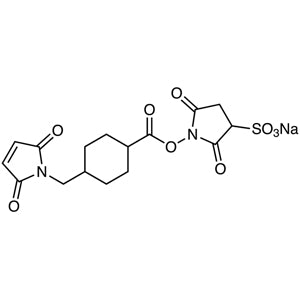
N-Succinimidyl Iodoacetate (NSIA) is a chemical compound widely used in the fields of chemical biology and peptide chemistry. It serves as a crucial reagent for protein modification, particularly for reacting with cysteine residues in proteins. In laboratory settings, NSIA is employed to activate proteins or enzymes prior to further research processes. Its reactive nature makes it essential for protein modification and biochemical research. NSIA's chemical structure allows it to react with thiol (-SH) groups on proteins, forming stable covalent bonds. This reactivity ensures its efficiency in chemical reactions requiring protein activation.
The compound’s stability under certain conditions makes it a preferred choice for laboratory use. Its ability to form stable covalent bonds with protein thiols ensures reliable results in biochemical experiments. NSIA is known for its consistency and effectiveness, making it a trusted reagent in various scientific applications. The compound’s chemical properties allow it to be used in multiple experimental setups without compromising its performance. Its reliability and reproducibility are key factors in its widespread use.
In Indonesian laboratories, NSIA is commonly used in biochemical, pharmacological, and biotechnological research. It plays a vital role in studies related to protein structure, enzyme activation, and drug development. Many research institutions and universities rely on NSIA for its efficiency and reliability. Its application in scientific research is extensive, making it a staple in the Indonesian laboratory community.
TCI brochures (PDF)
- Cross-linkers 2026-04-14 · p. 2
- Bioconjugation Reagents 2026-07-07 · p. 8
- Reagents for Biological Research 2025-03-11 · p. 29
Related TCI products
- TCI S0814 38862-24-7 N-Succinimidyl Acrylate
- TCI S0968 55750-61-3 N-Succinimidyl Maleimidoacetate
- TCI S0883 92921-24-9 3-Sulfo-N-succinimidyl 4-(N-Maleimidomethyl)cyclohexane-1-carboxylate Sodium Salt
- TCI S0863 91990-88-4 N-Succinimidyl 4-Benzoylbenzoate
- TCI S0853 64987-85-5 N-Succinimidyl 4-(N-Maleimidomethyl)cyclohexanecarboxylate
- TCI S0852 42014-51-7 N-Succinimidyl Bromoacetate
- Protein modification and labeling in biochemical research due to its ability to react with cysteine residues.
- Enzyme activation studies where covalent bonding with thiol groups is required for functional analysis.
- Peptide chemistry applications for cross-linking and conjugation of biomolecules in biotechnology.
- Drug development processes involving protein structure analysis and functional modification.
- Bioconjugation experiments requiring stable covalent bonds between proteins and other molecules.
| Brand | TCI |
|---|---|
| CAS number | 39028-27-8 |
| Molecular formula | — |
| Purity | — |
| Category | Chemistry > Chemical Biology > Peptide Chemistry |
| Pack sizes | Available in various quantities as per supplier specifications |
| Physical form | Solid or powder, depending on the formulation |
| Storage | Store in a cool, dry place away from moisture and light |
N-Succinimidyl Iodoacetate should be stored in a cool, dry environment to maintain its stability and effectiveness. It is recommended to keep the compound in a tightly sealed container to prevent exposure to moisture and air. Storage away from direct light is essential to avoid degradation. Due to its reactive nature, it should be handled with care in a well-ventilated area. Appropriate personal protective equipment, such as gloves and safety goggles, should be worn during handling. The compound is not flammable but should be stored separately from incompatible materials to ensure laboratory safety.
—
Product Categories
- Chemical BiologyPeptide ChemistryPeptide Coupling Agents
- Chemical BiologyLinkers and CrosslinkersHeterobifunctional Cross-Linkers
- Chemical BiologyLinkers and Crosslinkers
- Chemical BiologyBioconjugationHeterobifunctional Cross-Linkers
- Pharmaceutical Development and Drug Discovery Research ReagentsPeptide ChemistryPeptide Coupling Agents
- Pharmaceutical Development and Drug Discovery Research ReagentsLinkers and CrosslinkersHeterobifunctional Cross-Linkers
- Pharmaceutical Development and Drug Discovery Research ReagentsLinkers and Crosslinkers
- Biochemicals and ReagentsBioconjugationHeterobifunctional Cross-Linkers
- Pharmaceutical Development and Drug Discovery ResearchBioconjugationHeterobifunctional Cross-Linkers
- Pharmaceutical Development and Drug Discovery ResearchPeptide ChemistryPeptide Coupling Agents
- Pharmaceutical Development and Drug Discovery ResearchLinkers and CrosslinkersHeterobifunctional Cross-Linkers
- Pharmaceutical Development and Drug Discovery ResearchLinkers and Crosslinkers
Produk Terkait
-
N-SuccinimidylAcrylate TCI S0814
Regular price From Rp 3.207.750,00Regular priceRp 2.258.550,00Sale price From Rp 3.207.750,00 -
N-SuccinimidylMaleimidoacetate TCI S0968
Regular price Rp 6.306.300,00Regular priceRp 4.425.750,00Sale price Rp 6.306.300,00 -
3-Sulfo-N-succinimidyl4-(N-Maleimidomethyl)cyclohexane-1-carboxylateSodiumSalt TCI S0883
Regular price From Rp 2.121.000,00Regular priceRp 1.498.350,00Sale price From Rp 2.121.000,00 -
N-Succinimidyl4-Benzoylbenzoate TCI S0863
Regular price From Rp 3.790.500,00Regular priceRp 2.665.950,00Sale price From Rp 3.790.500,00 -
N-Succinimidyl4-(N-Maleimidomethyl)cyclohexanecarboxylate TCI S0853
Regular price From Rp 1.696.800,00Regular priceRp 1.202.250,00Sale price From Rp 1.696.800,00 -
N-SuccinimidylBromoacetate TCI S0852
Regular price Rp 3.658.200,00Regular priceRp 2.573.550,00Sale price Rp 3.658.200,00 -
N-Succinimidyl3-Maleimidopropionate[Cross-linkingReagent] TCI S0427
Regular price From Rp 1.510.950,00Regular priceRp 1.072.050,00Sale price From Rp 1.510.950,00 -
N-Succinimidyl3-Maleimidobenzoate[Cross-linkingReagent] TCI S0398
Regular price From Rp 1.351.350,00Regular priceRp 960.750,00Sale price From Rp 1.351.350,00