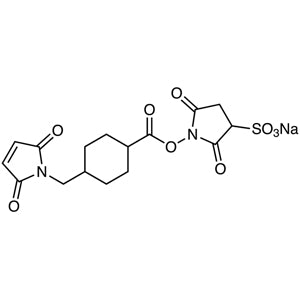
TCI S0398 58626-38-3 N-Succinimidyl 3-Maleimidobenzoate is a cross-linking reagent widely used in laboratory settings for connecting proteins or other biomolecules during various experimental procedures. This compound plays a crucial role in molecular interaction studies, drug development, and protein structure analysis. As a cross-linking agent, it enables researchers to chemically link two molecules through specific reactions, facilitating the observation of molecular interactions in biological environments. Its utility spans across multiple scientific disciplines, making it an essential tool for biochemists and molecular biologists alike.
The compound is known for its chemical stability and high reactivity, which make it a preferred choice in chemical biology applications. Its molecular structure allows for reactions with both amino and thiol groups, making it suitable for linking proteins and other biomolecules. This reagent's ability to maintain the biological activity of the molecules it connects is a key advantage, especially in experiments requiring high precision. Its versatility and effectiveness contribute to its widespread use in both academic and industrial research settings.
In Indonesian laboratories, TCI S0398 58626-38-3 N-Succinimidyl 3-Maleimidobenzoate is commonly used in biomedical, pharmacological, and biotechnological research. It is a valuable resource for scientists working on protein-protein interactions, antibody labeling, and conjugation studies. Its reliability and performance make it a go-to reagent for researchers aiming to achieve accurate and reproducible results in their experiments.
TCI brochures (PDF)
- Protein Site-specific Modification-related Reagents 2025-10-21 · p. 2
- Cross-linkers 2026-04-14 · p. 2
- Drug Delivery System (DDS) Research Reagents 2025-01-29 · p. 3
- Bioconjugation Reagents 2026-07-07 · p. 8
- Reagents for Biological Research 2025-03-11 · p. 29
Related TCI products
- TCI S0427 55750-62-4 N-Succinimidyl 3-Maleimidopropionate [Cross-linking Reagent]
- TCI S0968 55750-61-3 N-Succinimidyl Maleimidoacetate
- TCI S0883 92921-24-9 3-Sulfo-N-succinimidyl 4-(N-Maleimidomethyl)cyclohexane-1-carboxylate Sodium Salt
- TCI S0863 91990-88-4 N-Succinimidyl 4-Benzoylbenzoate
- TCI S0853 64987-85-5 N-Succinimidyl 4-(N-Maleimidomethyl)cyclohexanecarboxylate
- TCI S0852 42014-51-7 N-Succinimidyl Bromoacetate
- Protein-protein interaction studies benefit from this reagent as it allows for the specific and stable cross-linking of proteins, aiding in the analysis of molecular interactions.
- Drug development research utilizes this compound to study how biomolecules interact with potential therapeutic agents, enhancing the understanding of drug mechanisms.
- Antibody labeling and conjugation applications rely on its ability to react with amino and thiol groups, enabling the attachment of fluorescent or other markers to proteins.
- Structural biology experiments use this reagent to determine the spatial arrangement of proteins by cross-linking key residues, providing insights into molecular architecture.
- Biotransformation studies employ this cross-linking agent to investigate how proteins undergo modifications or interactions under different biochemical conditions.
| Brand | TCI |
|---|---|
| CAS number | 58626-38-3 |
| Molecular formula | — |
| Purity | — |
| Category | Chemistry > Chemical Biology > Linkers and Crosslinkers |
| Pack sizes | Available in various quantities as per supplier specifications |
| Physical form | Solid or powder, depending on the packaging |
| Storage | Store in a cool, dry place away from light and moisture |
This reagent should be stored in a cool, dry place, away from direct light and moisture to maintain its chemical stability. It is recommended to use airtight containers to prevent exposure to air and humidity, which could affect its reactivity. Due to its chemical nature, it should be handled with appropriate personal protective equipment, such as gloves and safety goggles, to ensure laboratory safety. It is important to keep the substance in a secure location, away from incompatible materials to avoid any potential chemical reactions. Proper labeling of storage containers is essential for safe handling and to prevent accidental exposure. Always follow standard laboratory safety protocols when working with cross-linking agents to ensure a safe and controlled environment.
—
Product Categories
- Chemical BiologyLinkers and CrosslinkersHeterobifunctional Cross-Linkers
- Chemical BiologyLinkers and Crosslinkers
- Chemical BiologyBioconjugationHeterobifunctional Cross-Linkers
- Pharmaceutical Development and Drug Discovery Research ReagentsLinkers and CrosslinkersHeterobifunctional Cross-Linkers
- Pharmaceutical Development and Drug Discovery Research ReagentsLinkers and Crosslinkers
- Biochemicals and ReagentsBioconjugationHeterobifunctional Cross-Linkers
- Pharmaceutical Development and Drug Discovery ResearchBioconjugationHeterobifunctional Cross-Linkers
- Pharmaceutical Development and Drug Discovery ResearchLinkers and CrosslinkersHeterobifunctional Cross-Linkers
- Pharmaceutical Development and Drug Discovery ResearchLinkers and Crosslinkers
Produk Terkait
-
N-Succinimidyl3-Maleimidopropionate[Cross-linkingReagent] TCI S0427
Regular price From Rp 1.510.950,00Regular priceRp 1.072.050,00Sale price From Rp 1.510.950,00 -
N-SuccinimidylMaleimidoacetate TCI S0968
Regular price Rp 6.306.300,00Regular priceRp 4.425.750,00Sale price Rp 6.306.300,00 -
3-Sulfo-N-succinimidyl4-(N-Maleimidomethyl)cyclohexane-1-carboxylateSodiumSalt TCI S0883
Regular price From Rp 2.121.000,00Regular priceRp 1.498.350,00Sale price From Rp 2.121.000,00 -
N-Succinimidyl4-Benzoylbenzoate TCI S0863
Regular price From Rp 3.790.500,00Regular priceRp 2.665.950,00Sale price From Rp 3.790.500,00 -
N-Succinimidyl4-(N-Maleimidomethyl)cyclohexanecarboxylate TCI S0853
Regular price From Rp 1.696.800,00Regular priceRp 1.202.250,00Sale price From Rp 1.696.800,00 -
N-SuccinimidylBromoacetate TCI S0852
Regular price Rp 3.658.200,00Regular priceRp 2.573.550,00Sale price Rp 3.658.200,00 -
N-SuccinimidylIodoacetate TCI S0844
Regular price Rp 2.623.950,00Regular priceRp 1.850.100,00Sale price Rp 2.623.950,00 -
DimethylPimelimidateDihydrochloride[Cross-linkingAgentforPeptidesResearch] TCI P0892
Regular price From Rp 3.340.050,00Regular priceRp 2.350.950,00Sale price From Rp 3.340.050,00