

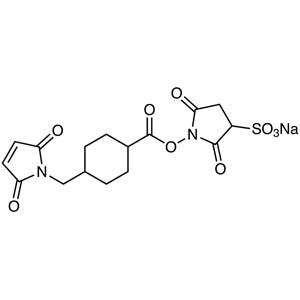
3-Sulfo-N-succinimidyl 4-(N-Maleimidomethyl)cyclohexane-1-carboxylate Sodium Salt is a chemical compound widely used in biochemical and biomedical research as a linker and crosslinker. This compound plays a crucial role in molecular conjugation by enabling covalent bonds between proteins and other biomolecules. Its unique structure allows for versatile applications in various laboratory settings, making it an essential tool for researchers working on protein analysis and modification. The compound's ability to form stable and specific linkages is particularly valuable in studies involving molecular interactions and functional assays.
The compound is preferred due to its high reactivity and the presence of two functional groups: the NHS ester and the maleimide group. These groups allow it to react with a wide range of biomolecules, including proteins, amino acids, and lipids. The combination of these reactive functionalities ensures that the compound can be used in multiple experimental setups, offering flexibility and reliability. Its stability under controlled conditions further enhances its suitability for use in laboratory environments where precision and reproducibility are critical.
In Indonesian laboratories, this compound is commonly used in biochemical and biomedical research. It supports various studies, including drug development, vaccine research, and protein analysis. Its availability in the local market facilitates research activities that require molecular crosslinking, enabling scientists to conduct experiments efficiently and effectively. The compound's role in advancing scientific research is well recognized among Indonesian researchers and institutions.
TCI brochures (PDF)
- Copper-free Click Reaction Linkers 2026-04-30 · p. 2
- Pre-Weighed Biotinylation Reagents 2025-03-25 · p. 2
- Cross-linkers 2026-04-14 · p. 2
- Protein and Biological Sample Preparation Reagents 2026-09-10 · p. 16
- Drug Delivery System (DDS) Research Reagents 2025-01-29 · p. 3
- Bioconjugation Reagents 2026-07-07 · p. 8
Related TCI products
- TCI S0853 64987-85-5 N-Succinimidyl 4-(N-Maleimidomethyl)cyclohexanecarboxylate
- TCI S0968 55750-61-3 N-Succinimidyl Maleimidoacetate
- TCI S0863 91990-88-4 N-Succinimidyl 4-Benzoylbenzoate
- TCI S0852 42014-51-7 N-Succinimidyl Bromoacetate
- TCI S0844 39028-27-8 N-Succinimidyl Iodoacetate
- TCI S0427 55750-62-4 N-Succinimidyl 3-Maleimidopropionate [Cross-linking Reagent]
- Protein conjugation and labeling experiments benefit from this compound's ability to form stable covalent bonds with proteins and other biomolecules.
- Crosslinking applications in immunology and biochemistry rely on its dual functional groups for precise molecular connections.
- Diagnostic assay development utilizes its reactivity to link biomarkers to detection platforms, enhancing sensitivity and specificity.
- Molecular imaging studies use it to attach fluorescent or radioactive tags to proteins for tracking and analysis.
- Drug conjugation research employs its crosslinking properties to create targeted therapeutics for improved delivery and efficacy.
| Brand | TCI |
|---|---|
| CAS number | 92921-24-9 |
| Molecular formula | — |
| Purity | — |
| Category | Chemistry > Chemical Biology > Linkers and Crosslinkers |
| Pack sizes | Available in various quantities as per standard laboratory requirements |
| Physical form | Solid powder |
| Storage | Store at controlled room temperature, away from moisture and light |
This compound should be stored in a cool, dry place, away from direct sunlight and moisture to maintain its stability and reactivity. It is recommended to keep it in a sealed container to prevent exposure to humidity, which could affect its performance. In a laboratory setting, it should be handled with appropriate personal protective equipment, such as gloves and safety goggles, to ensure safe handling. The compound is not flammable but should be stored separately from incompatible substances to avoid any potential chemical interactions. Regular monitoring of storage conditions is advised to ensure the integrity of the material remains unaffected over time. Proper labeling and storage practices are essential to maintain a safe and efficient laboratory environment.
—
Product Categories
- Chemical BiologyLinkers and CrosslinkersHeterobifunctional Cross-Linkers
- Chemical BiologyLinkers and Crosslinkers
- Chemical BiologyBioconjugationHeterobifunctional Cross-Linkers
- Pharmaceutical Development and Drug Discovery Research ReagentsLinkers and CrosslinkersHeterobifunctional Cross-Linkers
- Pharmaceutical Development and Drug Discovery Research ReagentsLinkers and Crosslinkers
- Biochemicals and ReagentsBioconjugationHeterobifunctional Cross-Linkers
- Pharmaceutical Development and Drug Discovery ResearchBioconjugationHeterobifunctional Cross-Linkers
- Pharmaceutical Development and Drug Discovery ResearchLinkers and CrosslinkersHeterobifunctional Cross-Linkers
- Pharmaceutical Development and Drug Discovery ResearchLinkers and Crosslinkers
Produk Terkait
-
N-Succinimidyl4-(N-Maleimidomethyl)cyclohexanecarboxylate TCI S0853
Regular price From Rp 1.644.300,00Regular price -
N-SuccinimidylMaleimidoacetate TCI S0968
Regular price Rp 6.253.800,00Regular price -
N-Succinimidyl4-Benzoylbenzoate TCI S0863
Regular price From Rp 3.738.000,00Regular price -
N-SuccinimidylBromoacetate TCI S0852
Regular price Rp 3.605.700,00Regular price -
N-SuccinimidylIodoacetate TCI S0844
Regular price Rp 2.571.450,00Regular price -
N-Succinimidyl3-Maleimidopropionate[Cross-linkingReagent] TCI S0427
Regular price From Rp 1.458.450,00Regular price -
N-Succinimidyl3-Maleimidobenzoate[Cross-linkingReagent] TCI S0398
Regular price From Rp 1.298.850,00Regular price -
N-Succinimidyl6-[[4-(N-Maleimidomethyl)cyclohexyl]carboxamido]hexanoate(2mg*5) TCI U0144
Regular price Rp 4.108.650,00Regular price


![55750-62-4 N-Succinimidyl 3-Maleimidopropionate [Cross-linking Reagent] - AMI Scientific](http://amiscientific.com/cdn/shop/files/TCI2510S0427.jpg?v=1767138756&width=533)
![58626-38-3 N-Succinimidyl 3-Maleimidobenzoate [Cross-linking Reagent] - AMI Scientific](http://amiscientific.com/cdn/shop/files/TCI2510S0398.jpg?v=1767138733&width=533)
![125559-00-4 N-Succinimidyl 6-[[4-(N-Maleimidomethyl)cyclohexyl]carboxamido]hexanoate (2mg*5) - AMI Scientific](http://amiscientific.com/cdn/shop/files/TCI2510U0144.jpg?v=1767145426&width=533)