

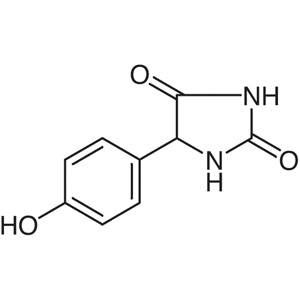
5-(4-Hydroxyphenyl)hydantoin is a chemical compound widely used as a building block in the synthesis of heterocyclic compounds. It plays a crucial role in laboratory settings where the formation of complex ring structures is required. This compound is particularly valuable in the development of pharmaceuticals, industrial chemicals, and organic molecules due to its versatile reactivity. Its ability to participate in various chemical reactions, such as substitution, coupling, and oxidation, makes it an essential tool for chemists working on synthetic pathways.
The compound's stability and controlled reactivity under specific reaction conditions make it a preferred choice for researchers. Its compatibility with a range of reagents, including acids, bases, and organic solvents, enhances its applicability in diverse experimental setups. This flexibility allows it to be used in both traditional and modern synthetic strategies. Additionally, its resistance to degradation simplifies isolation and purification processes, ensuring consistent results in laboratory experiments.
In Indonesian laboratories, 5-(4-Hydroxyphenyl)hydantoin is extensively utilized in both fundamental and applied chemical research. It is commonly found in studies related to the synthesis of new compounds, drug development, and molecular structure analysis. Its availability in suitable packaging formats facilitates its use in both academic and industrial research environments, supporting a wide range of chemical investigations.
Related TCI products
- TCI M1046 13253-44-6 5-[2-(Methylthio)ethyl]hydantoin
- TCI H0167 461-72-3 Hydantoin
- TCI A1845 67914-60-7 1-Acetyl-4-(4-hydroxyphenyl)piperazine
- TCI H1736 2963-66-8 2-(2-Hydroxyphenyl)-1H-benzimidazole
- TCI H1653 1218-69-5 2-(2-Hydroxyphenyl)-4H-1,3-benzoxazin-4-one
- TCI H1628 63676-22-2 2-(4-Hydroxyphenyl)benzo[b]thiophene-6-ol
- Drug development research benefits from this compound's role in synthesizing complex pharmaceutical molecules.
- Organic synthesis projects utilize it as a key intermediate in creating heterocyclic structures.
- Industrial chemical production relies on its stability and reactivity for efficient manufacturing processes.
- Molecular structure analysis uses it to study the behavior of heterocyclic compounds under various conditions.
- Academic research in chemical sciences incorporates it for teaching and experimental purposes in undergraduate and graduate programs.
| Brand | TCI |
|---|---|
| CAS number | 2420-17-9 |
| Molecular formula | — |
| Purity | — |
| Category | Chemistry > Building Blocks > Heterocyclic Building Blocks |
| Pack sizes | Available in various quantities as per standard laboratory requirements |
| Physical form | Solid |
| Storage | Store in a cool, dry place away from direct light |
This compound should be stored in a cool, dry environment, away from direct sunlight to maintain its stability. It is recommended to use airtight containers to prevent moisture absorption, which could affect its chemical integrity. Due to its reactivity with certain reagents, it should be handled with appropriate laboratory safety measures, including the use of personal protective equipment. It is best stored in a well-ventilated area to minimize exposure to airborne contaminants. Regular inspection of storage conditions is advised to ensure the compound remains in optimal condition for use in experiments.
—
Produk Terkait
-
5-[2-(Methylthio)ethyl]hydantoin TCI M1046
Regular price Rp 3.790.500,00Regular price -
Hydantoin TCI H0167
Regular price From Rp 823.200,00Regular price -
1-Acetyl-4-(4-hydroxyphenyl)piperazine TCI A1845
Regular price From Rp 903.000,00Regular price -
2-(2-Hydroxyphenyl)-1H-benzimidazole TCI H1736
Regular price From Rp 2.571.450,00Regular price -
2-(2-Hydroxyphenyl)-4H-1,3-benzoxazin-4-one TCI H1653
Regular price From Rp 637.350,00Regular price -
2-(4-Hydroxyphenyl)benzo[b]thiophene-6-ol TCI H1628
Regular price From Rp 1.485.750,00Regular price -
4-(4-Hydroxyphenyl)thiomorpholine1,1-Dioxide TCI H1063
Regular price Rp 3.075.450,00Regular price -
2-(2-Hydroxyphenyl)benzothiazole TCI H0973
Regular price From Rp 903.000,00Regular price
![13253-44-6 5-[2-(Methylthio)ethyl]hydantoin - AMI Scientific](http://amiscientific.com/cdn/shop/files/TCI2510M1046.jpg?v=1767124218&width=533)


![63676-22-2 2-(4-Hydroxyphenyl)benzo[b]thiophene-6-ol - AMI Scientific](http://amiscientific.com/cdn/shop/files/TCI2510H1628.jpg?v=1767118302&width=533)

