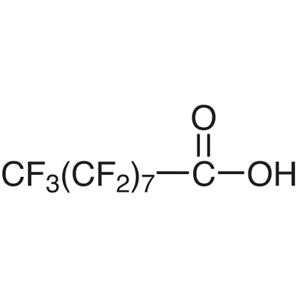
TCI H0843 Heptadecafluorononanoic Acid is a perfluorinated carboxylic acid built on a nine-carbon chain in which every hydrogen atom of the alkyl backbone has been replaced by fluorine. The compound belongs to the family of perfluoroalkyl carboxylic acids and serves as an important reference material in fluorous chemistry as well as in environmental analysis. In the laboratory it is used as a comparison standard in the analysis of perfluoroalkyl compounds, as a fluorous surfactant in two-phase reaction systems, and as a starting material for the synthesis of fluorine-labelled derivatives that carry distinctive surface properties.
The property that makes this material a preferred choice is the combination of a perfluoroalkyl chain that is strongly hydrophobic and lipophobic at the same time with a polar carboxylate head group. Perfluorinated chains are known for high chemical and thermal stability together with very low surface energy, so their derivatives are able to lower surface tension markedly and to form a fluorous phase that separates from both organic and aqueous phases. In fluorous chemistry this phase-separation behaviour is exactly what is exploited to simplify the purification of reaction products, while the carboxylate group remains available for conversion into salts, esters, amides, or acid chlorides.
In Indonesian laboratories the material is typically handled in analytical and synthetic settings where perfluoroalkyl substances are measured or prepared. It supports method development and comparison work in environmental analysis, and it is drawn on in synthesis groups that build fluorine-labelled derivatives or that run biphasic reactions relying on a separate fluorous layer. Because the reference role demands consistency, the material is normally kept in a controlled store and dispensed in small working portions.
TCI brochures (PDF)
- Fluorous Chemistry 2025-01-21 · p. 6
- Polymer Additives 2026-04-16 · p. 12
- Fluorination Reagents, Fluorinated Building Blocks 2026-03-18 · p. 53
Related TCI products
- TCI H1502 34598-33-9 2H,2H,3H,3H-Heptadecafluoroundecanoic Acid
- TCI T1545 375-85-9 Tridecafluoroheptanoic Acid
- TCI H1234 2058-94-8 Heneicosafluoroundecanoic Acid
- TCI T2528 647-42-7 1H,1H,2H,2H-Tridecafluoro-1-n-octanol
- TCI H0946 423-55-2 Heptadecafluoro-n-octyl Bromide
- TCI H1038 30377-52-7 Ethyl Heptadecafluorononanoate
- Reference standard for perfluoroalkyl analysis: the compound is a defined perfluorinated carboxylic acid, so it provides a consistent comparison point when perfluoroalkyl substances are identified and measured.
- Environmental analysis of perfluorinated compounds: as a recognised reference material in this field, it supports comparison work where perfluoroalkyl carboxylic acids are the analytical target of interest.
- Fluorous surfactant in two-phase reaction systems: the very low surface energy of the perfluorinated chain lowers surface tension markedly and helps establish the separate fluorous layer such systems depend on.
- Starting material for fluorine-labelled derivatives: the carboxylate head group can be converted into salts, esters, amides, or acid chlorides, giving access to derivatives with distinctive surface properties.
- Purification through fluorous phase separation: the chain is hydrophobic and lipophobic at once, so the fluorous phase separates from organic and aqueous phases and simplifies recovery of reaction products.
| Brand | TCI |
|---|---|
| CAS number | 375-95-1 |
| Molecular formula | — |
| Purity | — |
| Category | Chemistry > Specialty Synthesis > Fluorous Synthesis |
| Pack sizes | available in the pack sizes listed on this product page |
| Physical form | — |
| Storage | keep in a closed original container under the conditions stated by the manufacturer |
- Chemical class: perfluoroalkyl carboxylic acid, nine-carbon perfluorinated chain
Store the material in its tightly closed original container in a cool, dry, and well-ventilated area, away from moisture and from incompatible substances, following the conditions stated by the manufacturer on the label and safety data sheet. Chemically resistant containers with secure closures are appropriate, and the container should be reclosed promptly after each use so that the material is not left exposed. Handle the compound as a carboxylic acid: work in a fume hood, wear a laboratory coat, chemical-resistant gloves, and eye protection, and avoid contact with skin, eyes, and clothing as well as inhalation of any dust or vapour. Dispense only the amount required for the work in hand, keep the bulk container closed in the store, and consult the safety data sheet before use and before disposal.
—
Produk Terkait
-
2H,2H,3H,3H-HeptadecafluoroundecanoicAcid TCI H1502
Regular price Rp 4.028.850,00Regular price -
TridecafluoroheptanoicAcid TCI T1545
Regular price From Rp 1.776.600,00Regular price -
HeneicosafluoroundecanoicAcid TCI H1234
Regular price Rp 1.087.800,00Regular price -
1H,1H,2H,2H-Tridecafluoro-1-n-octanol TCI T2528
Regular price From Rp 875.700,00Regular price -
Heptadecafluoro-n-octylBromide TCI H0946
Regular price From Rp 980.700,00Regular price -
EthylHeptadecafluorononanoate TCI H1038
Regular price Rp 1.565.550,00Regular price -
BenzyldimethyltetradecylammoniumChloride TCI A0208
Regular price From Rp 610.050,00Regular price -
UndecafluorohexanoylFluoride TCI U0075
Regular price Rp 3.658.200,00Regular price