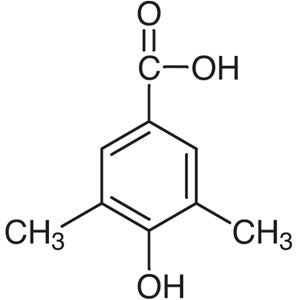
4-Hydroxy-3,5-dimethylbenzoic Acid is a substituted benzoic acid that carries a phenolic hydroxyl group flanked by two methyl groups at both neighbouring positions. This symmetrical substitution pattern produces a sterically hindered phenol, a feature widely exploited when chemists need a hydroxyl group in a protected environment. In the laboratory, the compound serves as a building block for the synthesis of polymers, ligands, and target molecules that call for an aromatic framework bearing two clearly defined functionalisation points positioned well apart from one another.
The properties that make it a frequent choice are the combination of steric hindrance and molecular symmetry. The two methyl groups shield the hydroxyl group from unwanted attack while also reducing the tendency toward uncontrolled phenol oxidation, whereas the symmetry of the ring simplifies NMR spectra and makes characterisation data easier to interpret. The carboxylate group at the para position remains free to be esterified, amidated, or coordinated to a metal centre, so the molecule behaves as a rigid linear linker. It is supplied as a crystalline solid with limited solubility in water.
In Indonesian laboratories, this building block is typically used in university research groups and industrial R&D units engaged in organic synthesis, materials chemistry, and coordination chemistry. It is normally purchased in small research quantities, weighed out on an analytical balance, and carried directly into a reaction sequence. Because it is a stable crystalline solid, it is convenient to store in a shared chemical store and to withdraw as needed across several projects over an extended period.
Related TCI products
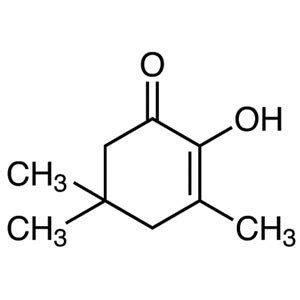
- TCI T2723 4883-60-7 2-Hydroxy-3,5,5-trimethyl-2-cyclohexen-1-one
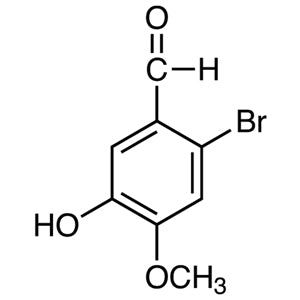
- TCI B4681 2973-59-3 2-Bromo-5-hydroxy-4-methoxybenzaldehyde
- TCI B3229 2208-15-3 4-Bromo-3-hydroxy-2-naphthoic Acid
- TCI B3180 1779-11-9 7-Bromo-3-hydroxy-2-naphthoic Acid
- TCI M3737 567-61-3 2-Hydroxy-6-methylbenzoic Acid
- TCI M2806 884-35-5 Methyl 4-Hydroxy-3,5-dimethoxybenzoate
- Organic synthesis building block: the free carboxylic acid and the hindered phenol give two independent handles, allowing chemists to elaborate each end selectively toward a defined target molecule.
- Ligand preparation for coordination chemistry: the para-positioned carboxylate coordinates readily to metal centres while the rigid aromatic core enforces a predictable, linear donor geometry.
- Polymer chemistry: the molecule acts as a rigid linear linker whose two widely separated functional groups make it suitable for constructing extended chains and framework-type materials.
- Esterification and amidation studies: the unhindered carboxylate reacts cleanly under standard coupling conditions, while the flanking methyl groups protect the phenol from competing side reactions.
- Sterically hindered phenol chemistry: the two ortho-methyl groups shield the hydroxyl and lower its susceptibility to uncontrolled oxidation, making it a useful model system for hindered-phenol reactivity.
| Brand | TCI, product code H0938 |
|---|---|
| CAS number | 4919-37-3 |
| Molecular formula | — |
| Purity | — |
| Category | Chemistry > Building Blocks > Non-Heterocyclic Building Blocks |
| Pack sizes | available in standard TCI research pack sizes; please confirm the size required when ordering |
| Physical form | crystalline solid with limited solubility in water |
| Storage | keep in a cool, dry place in a tightly closed container |
Store the container tightly closed in a cool, dry, and well-ventilated area, away from direct sunlight, heat sources, and strong oxidising agents. The original supplier bottle is the most suitable container; if the material is transferred, use a clean, chemically compatible glass or plastic vessel with a secure closure and a clear label showing the compound name and CAS number. Handle the solid in a fume hood to limit dust formation, and wear a laboratory coat, safety glasses, and chemical-resistant gloves. Avoid contact with skin and eyes and avoid inhaling dust. Weigh out only the quantity required, close the container immediately after use, and consult the supplier safety data sheet before first handling.
—
Produk Terkait
-
2-Hydroxy-3,5,5-trimethyl-2-cyclohexen-1-one TCI T2723
Regular price Rp 1.273.650,00Regular price -
2-Bromo-5-hydroxy-4-methoxybenzaldehyde TCI B4681
Regular price Rp 4.293.450,00Regular price -
4-Bromo-3-hydroxy-2-naphthoicAcid TCI B3229
Regular price From Rp 2.174.550,00Regular price -
7-Bromo-3-hydroxy-2-naphthoicAcid TCI B3180
Regular price From Rp 769.650,00Regular price -
2-Hydroxy-6-methylbenzoicAcid TCI M3737
Regular price From Rp 2.332.050,00Regular price -
Methyl4-Hydroxy-3,5-dimethoxybenzoate TCI M2806
Regular price From Rp 1.193.850,00Regular price -
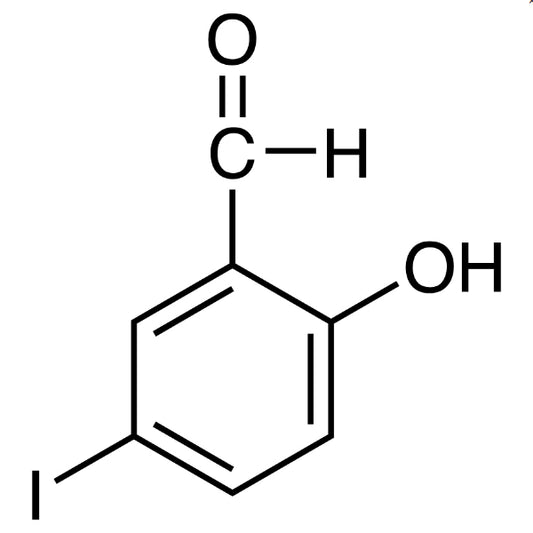
2-Hydroxy-5-iodobenzaldehyde TCI I1175
Regular price From Rp 903.000,00Regular price -
3-Hydroxy-2,2,4-trimethylpentylIsobutyrate(containsca40%2,2,4-Trimethyl-1,3-pentanediol3-Monoisobutyrate) TCI I0405
Regular price From Rp 505.050,00Regular price