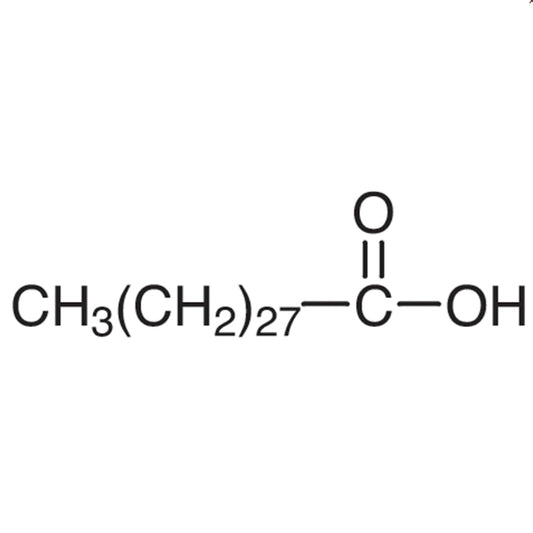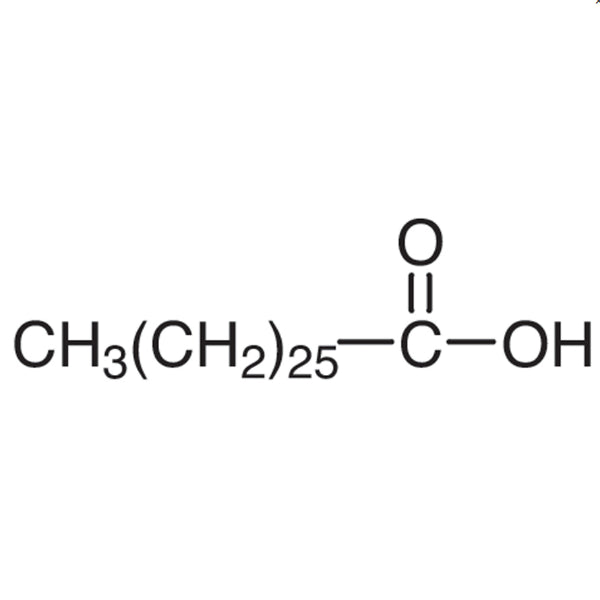
Heptacosanoic Acid is a long-chain saturated fatty acid with an odd number of carbon atoms — twenty-seven carbons — placing it within the very long chain fatty acid group. The compound consists of a long straight hydrocarbon chain terminating in a single carboxylic acid group. In the laboratory it serves a dual role: as a surface ligand and surfactant in nanomaterial synthesis, particularly colloidal quantum dot research, and as a reference compound in fatty acid profiling analysis, since odd-numbered chains are rarely found in large quantities in natural samples.
The properties that make Heptacosanoic Acid a preferred choice are its very long, highly hydrophobic alkyl chain combined with a carboxylate group capable of coordinating strongly with both metal and metal oxide surfaces. This combination produces a dense ligand layer that helps control particle growth, prevents aggregation, and keeps colloidal dispersions stable in nonpolar solvents. Its greater chain length compared with common fatty acids such as oleic acid or stearic acid gives researchers an additional variable for studying how ligand length influences the size, shape, and optical properties of nanocrystals.
In Indonesian laboratories this material is typically used in university and institutional research settings working on nanomaterials and electronic materials, where controlled colloidal synthesis requires ligands of well-defined chain length. It is also drawn on by analytical laboratories that build fatty acid profiles and need an odd-chain reference compound for comparison. Because it is supplied as a specialty research reagent, it is generally ordered per experimental campaign rather than kept as a bulk consumable.
TCI brochures (PDF)
- Colloidal Quantum Dot (QD) Research Reagents 2026-05-21 · p. 3
- Lipids 2025-12-17 · p. 4
- Building Blocks for Organic Semiconductor 2026-03-24 · p. 43
- Colloidal quantum dot synthesis — the carboxylate head group binds strongly to the growing nanocrystal surface, controlling growth kinetics and yielding well-defined particle populations.
- Surface ligand exchange studies — the distinctive twenty-seven carbon chain allows researchers to systematically compare ligand length effects against shorter, more conventional fatty acid ligands.
- Nanoparticle dispersion stabilization — its extended hydrophobic chain forms a dense protective shell that prevents aggregation and maintains stable dispersion in nonpolar organic solvents.
- Fatty acid profile analysis — as an odd-chain fatty acid rarely abundant in natural samples, it serves cleanly as a reference compound without overlapping native sample peaks.
- Surfactant studies in materials science — the compound functions as a model long-chain surfactant for investigating interfacial behaviour at metal and metal oxide surfaces.
| Brand | TCI |
|---|---|
| CAS number | 7138-40-1 |
| Molecular formula | — |
| Purity | — |
| Category | Materials Science > Electronic Materials > Colloidal Quantum Dot (QD) Research Reagents |
| Pack sizes | available in standard research-scale pack sizes as supplied by the manufacturer |
| Physical form | — |
| Storage | store in a cool, dry place in a tightly closed container |
- Product code: H0971
Store Heptacosanoic Acid in a cool, dry location away from direct sunlight, heat sources, and strong oxidising agents. Keep the material in its original tightly closed container, or transfer it to a clean, dry, chemically compatible container that is clearly labelled with the product name and CAS number. Handle the compound in a well-ventilated area or within a fume hood, wearing standard laboratory personal protective equipment including gloves, safety glasses, and a laboratory coat. Avoid generating dust during weighing and transfer operations, and close the container promptly after use to limit moisture uptake and contamination. Follow the manufacturer's safety data sheet and institutional chemical handling procedures at all times.
—
Product Categories
Produk Terkait
-
OctacosanoicAcid TCI M1342
Regular price Rp 1.326.150,00Regular priceRp 942.900,00Sale price Rp 1.326.150,00 -
PentacosanoicAcid TCI P0882
Regular price From Rp 7.023.450,00Regular priceRp 4.926.600,00Sale price From Rp 7.023.450,00 -
NonacosanoicAcid TCI N0662
Regular price From Rp 7.048.650,00Regular priceRp 4.944.450,00Sale price From Rp 7.048.650,00 -
ValericAcid TCI V0003
Regular price From Rp 610.050,00Regular priceRp 426.300,00Sale price From Rp 610.050,00 -
UndecanoicAcid TCI U0004
Regular price From Rp 1.008.000,00Regular priceRp 720.300,00Sale price From Rp 1.008.000,00 -
BehenicAcid TCI B1747
Regular price Rp 4.028.850,00Regular priceRp 2.832.900,00Sale price Rp 4.028.850,00 -
ButyricAcid TCI B0754
Regular price From Rp 477.750,00Regular priceRp 333.900,00Sale price From Rp 477.750,00 -
TridecanoicAcid TCI T0412
Regular price From Rp 3.843.000,00Regular priceRp 2.702.700,00Sale price From Rp 3.843.000,00