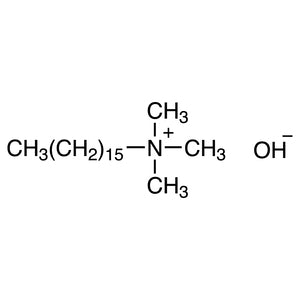
Hexadecyltrimethylammonium Hydroxide (10% in Water) is a strong quaternary ammonium base that also functions as a cationic surfactant. Its molecule combines a long, hydrophobic hexadecyl hydrocarbon tail with a positively charged trimethylammonium head group, paired with a hydroxide counter-anion. This combination allows the product to act simultaneously as a base and as a structure-directing agent. In the laboratory, the solution is widely used in the synthesis of porous materials, as a phase-transfer catalyst, and as a basic reagent in reactions and titrations carried out in non-aqueous media.
The main advantage of this product lies in a dual character that few other reagents possess. As a base, its hydroxide ion is strong yet entirely free of alkali metal cations, which makes it especially valuable in systems that must not be contaminated with sodium or potassium, such as zeolite and mesoporous silica synthesis. As a cationic surfactant, the hexadecyl portion forms micelles that act as a soft template for the formation of ordered pores. The ten percent aqueous solution form allows accurate volumetric dispensing and avoids the difficulty of weighing a hygroscopic solid.
In Indonesian laboratories, this reagent is typically found in materials chemistry and catalysis groups at universities and research institutes, as well as in industrial research units working on adsorbents and porous supports. It is generally handled at the bench in fume-hood conditions during hydrothermal preparations, in analytical laboratories performing non-aqueous titrations, and in synthetic chemistry laboratories that require an organic-soluble base for phase-transfer work.
Related TCI products
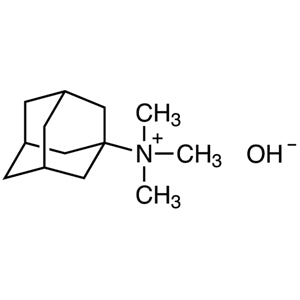
- TCI T3821 53075-09-5 N,N,N-Trimethyl-1-adamantylammonium Hydroxide (25% in Water)
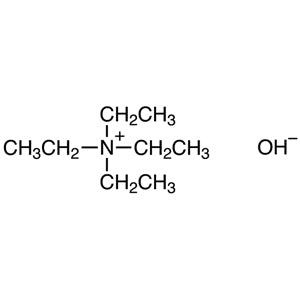
- TCI T2589 77-98-5 Tetraethylammonium Hydroxide (35% in Water)
- TCI T1685 2052-49-5 Tetrabutylammonium Hydroxide (40% in Water)
- TCI T1565 4499-86-9 Tetrapropylammonium Hydroxide (ca. 40% in Water)
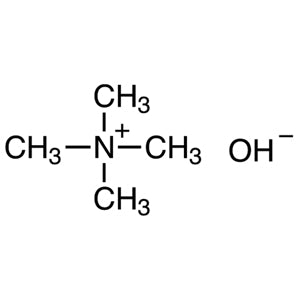
- TCI T1460 75-59-2 Tetramethylammonium Hydroxide (ca. 25% in Water)
- TCI B1071 100-85-6 Benzyltrimethylammonium Hydroxide (40% in Water)
- Mesoporous silica synthesis: the hexadecyl tail forms micellar templates that direct ordered pore architecture while the hydroxide simultaneously supplies the alkaline conditions required for silicate condensation.
- Zeolite preparation: supplies a strong hydroxide source without introducing sodium or potassium ions, keeping the framework free of alkali metal contamination that would otherwise alter the product.
- Phase-transfer catalysis: the cationic head paired with a long hydrophobic chain carries anionic reagents across phase boundaries, allowing reactions between species in otherwise immiscible media.
- Non-aqueous titration: serves as a strong, metal-free basic titrant for determinations conducted in solvent systems where conventional alkali hydroxide solutions are unsuitable.
- General basic reagent work: the accurately dispensable ten percent aqueous solution provides a convenient strong base for reactions requiring alkaline conditions without the handling burden of a hygroscopic solid.
| Brand | TCI |
|---|---|
| CAS number | 505-86-2 |
| Molecular formula | — |
| Purity | — |
| Category | Chemistry > Synthetic Reagents > Acids, Bases [Synthetic Reagents] |
| Pack sizes | — |
| Physical form | aqueous solution, 10% in water |
| Storage | store in a tightly closed container under the conditions recommended by the manufacturer |
- Catalogue code: H0974
Store the solution in its original tightly closed container, kept upright in a cool, well-ventilated area away from acids and other incompatible materials. Containers should be chemically resistant and sealed to prevent absorption of atmospheric carbon dioxide, which gradually reduces the strength of the hydroxide. Handle the material in a fume hood using safety goggles, chemical-resistant gloves, and a laboratory coat, since strong bases are corrosive to skin and eyes. Dispense volumetrically with clean glassware or plastic pipettes, avoid generating aerosols during transfer, and wipe up any spills promptly with adequate ventilation. Always consult the manufacturer's safety data sheet before use.
—
Produk Terkait
-
N,N,N-Trimethyl-1-adamantylammoniumHydroxide(25%inWater) TCI T3821
Regular price From Rp 2.041.200,00Regular price -
TetraethylammoniumHydroxide(35%inWater) TCI T2589
Regular price From Rp 769.650,00Regular price -
TetrabutylammoniumHydroxide(40%inWater) TCI T1685
Regular price From Rp 1.193.850,00Regular price -
TetrapropylammoniumHydroxide(ca.40%inWater) TCI T1565
Regular price From Rp 2.147.250,00Regular price -
TetramethylammoniumHydroxide(ca.25%inWater) TCI T1460
Regular price From Rp 505.050,00Regular price -
BenzyltrimethylammoniumHydroxide(40%inWater) TCI B1071
Regular price From Rp 689.850,00Regular price -
BenzyltrimethylammoniumHydroxide(10%inWater) TCI B1070
Regular price From Rp 743.400,00Regular price -
BenzyltrimethylammoniumHydroxide(10%inWater) TCI B0428
Regular price Rp 1.035.300,00Regular price