


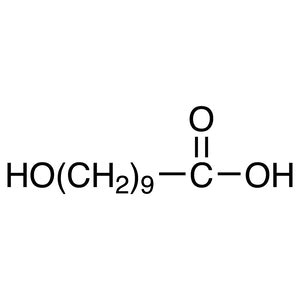
10-Hydroxydecanoic Acid from TCI is a saturated ten-carbon fatty acid with a hydroxyl group at the end of the chain opposite its carboxylic acid group. Because it is an omega-hydroxy compound, it belongs to the non-heterocyclic building blocks and has many uses in organic synthesis. It carries two different functional groups, one at each end of the chain, so chemists can use it as a linker, a monomer, or a precursor to many target compounds. It is also known as one of the fatty acid components found in royal jelly.
Researchers choose this compound mainly because it is bifunctional. The carboxylic acid group can be esterified or converted into an amide. The primary hydroxyl group can be oxidised, protected, or coupled to other molecules. With both groups available, the compound can be used to build linear polyesters, macrocyclic lactones, and surfactants whose hydrophobic chain length is controlled. The ten-carbon aliphatic chain gives a balance of hydrophobic character and flexibility. That makes it a good spacer in molecular design, polymer materials, and biological conjugates.
In Indonesia, this compound is relevant to organic chemistry laboratories, polymer chemistry groups, and teams studying bee products. University research groups can use it to study esterification, lactonisation, and step-growth polymerisation. Polymer laboratories can use it to make long-chain polyesters, and researchers working with royal jelly can use it as a known reference compound. Because it comes from TCI, an established reagent brand, laboratories can use the same material across academic, industrial, and natural product research projects.
- Linear polyester synthesis: the hydroxyl and carboxylic acid groups sit at opposite ends of the chain, so the molecule can undergo self-condensation to form linear aliphatic polyesters with a regular repeating structure.
- Macrocyclic lactone preparation: the terminal hydroxyl group can react intramolecularly with the carboxylic acid group, giving a route to macrocyclic lactones for studies of ring-closing methods.
- Linker and spacer design: the flexible ten-carbon aliphatic chain gives a defined distance between two functional ends, which suits the construction of molecular conjugates and biological probes.
- Surfactant and amphiphile research: the hydrophobic chain combined with modifiable polar end groups lets researchers prepare surfactants with controlled chain length and tune their surface properties.
- Royal jelly and bee product studies: the compound is a known fatty acid component of royal jelly, so it is useful as a reference material in analytical and compositional work on bee products.
| Brand | TCI (product code H1090) |
|---|---|
| CAS number | 1679-53-4 |
| Molecular formula | — |
| Purity | — |
| Category | Chemistry > Building Blocks > Non-Heterocyclic Building Blocks |
| Pack sizes | see the available options on the product listing |
| Physical form | — |
| Storage | follow the storage conditions on the TCI label and Safety Data Sheet |
- Chemical class: saturated omega-hydroxy fatty acid with a ten-carbon chain
Store 10-Hydroxydecanoic Acid in its original, tightly closed container in a cool, dry, well-ventilated place, away from direct sunlight, heat, and incompatible materials such as strong oxidising agents. Always check the storage temperature on the TCI label and in the Safety Data Sheet, and follow it. Wear suitable gloves, safety glasses, and a laboratory coat when handling the material, and work in a fume hood or another well-ventilated area. Do not inhale dust and do not let the material touch your skin or eyes. Close the container right after use to protect it from moisture. Label secondary containers clearly and dispose of waste according to local regulations and institutional procedures.
—
Produk Terkait
-
12-HydroxydodecanoicAcid TCI H1092
Regular price From Rp 2.121.000,00Regular priceRp 1.498.350,00Sale price From Rp 2.121.000,00 -
15-HydroxypentadecanoicAcid TCI H0676
Regular price From Rp 1.510.950,00Regular priceRp 1.072.050,00Sale price From Rp 1.510.950,00


