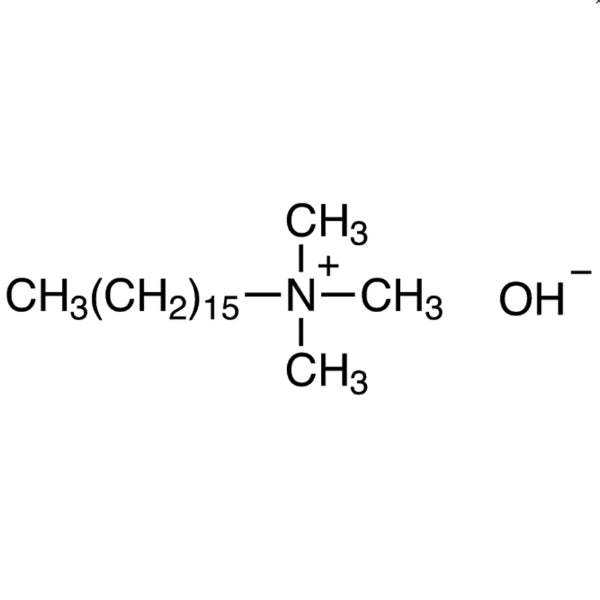
Hexadecyltrimethylammonium Hydroxide (10% in Water) is a strongly basic solution of a quaternary ammonium salt that carries one long hexadecyl alkyl chain on one side and three methyl groups on its nitrogen atom. This structure makes it simultaneously a cationic surfactant and an organic base, a combination that ordinary inorganic bases do not offer. Supplied as a ready-to-use aqueous solution, the reagent simplifies laboratory work because there is no need to dissolve a solid surfactant that tends to foam and is awkward to handle, so reaction mixtures are prepared faster and results are more uniform from one experiment to the next.
The characteristic that makes it a preferred choice is its ability to form micelles in water while at the same time supplying hydroxide ions as a base. This combination is especially useful in the synthesis of porous materials, because the surfactant micelles act as a template that directs the formation of the pore structure, while the hydroxide ions maintain the basic conditions required for condensation of silica precursors. Its cationic nature also allows the compound to interact strongly with negatively charged surfaces and species, which is difficult to reproduce using a simple inorganic hydroxide.
In Indonesian laboratories this reagent is typically used in materials chemistry and synthetic research groups, where mesoporous silica preparation and surfactant-directed synthesis are routine. As an aqueous solution it is easy to pipette, which suits bench-scale work in university and institutional laboratories. However, it is corrosive and readily forms foam when shaken, so it is normally handled with the same care given to other strong bases and dispensed carefully rather than poured.
Related TCI products
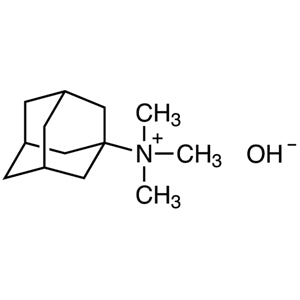
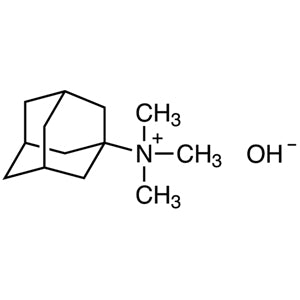
- TCI T3821 53075-09-5 N,N,N-Trimethyl-1-adamantylammonium Hydroxide (25% in Water)
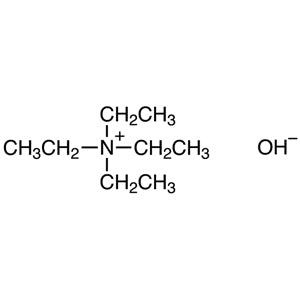
- TCI T2589 77-98-5 Tetraethylammonium Hydroxide (35% in Water)
- TCI T1685 2052-49-5 Tetrabutylammonium Hydroxide (40% in Water)
- TCI T1565 4499-86-9 Tetrapropylammonium Hydroxide (ca. 40% in Water)
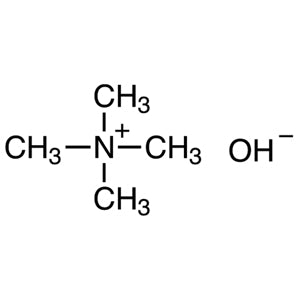
- TCI T1460 75-59-2 Tetramethylammonium Hydroxide (ca. 25% in Water)
- TCI B1071 100-85-6 Benzyltrimethylammonium Hydroxide (40% in Water)
- Mesoporous silica synthesis, where the surfactant micelles act as a structure-directing template while the hydroxide ions provide the basic medium needed for silica precursor condensation.
- Porous material research, because a single reagent supplies both the templating agent and the base, reducing the number of components that must be weighed and balanced separately.
- Cationic surfactant studies, since the long hexadecyl chain and quaternary ammonium head group allow reliable micelle formation in water at bench scale.
- Surface modification work involving negatively charged substrates, where the cationic character of the compound promotes strong interaction with the target surface.
- General base-mediated preparations requiring an organic hydroxide, where an ordinary inorganic base would not contribute the surfactant behaviour that the experiment depends on.
| Brand | TCI |
|---|---|
| CAS number | 505-86-2 |
| Molecular formula | — |
| Purity | — |
| Category | Chemistry > Synthetic Reagents > Acids, Bases [Synthetic Reagents] |
| Pack sizes | — |
| Physical form | aqueous solution, 10% in water |
| Storage | keep tightly closed in its original container, away from incompatible materials |
- Product code: TCI H1354
Store the solution in its original tightly closed container, kept upright and protected from contamination, in a designated area for corrosive materials and away from acids. Because the product is corrosive, handle it with gloves, safety glasses and a laboratory coat, and work in a fume hood or a well-ventilated area when transferring larger volumes. The solution foams readily, so dispense by pipette rather than pouring and avoid vigorous shaking. Wipe spills promptly and rinse glassware thoroughly after use.
—
Produk Terkait
-
N,N,N-Trimethyl-1-adamantylammoniumHydroxide(25%inWater) TCI T3821
Regular price From Rp 2.041.200,00Regular price -
TetraethylammoniumHydroxide(35%inWater) TCI T2589
Regular price From Rp 769.650,00Regular price -
TetrabutylammoniumHydroxide(40%inWater) TCI T1685
Regular price From Rp 1.193.850,00Regular price -
TetrapropylammoniumHydroxide(ca.40%inWater) TCI T1565
Regular price From Rp 2.147.250,00Regular price -
TetramethylammoniumHydroxide(ca.25%inWater) TCI T1460
Regular price From Rp 505.050,00Regular price -
BenzyltrimethylammoniumHydroxide(40%inWater) TCI B1071
Regular price From Rp 689.850,00Regular price -
BenzyltrimethylammoniumHydroxide(10%inWater) TCI B1070
Regular price From Rp 743.400,00Regular price -
BenzyltrimethylammoniumHydroxide(10%inWater) TCI B0428
Regular price Rp 1.035.300,00Regular price