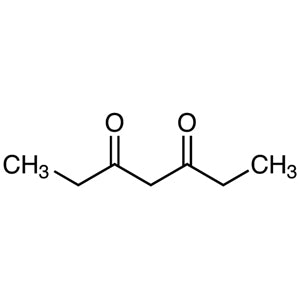
3,5-Heptanedione is an aliphatic 1,3-diketone in which two carbonyl groups are separated by a single carbon atom, forming the beta-diketone motif that is so characteristic in organic chemistry. This arrangement allows the compound to undergo keto-enol tautomerisation readily and gives rise to a methylene proton positioned between the two carbonyls that is comparatively acidic. In the laboratory, compounds of this type serve as versatile starting materials for building heterocyclic rings, forming metal complexes, and preparing more elaborate intermediates within multi-step synthesis programmes.
The feature that makes 3,5-Heptanedione a preferred selection is its ability to act as a bidentate chelating ligand once deprotonated, while simultaneously functioning as a two-carbonyl unit ready to react with binucleophilic reagents. Condensation with hydrazine affords substituted pyrazoles, whereas reaction with hydroxylamine or amidines opens routes towards isoxazoles and pyrimidines. The difference in chain length between the ethyl and methyl substituents flanking the two carbonyl groups produces an unsymmetrical substitution pattern, so the resulting heterocyclic products display steric and electronic profiles distinct from those obtained with the more commonly used symmetrical diketones.
In Indonesian laboratories, a building block of this kind is typically held as part of a synthetic chemistry inventory in university research groups, government research institutes, and industrial development units. It is drawn upon when a research programme requires the construction of heterocyclic scaffolds or coordination compounds from small, well-defined precursors, and it is generally handled on the bench scale alongside other non-heterocyclic building blocks used in exploratory and route-development work.
TCI brochures (PDF)
- Ligands 2025-12-01 · p. 17
- Pyrazole synthesis: condensation of the two carbonyl groups with hydrazine delivers substituted pyrazole rings, making this diketone a direct and economical entry point into that scaffold.
- Isoxazole preparation: reaction with hydroxylamine exploits the same two-carbonyl arrangement, giving isoxazole products whose substitution pattern reflects the unsymmetrical ethyl and methyl chains.
- Pyrimidine construction: treatment with amidines uses the beta-diketone as a three-carbon fragment, allowing pyrimidine rings to be assembled under classical condensation conditions.
- Metal complex formation: after deprotonation of the acidic methylene position, the compound acts as a bidentate chelating ligand and binds metal centres in coordination chemistry studies.
- Multi-step intermediate preparation: as a small, well-defined building block it supports the stepwise elaboration of more complex intermediates within extended organic synthesis programmes.
| Brand | TCI |
|---|---|
| CAS number | 7424-54-6 |
| Molecular formula | — |
| Purity | — |
| Category | Chemistry > Building Blocks > Non-Heterocyclic Building Blocks |
| Pack sizes | available in standard TCI research-scale packaging; please confirm the size required when ordering |
| Physical form | — |
| Storage | keep in the original tightly closed container in a cool, well-ventilated area away from ignition sources |
- Catalogue number: H1395
Store the container tightly closed in a cool, dry and well-ventilated place, away from heat, direct sunlight and sources of ignition, and keep it separated from strong oxidising agents and strong bases. The original manufacturer's container is the most suitable vessel; where transfer is necessary, use chemically compatible glassware with a secure closure and label it clearly. Handle in a fume hood, wear safety goggles, gloves and a laboratory coat, and avoid inhalation of vapour or contact with skin and eyes. Always consult the manufacturer's safety data sheet before use and dispose of residues through the laboratory's chemical waste procedure.
—
Produk Terkait
-
6-Methyl-2,4-heptanedione TCI M0597
Regular price Rp 1.353.450,00Regular price -
1,3-Cycloheptanedione TCI C3564
Regular price Rp 2.411.850,00Regular price -
Monoethyl4-Oxoheptanedioate TCI O0211
Regular price Rp 4.506.600,00Regular price -
2,6-Dimethyl-3,5-heptanedione TCI D2413
Regular price From Rp 3.446.100,00Regular price -
1-(4-Bromophenyl)-1,3-butanedione TCI B4754
Regular price From Rp 4.929.750,00Regular price -
1-Phenyl-1,3-butanedione TCI P0160
Regular price From Rp 1.696.800,00Regular price -
2-Methyl-1,3-cyclohexanedione TCI M1133
Regular price From Rp 1.618.050,00Regular price -
5-Methyl-1,3-cyclohexanedione TCI M0945
Regular price From Rp 955.500,00Regular price