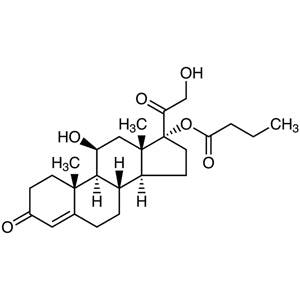
Hydrocortisone 17-Butyrate is a chemical compound widely used in pharmaceutical research and biochemical studies. It belongs to the category of pharmaceutical research reagents, specifically designed for experimental use in scientific laboratories. This compound plays a crucial role in the development of new drugs and the investigation of pharmacological effects. Its presence in laboratory settings is essential for researchers aiming to understand the mechanisms of inflammation and immune responses. Due to its stability and solubility in organic solvents, it is a versatile tool for various experimental procedures.
The compound is favored for its high anti-inflammatory activity, making it a key component in studies related to inflammatory diseases and autoimmune conditions. Its chemical properties allow it to react effectively with a range of reagents, facilitating chemical modifications and synthetic processes. This reactivity, combined with its stability, makes it an ideal choice for both synthesis and testing in laboratory environments. Its reliability and consistent performance contribute to its popularity among researchers working in pharmacology and biochemistry.
In Indonesian laboratories, Hydrocortisone 17-Butyrate is commonly used in research focused on inflammation and the development of new therapeutic agents. It is frequently found in pharmaceutical, biomedical, and health research laboratories. Its application extends to the study of drug mechanisms and the evaluation of potential treatments for inflammatory disorders. Its presence in these settings underscores its importance in advancing scientific understanding and innovation in the field of medicine.
TCI brochures (PDF)
- Anti-Rheumatoid Arthritis Ingredients 2025-01-29 · p. 1
- Steroids 2026-07-28 · p. 6
- Immune System, Inflammation, Allergy Research Reagents 2025-05-26 · p. 2
- Pharmaceutical Ingredients for Research and Experimental Use 2026-03-09 · p. 32
- Pharmaceutical research for the development of anti-inflammatory and immunomodulatory drugs due to its high anti-inflammatory activity.
- Biochemical studies to investigate the molecular mechanisms of inflammation and immune response modulation.
- Drug synthesis experiments as a starting material for the creation of corticosteroid derivatives and related compounds.
- In vitro testing to evaluate the pharmacological effects of corticosteroids on cell cultures and tissue models.
- Research on autoimmune diseases to explore the therapeutic potential of corticosteroid-based compounds in disease treatment.
| Brand | TCI |
|---|---|
| CAS number | 13609-67-1 |
| Molecular formula | — |
| Purity | — |
| Category | Life Science > Biochemicals and Reagents > Pharmaceutical Research Reagents |
| Pack sizes | Available in various quantities as per supplier specifications |
| Physical form | Solid powder (based on standard chemical properties) |
| Storage | Store in a cool, dry place away from light and moisture |
Hydrocortisone 17-Butyrate should be stored in a cool, dry environment to maintain its chemical stability. It is recommended to keep the compound in a tightly sealed container to prevent exposure to moisture and air. Storage away from direct sunlight is essential to avoid degradation. Suitable containers for this material include glass or high-density polyethylene (HDPE) bottles to ensure chemical compatibility. In laboratory settings, it is important to handle the compound with care, using appropriate personal protective equipment such as gloves and safety goggles. Proper labeling of containers is also crucial to ensure safe handling and prevent accidental contamination. Regular monitoring of storage conditions is advised to maintain the integrity of the compound for experimental use.
—
Product Categories
- Biochemicals and ReagentsPharmaceutical Research Reagents (for Experimental Use)Anti-inflammatory Ingredients (for Research and Experimental Use)
- Biochemicals and ReagentsPharmaceutical Research Reagents (for Experimental Use)Anti-rheumatoid Arthritis Ingredients (for Research and Experimental Use)
- Biochemicals and ReagentsSteroidsPregnanes (Corticoids) [Steroids]
- Cell BiologyCell Signaling and NeuroscienceCytokines, Growth Factors and Hormones
- Cell BiologyImmune System, Inflammation, Allergy ResearchAdrenocortical Hormones
- Pharmaceutical Development and Drug Discovery ResearchPharmaceutical Research Reagents (for Experimental Use)Anti-inflammatory Ingredients (for Research and Experimental Use)
- Pharmaceutical Development and Drug Discovery ResearchPharmaceutical Research Reagents (for Experimental Use)Anti-rheumatoid Arthritis Ingredients (for Research and Experimental Use)
Produk Terkait
-
Hydrocortisone TCI H0533
Regular price From Rp 769.650,00Regular price -
TriamcinoloneAcetonide TCI T2308
Regular price From Rp 1.378.650,00Regular price -
Triamcinolone TCI T2303
Regular price Rp 3.763.200,00Regular price -
BetamethasoneValerate TCI B4157
Regular price From Rp 1.353.450,00Regular price -
Betamethasone21-PhosphateDisodiumSalt TCI B4110
Regular price Rp 4.691.400,00Regular price -
Betamethasone17,21-Dipropionate TCI B3166
Regular price From Rp 1.378.650,00Regular price -
Betamethasone TCI B1837
Regular price From Rp 1.353.450,00Regular price -
PrednisoloneAcetate TCI P1283
Regular price Rp 4.213.650,00Regular price