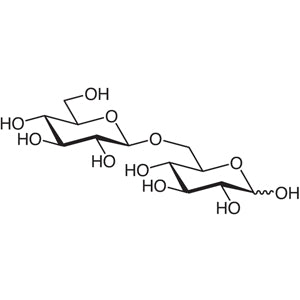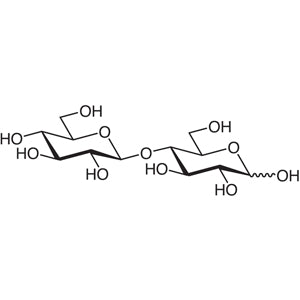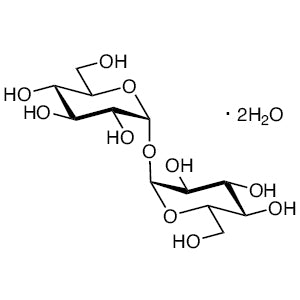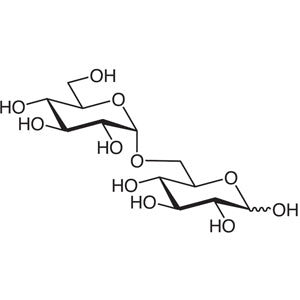
Isomaltose TCI I0231, with the CAS number 499-40-1, is a disaccharide composed of two glucose molecules linked together. It is widely used in chemical and biochemical experiments in laboratories due to its unique structural properties. This compound plays a crucial role in studying carbohydrate metabolism, enzymatic reactions, and glycoscience research. Its chemical stability and solubility make it a reliable reagent for various analytical and synthetic applications.
Isomaltose is preferred for its chemical stability and non-toxic nature, making it safe for use in laboratory settings. It dissolves easily in water and does not evaporate readily, which simplifies handling and measurement. Its inertness and lack of hazardous components ensure a safe working environment. Additionally, its physical clarity and purity contribute to accurate experimental results. These properties make it a trusted choice for both academic and industrial research.
In Indonesian laboratories, isomaltose is commonly used in biochemical and pharmacological studies. It is a key component in experiments involving enzymatic activity, such as amylase and sucrase assays. Its role in carbohydrate metabolism research and substrate preparation for specific chemical reactions further highlights its importance in the scientific community. Its consistent performance and reliability make it an essential material for researchers in Indonesia.
- Enzymatic Activity Testing – Isomaltose serves as a substrate for enzymes like amylase and sucrase, allowing researchers to study enzyme kinetics and activity.
- Carbohydrate Metabolism Research – Its role as a disaccharide enables investigation into metabolic pathways and the breakdown of carbohydrates in biological systems.
- Glycoscience Studies – Isomaltose is used to explore the structure and function of carbohydrates in molecular biology and biochemistry.
- Substrate Preparation – It is commonly used to create substrates for specific chemical reactions, aiding in the development of new compounds and processes.
- Biochemical Analysis – Its solubility and stability make it ideal for use in various analytical techniques, including chromatography and spectroscopy.
| Brand | — |
|---|---|
| CAS number | — |
| Molecular formula | — |
| Purity | — |
| Category | — |
| Pack sizes | — |
| Physical form | — |
| Storage | — |
- Brand – TCI
- CAS Number – 499-40-1
- Category – Chemistry > Chemical Biology > Glycoscience
- Pack Sizes – Available in standard laboratory quantities
- Physical Form – White crystalline powder
- Storage Note – Store in a cool, dry place away from direct sunlight
Isomaltose should be stored in a cool, dry environment to maintain its chemical stability and prevent degradation. It is best kept in airtight containers to avoid moisture absorption, which could affect its solubility and purity. Due to its non-toxic nature, it does not require special handling beyond standard laboratory safety protocols. However, it is recommended to use gloves and proper ventilation when working with large quantities. Its inert properties make it safe for use in most laboratory settings, but care should be taken to avoid contamination. Regular inspection of storage conditions ensures the material remains suitable for experimental use.
—
Product Categories
- GlycoscienceApplications Using Glyco-materialsGlyco-chemical Analysis [Applications Using Glyco-materials]
- GlycoscienceDisaccharides [Glycoscience]
- GlycoscienceEnzyme, Lectin, Antibody [Glycoscience]Glycohydrases and Related Reagents [Glycoscience]
- GlycoscienceFunctional OligosaccharidesPolysaccharides [Functional Oligosaccharides]
- GlycoscienceFunctional OligosaccharidesNatural Oligosaccharides [Functional Oligosaccharides]
- Biochemicals and ReagentsCarbohydrates
Produk Terkait
-
Gentiobiose TCI G0026
Regular price Rp 1.961.400,00Regular price -
D-(+)-Cellobiose TCI C0056
Regular price From Rp 875.700,00Regular price -
Isomaltotriose TCI I0329
Regular price From Rp 2.386.650,00Regular price -
Xylobiose TCI X0067
Regular price From Rp 4.268.250,00Regular price -
Cellopentaose TCI C2644
Regular price Rp 8.480.850,00Regular price -
Xylosucrose TCI X0065
Regular price From Rp 2.041.200,00Regular price -
D-(+)-TrehaloseAnhydrous TCI T0832
Regular price From Rp 1.115.100,00Regular price -
D-(+)-TrehaloseDihydrate TCI T0331
Regular price From Rp 505.050,00Regular price