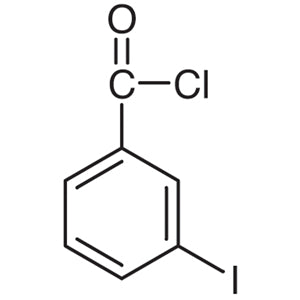
TCI I0720 3-Iodobenzoyl Chloride is an aromatic acid chloride carrying an iodine atom at the meta position relative to the acyl chloride group. The compound serves both as a highly reactive acylating reagent and as a bifunctional building block in organic synthesis laboratories. The acyl chloride group enables rapid formation of amides, esters, ketones, and anhydrides without requiring additional activating reagents, while the iodine atom remains available as a handle for subsequent cross-coupling steps, making it an efficient choice for stepwise molecular assembly.
The property that makes this material a preferred choice is its high and predictable reactivity. Acylation with an acid chloride proceeds quickly at low temperature with the help of an acid-scavenging base such as triethylamine or pyridine, delivering high conversion and short reaction times compared with direct coupling routes starting from the carboxylic acid. This advantage carries an important consequence: the compound is highly moisture sensitive and will hydrolyse to 3-iodobenzoic acid while releasing hydrogen chloride gas. All work therefore demands anhydrous solvents, dry glassware, and preferably an inert atmosphere so that material quality is preserved.
In Indonesian laboratories, this reagent is typically used in synthetic organic chemistry groups at universities and research institutes, as well as in pharmaceutical and materials development work where intermediates must be prepared in-house. Its dual functionality suits multi-step routes in which an amide or ester linkage is installed first and the iodine position is elaborated later. Because the humid tropical climate accelerates hydrolysis, careful handling discipline matters even more here than in drier environments.
- Amide synthesis: the acyl chloride reacts rapidly with primary and secondary amines in the presence of an acid-scavenging base, giving high conversion at low temperature without separate coupling reagents.
- Ester preparation: alcohols and phenols are acylated directly and quickly, which shortens reaction times considerably compared with direct condensation routes that start from 3-iodobenzoic acid itself.
- Cross-coupling substrate preparation: the retained meta-iodine atom acts as a reliable handle for subsequent palladium-catalysed coupling steps after the acylation stage has already been completed.
- Bifunctional building block assembly: the two independently addressable reactive sites allow chemists to plan stepwise synthetic routes in which each functional group is elaborated in a controlled sequence.
- Ketone and anhydride formation: the reagent acylates suitable nucleophilic partners to build ketone or anhydride linkages, again without the need for any additional activating reagent in the reaction mixture.
| Brand | TCI (Tokyo Chemical Industry) |
|---|---|
| CAS number | 1711-10-0 |
| Molecular formula | — |
| Purity | — |
| Category | Chemistry > Building Blocks > Non-Heterocyclic Building Blocks |
| Pack sizes | available in standard TCI research-scale packaging; please refer to the pack options listed on this page |
| Physical form | — |
| Storage | keep tightly closed under dry conditions; moisture sensitive |
- Catalogue number: I0720
Store the container tightly closed in a cool, dry, and well-ventilated place, away from moisture, water, and incompatible materials such as alcohols, amines, and bases. Keep the original supplier container sealed, or transfer to a tightly closed glass container suitable for moisture-sensitive reagents; storage under an inert atmosphere is recommended. Handle only in a functioning fume hood, since contact with moisture liberates hydrogen chloride gas. Wear chemical-resistant gloves, safety goggles, and a laboratory coat. Use anhydrous solvents and thoroughly dried glassware for all transfers and reactions, and close the container immediately after dispensing to limit exposure to humid air.
—
Produk Terkait
-
4-IodobenzoylChloride TCI I0508
Regular price From Rp 1.776.600,00Regular price -
2-IodobenzoylChloride TCI I0402
Regular price From Rp 2.386.650,00Regular price -
5-Bromo-2-iodobenzoicAcid TCI B4296
Regular price Rp 1.696.800,00Regular price -
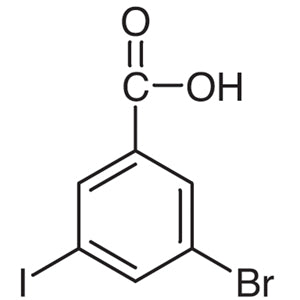
3-Bromo-5-iodobenzoicAcid TCI B1807
Regular price From Rp 1.273.650,00Regular price -
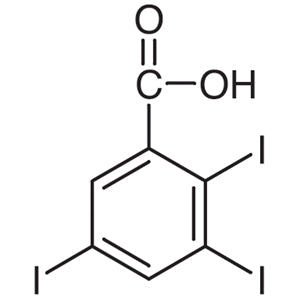
2,3,5-TriiodobenzoicAcid TCI T0451
Regular price From Rp 1.220.100,00Regular price -
Methyl5-Bromo-2-iodobenzoate TCI M3084
Regular price From Rp 903.000,00Regular price -
Methyl4-Iodobenzoate TCI I0593
Regular price From Rp 1.167.600,00Regular price -
Methyl2-Iodobenzoate TCI I0586
Regular price From Rp 2.254.350,00Regular price