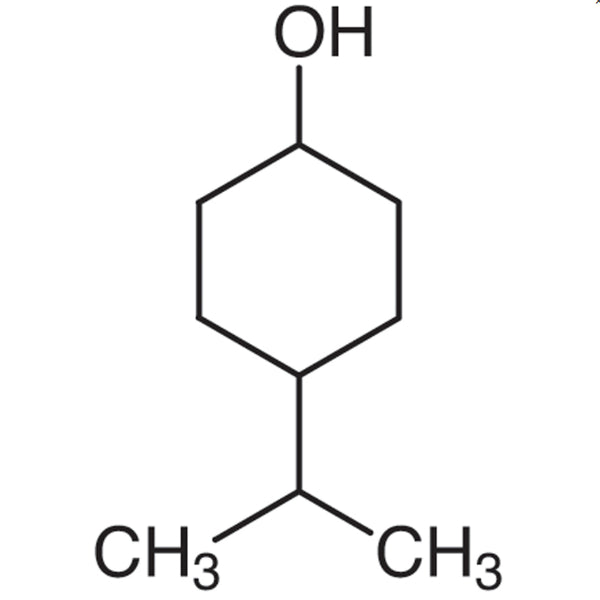
TCI I0780 4-Isopropylcyclohexanol, CAS 4621-04-9, is an alicyclic secondary alcohol supplied as a mixture of cis and trans isomers. It belongs to the family of non-heterocyclic building blocks, meaning starting materials built on a simple carbon skeleton that chemists use to assemble more elaborate molecules. The cyclohexane ring carrying an isopropyl group at the para position gives the molecule a rigid yet readily modified framework, while the hydroxyl group on the ring provides a reaction site for esterification, etherification, oxidation to the corresponding ketone, or conversion into a leaving group during multi-step organic synthesis.
The properties that make this material a preferred choice are the combination of structural simplicity and accessible reactivity. As a secondary alcohol it reacts more slowly than a primary alcohol, yet it is far easier to handle than a tertiary alcohol, which is prone to elimination; this middle position makes it a well-behaved model substrate for mechanistic studies. The supply of the compound as a mixture of cis and trans isomers is an advantage rather than a limitation for work that does not demand stereochemical purity, such as preparing intermediates or optimising reaction conditions, because the material remains efficient to work with in that role.
In Indonesian laboratories this type of building block is typically held as a general-purpose synthetic starting material rather than as a single-method reagent. University and institutional organic chemistry groups draw on it for teaching-scale and research-scale preparations, for mechanism and reactivity exercises, and for developing routes before committing to a stereochemically defined starting material. Industrial and contract research laboratories use it in the same way, as an intermediate on the path to a more complex target molecule.
Related TCI products
- TCI I0782 15890-36-5 trans-4-Isopropylcyclohexanol
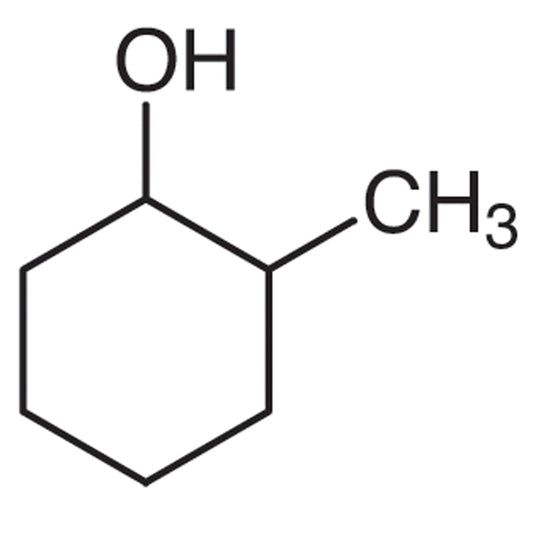
- TCI M0194 583-59-5 2-Methylcyclohexanol (cis- and trans- mixture)
- TCI T2278 118-56-9 3,3,5-Trimethylcyclohexyl Salicylate (cis- and trans- mixture)
- TCI B1930 70568-60-4 4-Butylcyclohexanol (cis- and trans- mixture)
- TCI B0696 6117-91-5 Crotyl Alcohol (cis- and trans- mixture)
- TCI B0383 98-52-2 4-tert-Butylcyclohexanol (cis- and trans- mixture)
- Multi-step organic synthesis: the hydroxyl group on the cyclohexane ring serves as a defined handle that can be carried through several transformations toward a more complex target molecule.
- Esterification and etherification reactions: the secondary alcohol converts cleanly into esters and ethers, making the compound a convenient starting point for preparing derivative libraries in the laboratory.
- Oxidation chemistry: the ring hydroxyl can be oxidised to the corresponding ketone, so the material works well as a substrate for developing and comparing oxidation procedures.
- Mechanistic and reactivity studies: as a secondary alcohol it reacts more slowly than a primary alcohol but resists the elimination that complicates tertiary alcohols, giving predictable model behaviour.
- Reaction condition optimisation: because the cis and trans mixture does not demand stereochemical purity, it suits screening solvents, catalysts, and temperatures before moving to a defined isomer.
| Brand | TCI (Tokyo Chemical Industry) |
|---|---|
| CAS number | 4621-04-9 |
| Molecular formula | — |
| Purity | — |
| Category | Chemistry > Building Blocks > Non-Heterocyclic Building Blocks |
| Pack sizes | available in standard TCI research packaging; please confirm the pack size when ordering |
| Physical form | — |
| Storage | keep the container tightly closed in a cool, dry, well-ventilated place |
- Product code: I0780
- Chemical name: 4-Isopropylcyclohexanol (mixture of cis and trans isomers)
Store the product in its original tightly closed container in a cool, dry, and well-ventilated area, away from heat, open flame, and sources of ignition, and separated from strong oxidising agents. Compatible glass or approved chemical-resistant containers with secure closures should be used for any transfer or sub-division of the material, and containers must be clearly labelled. Handle the compound inside a fume hood with appropriate personal protective equipment, including safety goggles, chemical-resistant gloves, and a laboratory coat. Avoid inhalation of vapour and contact with skin and eyes, keep the container closed when not in use to limit evaporation and moisture uptake, and always consult the manufacturer Safety Data Sheet before use and before disposal of residues.
—
Produk Terkait
-
trans-4-Isopropylcyclohexanol TCI I0782
Regular price Rp 4.771.200,00Regular price -
2-Methylcyclohexanol(cis-andtrans-mixture) TCI M0194
Regular price From Rp 505.050,00Regular price -
3,3,5-TrimethylcyclohexylSalicylate(cis-andtrans-mixture) TCI T2278
Regular price From Rp 664.650,00Regular price -
4-Butylcyclohexanol(cis-andtrans-mixture) TCI B1930
Regular price From Rp 3.446.100,00Regular price -
CrotylAlcohol(cis-andtrans-mixture) TCI B0696
Regular price Rp 1.776.600,00Regular price -
4-tert-Butylcyclohexanol(cis-andtrans-mixture) TCI B0383
Regular price From Rp 795.900,00Regular price -
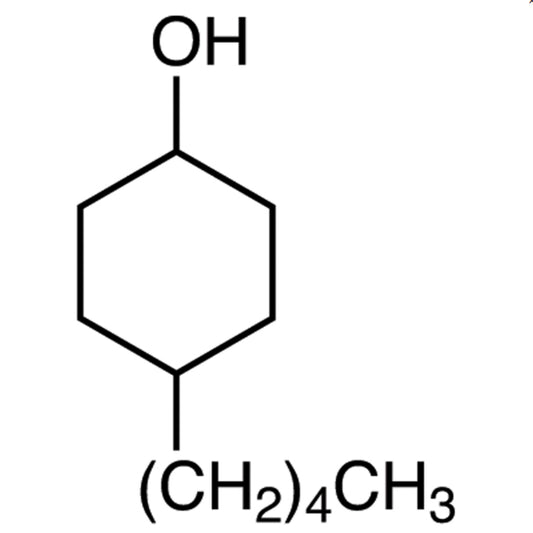
4-Amylcyclohexanol(cis-andtrans-mixture) TCI A1926
Regular price From Rp 980.700,00Regular price -
4-Acetamidocyclohexanol(cis-andtrans-mixture) TCI A1617
Regular price Rp 1.538.250,00Regular price