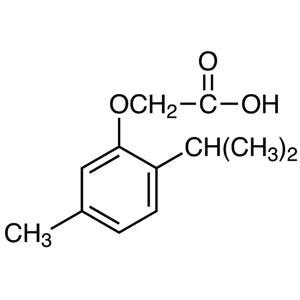
(2-Isopropyl-5-methylphenoxy)acetic Acid is a chemical compound widely used as a foundational building block in the synthesis of complex organic compounds. This versatile reagent plays a crucial role in laboratory settings, particularly in the development of pharmaceuticals and industrial chemicals. Its molecular structure includes both a carboxylic acid group and a phenyl group, making it highly reactive and suitable for various chemical transformations. Due to its functional groups, it is frequently employed in substitution reactions, esterification, and other synthetic pathways that require active functional groups.
The compound's stability under controlled conditions and its reactivity make it a preferred choice for chemists working on organic synthesis. The presence of both aromatic and alkyl chains allows it to participate in a wide range of chemical reactions, enhancing its utility in both research and industrial applications. Its ability to form esters and undergo substitution reactions makes it an essential component in the synthesis of more complex molecules. These properties ensure its reliability and effectiveness in laboratory environments.
In Indonesian laboratories, this compound is extensively used in both fundamental and applied chemical research. It is commonly found in academic institutions and research centers that focus on drug development, material science, and environmental chemistry. Its availability and chemical versatility make it a go-to reagent for chemists aiming to create new compounds with specific functional properties. Its widespread use highlights its importance in advancing scientific research in Indonesia.
Related TCI products
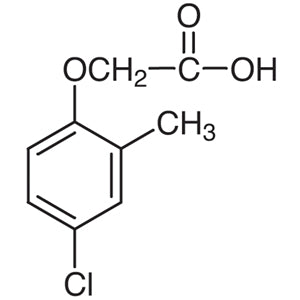
- TCI C0206 94-74-6 (4-Chloro-2-methylphenoxy)acetic Acid
- TCI T3391 21120-65-0 4-(4-Methylphenoxy)benzoic Acid
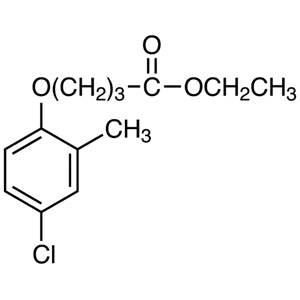
- TCI E1149 10443-70-6 Ethyl 4-(4-Chloro-2-methylphenoxy)butyrate
- TCI M2729 940-64-7 4-Methylphenoxyacetic Acid
- TCI D5121 53012-41-2 1-(2,6-Dimethylphenoxy)-2-propanone
- TCI D4345 13335-71-2 2,6-Dimethylphenoxyacetic Acid
- Pharmaceutical research: This compound is ideal for synthesizing drug molecules due to its reactive functional groups and structural versatility.
- Organic synthesis: Its ability to undergo esterification and substitution reactions makes it a valuable tool in creating complex organic compounds.
- Material science: It is used in the development of new materials, particularly those requiring aromatic and alkyl chain functionalities.
- Environmental chemistry: It plays a role in the synthesis of compounds used for pollution control and environmental remediation.
- Academic research: Widely used in Indonesian universities and research institutions for teaching and experimental purposes.
| Brand | TCI |
|---|---|
| CAS number | 5333-40-4 |
| Molecular formula | — |
| Purity | — |
| Category | Chemistry > Building Blocks > Non-Heterocyclic Building Blocks |
| Pack sizes | Available in various quantities as per standard laboratory supply |
| Physical form | Solid or liquid, depending on the specific product variant |
| Storage | Store in a cool, dry place away from direct sunlight and moisture |
This compound should be stored in a cool, dry environment to maintain its chemical stability. It is recommended to keep it in airtight containers to prevent moisture absorption and contamination. Due to its reactive nature, it should be handled in a well-ventilated laboratory setting, ideally with appropriate personal protective equipment. Avoid exposure to heat or direct sunlight to prevent degradation. Proper labeling and storage conditions ensure safe handling and prolong the compound's usability in laboratory applications. Always follow standard chemical safety protocols when working with reactive organic compounds.
—
Produk Terkait
-
(4-Chloro-2-methylphenoxy)aceticAcid TCI C0206
Regular price Rp 689.850,00Regular price -
4-(4-Methylphenoxy)benzoicAcid TCI T3391
Regular price From Rp 2.889.600,00Regular price -
Ethyl4-(4-Chloro-2-methylphenoxy)butyrate TCI E1149
Regular price From Rp 2.359.350,00Regular price -
4-MethylphenoxyaceticAcid TCI M2729
Regular price From Rp 1.405.950,00Regular price -
1-(2,6-Dimethylphenoxy)-2-propanone TCI D5121
Regular price From Rp 769.650,00Regular price -
2,6-DimethylphenoxyaceticAcid TCI D4345
Regular price From Rp 928.200,00Regular price -
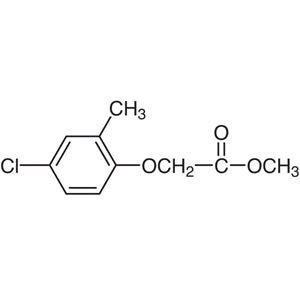
Methyl4-Chloro-2-methylphenoxyacetate TCI C0598
Regular price From Rp 477.750,00Regular price -
2-(4-Iodophenyl)aceticAcid TCI I0863
Regular price From Rp 1.220.100,00Regular price