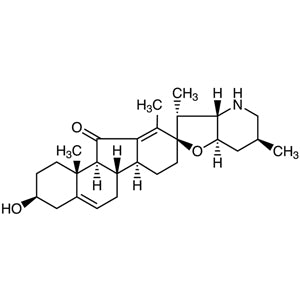
Jervine is a naturally occurring alkaloid widely used in scientific research, particularly in the fields of biochemistry and pharmacology. This compound is commonly found in extracts from specific plant sources and is known for its intriguing biological activities, including antimitotic and antitumor effects. In the laboratory, Jervine serves as a key reagent for the synthesis of other compounds or as an investigative agent in health-related research. Its unique chemical structure and specific stability under certain conditions make it a valuable tool for studying the mechanisms of natural compounds.
Jervine is preferred due to its complex chemical properties and its ability to interact with various biological systems. Its solid form and limited solubility require careful handling to ensure accuracy in experimental results. The compound’s stability and reactivity in controlled environments make it suitable for precise applications. Its role in both qualitative and quantitative analyses further enhances its utility in research settings. The compound’s biological activity also makes it a subject of interest in studies related to natural products and drug development.
In Indonesian laboratories, Jervine is commonly used in research focused on natural medicines and the development of new compounds. It is frequently employed in pharmacological studies to investigate the effects of medicinal plants. Its application in health-related research underscores its importance in understanding the therapeutic potential of natural substances. The compound’s reliability and consistent performance make it a preferred choice for scientific investigations in Indonesia.
- Natural Product Research - Jervine is used to study the pharmacological effects of plant-derived compounds due to its antimitotic and antitumor properties.
- Drug Development - This compound is a valuable tool in the synthesis of new pharmaceutical agents and the evaluation of their biological activity.
- Biochemical Analysis - Jervine’s unique chemical structure allows it to be used in assays that require precise and consistent results.
- Toxicology Studies - Its biological activity makes it suitable for assessing the effects of natural compounds on cellular processes.
- Pharmacological Testing - Jervine is employed in experiments to evaluate the efficacy and safety of plant-based medicinal compounds.
| Brand | TCI |
|---|---|
| CAS number | 469-59-0 |
| Molecular formula | — |
| Purity | — |
| Category | Life Science > Biochemicals and Reagents > Alkaloids |
| Pack sizes | Available in various quantities as per standard laboratory supply |
| Physical form | Solid |
| Storage | Store in a cool, dry place away from light and moisture |
Jervine should be stored in a cool, dry environment, away from direct light and moisture to maintain its stability. It is recommended to use airtight containers to prevent exposure to air and contaminants. Due to its limited solubility, it should be handled with care to avoid loss of potency during experimentation. Proper labeling and storage conditions are essential to ensure the integrity of the compound. Laboratory personnel should wear appropriate personal protective equipment when handling Jervine to ensure safety. The compound’s reactivity and biological activity necessitate careful handling to maintain accuracy in research applications.
—
Produk Terkait
-
TCI B5774 5,10-Bis(4,4,5,5-tetramethyl-1,3,2-dioxaborolan-2-yl)naphtho[1,2-c:5,6-c']bis([1,2,5]oxadiazole)
Regular price Rp 10.255.350,00Regular price -
Dihydroiodide TCI B6569
Regular price From Rp 1.936.200,00Regular price -
Trifluoromethanesulfonate TCI B7003
Regular price From Rp 1.936.200,00Regular price
![5,10-Bis(4,4,5,5-tetramethyl-1,3,2-dioxaborolan-2-yl)naphtho[1,2-c:5,6-c']bis([1,2,5]oxadiazole) - TCI B5774 - AMI Scientific](http://amiscientific.com/cdn/shop/files/TCI2510B5774.jpg?v=1769180228&width=533)