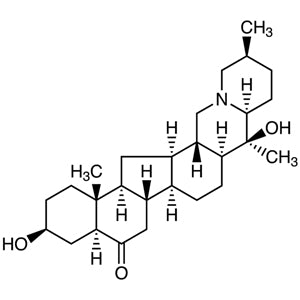
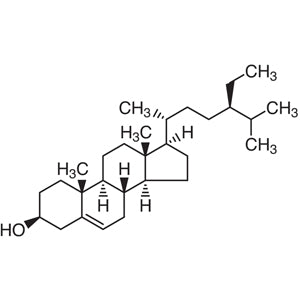
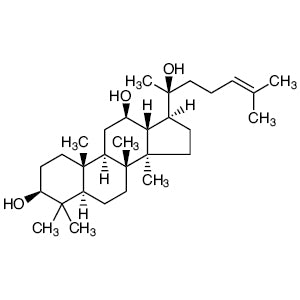
Peimine is an alkaloid compound widely utilized in scientific experiments, particularly in the fields of biochemistry and pharmacology. As a key reagent in laboratory settings, it plays a crucial role in studying the biological activities and mechanisms of various compounds. Its complex chemical structure makes it an essential tool for researchers aiming to understand molecular interactions and the effects of organic substances on living systems. Peimine is often employed as a building block in the synthesis of other compounds or as a test material in pharmacological activity assessments. Its versatility and relevance in scientific research make it a valuable resource for laboratories worldwide.
Peimine is valued for its chemical stability under specific conditions, although it is highly sensitive to moisture and air exposure. This sensitivity necessitates careful handling and storage to maintain its integrity. Its alkaline nature allows it to react with acids or bases, making it suitable for controlled chemical reactions. The distinct crystalline form and characteristic aroma of Peimine further contribute to its identification and use in laboratory settings. These properties make Peimine a preferred choice for researchers seeking a reliable and reactive compound for their experiments.
In Indonesian laboratories, Peimine is commonly used in biochemical, pharmaceutical, and environmental research. It supports studies on drug development, biological activity testing, and environmental impact assessments. Its presence in these research areas highlights its importance as a fundamental reagent in scientific investigations across various disciplines.
TCI brochures (PDF)
- Alkaloids 2025-10-10 · p. 3
- Steroids 2026-07-28 · p. 8
- Phytochemicals 2025-12-17 · p. 3
- Biochemical Research: Peimine is used to study the biochemical pathways and molecular interactions of organic compounds due to its complex structure and reactivity.
- Pharmacological Testing: It serves as a test compound to evaluate the pharmacological effects and mechanisms of action of various substances in drug development.
- Environmental Analysis: Peimine is utilized in environmental studies to assess the impact of organic compounds on ecosystems and biological systems.
- Organic Synthesis: Its chemical properties make it a valuable reagent for the synthesis of other alkaloids and related compounds in synthetic chemistry.
- Toxicological Studies: Peimine is employed in toxicity assessments to determine the biological effects of compounds on living organisms.
| Brand | TCI |
|---|---|
| CAS number | 23496-41-5 |
| Molecular formula | — |
| Purity | — |
| Category | Life Science > Biochemicals and Reagents > Alkaloids |
| Pack sizes | Available in various quantities as per standard laboratory supply |
| Physical form | Solid crystalline |
| Storage | Should be stored in a dry, cool, and airtight container to prevent degradation |
Peimine should be stored in a dry, cool, and airtight container to prevent moisture and air exposure, which can degrade its chemical properties. It is recommended to use glass or sealed plastic containers to maintain its stability. Due to its alkaline nature, it should be handled with appropriate personal protective equipment to avoid direct contact. In laboratory settings, it should be kept away from acids and bases to prevent unwanted reactions. Regular monitoring of storage conditions is essential to ensure its integrity and effectiveness for research purposes. Proper labeling and storage practices are crucial to maintaining safety and preventing contamination.
—
Product Categories
- Biochemicals and ReagentsAlkaloidsPiperidine Alkaloids
- Biochemicals and ReagentsCrude Medicine Ingredients for Research and Experimental Use
- Biochemicals and ReagentsSteroidsPhytosteroids [Steroids]
- Cell BiologyCell Signaling and NeuroscienceCytokines, Growth Factors and Hormones
- Cell BiologyNutrition ResearchPhytochemicals
- Pharmaceutical Development and Drug Discovery ResearchCrude Medicine Ingredients for Research and Experimental Use
Produk Terkait
-
TomatinefromTomato TCI T3636
Regular price Rp 4.849.950,00Regular priceRp 3.407.250,00Sale price Rp 4.849.950,00 -
Peiminine TCI P2609
Regular price From Rp 3.207.750,00Regular priceRp 2.258.550,00Sale price From Rp 3.207.750,00 -
Jervine TCI J0009
Regular price Rp 8.055.600,00Regular priceRp 5.649.000,00Sale price Rp 8.055.600,00 -
Sarsasapogenin TCI A3192
Regular price From Rp 2.411.850,00Regular priceRp 1.702.050,00Sale price From Rp 2.411.850,00 -
beta-SitosterolAcetate(containsCampesterolAcetate) TCI S0221
Regular price From Rp 2.359.350,00Regular priceRp 1.649.550,00Sale price From Rp 2.359.350,00 -
Stigmasterol TCI S0088
Regular price From Rp 928.200,00Regular priceRp 664.650,00Sale price From Rp 928.200,00 -
beta-Sitosterol(containsCampesterol) TCI S0040
Regular price Rp 1.563.450,00Regular priceRp 1.108.800,00Sale price Rp 1.563.450,00 -
(20S)-Protopanaxadiol TCI P2651
Regular price Rp 5.988.150,00Regular priceRp 4.203.150,00Sale price Rp 5.988.150,00