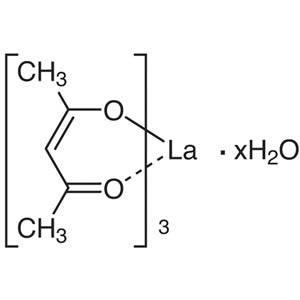
Tris(2,4-pentanedionato)lanthanum(III) Hydrate is a lanthanum(III) coordination complex in which three acetylacetonate (2,4-pentanedionate) ligands bind in a bidentate fashion to the rare earth metal centre, accompanied by water of hydration within the solid lattice. The compound belongs to the family of rare earth beta-diketonate complexes that are widely used as organic-soluble sources of lanthanum. In the laboratory, its role is to deliver the La³⁺ ion in a form that is easy to weigh, easy to disperse, and readily decomposed thermally, making it far more practical than hygroscopic inorganic lanthanum salts whose stoichiometry is difficult to control.
The characteristics that make this material a preferred choice are the stability of the beta-diketonate chelate complex, which protects the metal centre from premature hydrolysis, together with good solubility in organic solvents such as alcohols, toluene, and coordinating solvents. Its thermal decomposition profile is clean, leaving lanthanum oxide behind without interfering ionic residues such as chloride or nitrate. The acetylacetonate ligand also confers relatively controlled sublimation and volatilisation behaviour, which is why this complex is frequently adopted as a precursor in deposition techniques where a well-defined, reproducible metal source is required.
In Indonesian laboratories, this compound is typically encountered in university and institutional research groups working on catalysis, materials chemistry, and rare earth chemistry. It serves academic laboratories preparing lanthanum-containing oxide materials, industrial research units developing catalyst formulations, and analytical groups that need a soluble lanthanum source for organic-phase work. Because the material is supplied ready to weigh and disperse, it fits routine bench-scale preparative work without the additional drying and handling steps demanded by more hygroscopic lanthanum salts.
Related TCI products
- TCI T4230 14319-13-2 Tris(dipivaloylmethanato)lanthanum
- TCI T1293 52093-26-2 Lanthanum(III) Trifluoromethanesulfonate
- TCI L0437 14507-19-8 Lanthanum(III) Hydroxide
- TCI L0428 10099-58-8 Lanthanum(III) Chloride
- TCI L0294 168106-26-1 Lanthanum(III) Bis(trifluoromethanesulfonyl)imide
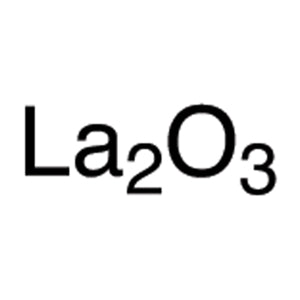
- TCI L0235 1312-81-8 Lanthanum(III) Oxide
- Lanthanum oxide precursor preparation: the clean thermal decomposition pathway yields lanthanum oxide without leaving chloride or nitrate residues that would otherwise contaminate the final oxide product.
- Thin film deposition processes: the controlled sublimation and volatilisation behaviour imparted by the acetylacetonate ligands makes the complex suitable as a well-defined metal source for deposition techniques.
- Catalyst research and development: the complex delivers La³⁺ in an organic-soluble form, allowing lanthanum to be introduced into catalyst formulations with accurate and reproducible stoichiometry.
- Organic-phase coordination chemistry studies: good solubility in alcohols, toluene, and coordinating solvents permits homogeneous reaction conditions that are unattainable with inorganic lanthanum salts.
- Rare earth materials synthesis: the stable beta-diketonate chelate protects the metal centre against premature hydrolysis, supporting controlled preparation of lanthanum-containing materials in the laboratory.
| Brand | TCI |
|---|---|
| CAS number | 64424-12-0 |
| Molecular formula | — |
| Purity | — |
| Category | Chemistry > Catalysis and Inorganic Chemistry > Rare Earth Elements |
| Pack sizes | — |
| Physical form | solid, supplied as the hydrate |
| Storage | keep in a tightly closed container in a cool, dry place; pack sizes available on request |
- Product code: L0148
Store the material in its original tightly closed container in a cool, dry, and well-ventilated area, protected from moisture and away from direct sunlight and sources of heat. Glass or suitably inert containers with secure closures are appropriate, and the container should be resealed promptly after each use to limit exposure to atmospheric humidity. Handle the solid in a fume hood or a well-ventilated working area using standard laboratory personal protective equipment, including safety glasses, gloves, and a laboratory coat. Avoid generating or inhaling dust during weighing and transfer, keep the material separated from incompatible substances, and follow the supplier safety data sheet together with your institution's chemical waste disposal procedures.
—
Produk Terkait
-
Tris(dipivaloylmethanato)lanthanum TCI T4230
Regular price From Rp 1.856.400,00Regular priceRp 1.313.550,00Sale price From Rp 1.856.400,00 -
Lanthanum(III)Trifluoromethanesulfonate TCI T1293
Regular price From Rp 2.359.350,00Regular priceRp 1.665.300,00Sale price From Rp 2.359.350,00 -
Lanthanum(III)Hydroxide TCI L0437
Regular price From Rp 2.093.700,00Regular priceRp 1.479.450,00Sale price From Rp 2.093.700,00 -
Lanthanum(III)Chloride TCI L0428
Regular price From Rp 1.405.950,00Regular priceRp 998.550,00Sale price From Rp 1.405.950,00 -
Lanthanum(III)Bis(trifluoromethanesulfonyl)imide TCI L0294
Regular price From Rp 2.384.550,00Regular priceRp 1.683.150,00Sale price From Rp 2.384.550,00 -
Lanthanum(III)Oxide TCI L0235
Regular price From Rp 689.850,00Regular priceRp 497.700,00Sale price From Rp 689.850,00 -
ChloranilicAcidLanthanum(III)SaltDecahydrate TCI C0079
Regular price From Rp 689.850,00Regular priceRp 497.700,00Sale price From Rp 689.850,00 -
Tris(2,4-pentanedionato)aluminum(III) TCI A0241
Regular price From Rp 689.850,00Regular priceRp 481.950,00Sale price From Rp 689.850,00