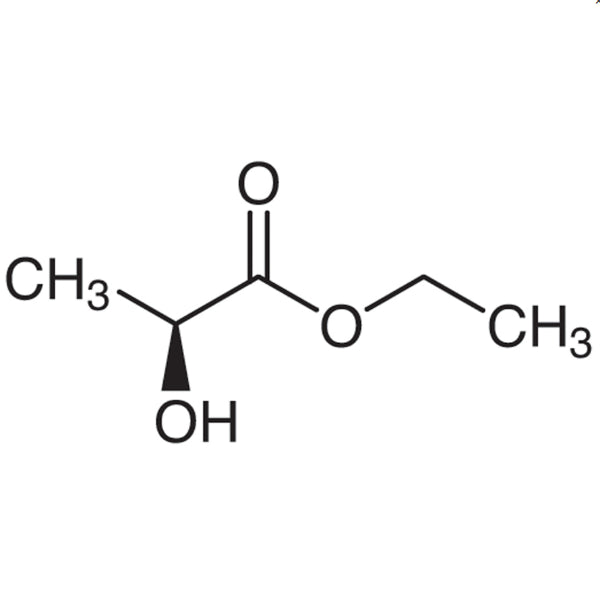
Ethyl L-(-)-Lactate is the ethyl ester of L-lactic acid, a chiral compound that occupies a dual position in the laboratory: it serves both as a building block for asymmetric synthesis and as an environmentally friendly solvent. The molecule carries a single stereogenic centre with defined configuration, a reactive secondary hydroxyl group, and an ester group that is readily transformed. Because it is derived from lactic acid obtained by fermentation, the compound originates from a renewable source, and this characteristic makes it one of the most affordable chiral materials and one of the most frequently chosen starting points for stereoselective synthetic routes.
The characteristics that lead chemists to select this material include stable enantiomeric purity, exceptionally broad solubility behaviour arising from its good miscibility with both water and most organic solvents, and a high dissolving power towards a wide range of organic compounds and resins. As a solvent, ethyl lactate offers an adequate boiling point, a relatively mild odour, and a toxicity profile that is far more benign than that of chlorinated solvents. As a building block, its hydroxyl group can be protected, oxidised to the corresponding pyruvate, or activated as a sulfonate for nucleophilic substitution with inversion of configuration.
In Indonesian laboratories this material is typically encountered wherever defined stereochemistry has to be introduced into a target molecule without recourse to expensive chiral auxiliaries, and wherever a laboratory is working to replace harsher solvents in its routine procedures. Academic research groups, pharmaceutical and fine-chemical development laboratories, and formulation and coatings laboratories all draw on it, since a single reagent covers both a synthetic role and a solvent role and therefore simplifies purchasing and storage for facilities that maintain a limited chemical inventory.
TCI brochures (PDF)
- Chiral Building Blocks 2025-04-14 · p. 10
- Asymmetric synthesis starting material: the defined stereogenic centre is carried through subsequent transformations, allowing a target molecule to inherit its configuration from an inexpensive, fermentation-derived chiral pool compound rather than an auxiliary.
- Preparation of chiral sulfonate intermediates: the secondary hydroxyl group is readily activated as a sulfonate ester, enabling clean nucleophilic substitution that proceeds with inversion of configuration at the stereocentre.
- Oxidation to pyruvate derivatives: the hydroxyl function can be oxidised to the corresponding keto ester, giving convenient access to pyruvate building blocks from a single, readily available chiral precursor.
- Green solvent substitution: its mild odour and far more favourable toxicity profile compared with chlorinated solvents make it a practical replacement in cleaning, extraction, and reaction media where solvent hazard reduction is a stated objective.
- Dissolution of organic compounds and resins: the high dissolving power and miscibility with water as well as most organic solvents suit formulation work, resin handling, and sample preparation requiring broad solvent compatibility.
| Brand | TCI |
|---|---|
| CAS number | 687-47-8 |
| Molecular formula | — |
| Purity | — |
| Category | Chemistry > Asymmetric Synthesis > Chiral Building Blocks |
| Pack sizes | available in the standard TCI catalogue pack sizes; please confirm the size required when ordering |
| Physical form | liquid ester, miscible with water and most organic solvents |
| Storage | keep containers tightly closed in a cool, dry, well-ventilated area |
- Product code: L0162
Store the material in its original tightly closed container in a cool, dry, well-ventilated area, away from direct sunlight, heat sources, and open flames. Glass bottles or the supplier's original packaging are suitable containers; keep the closure sealed between uses to limit evaporation and moisture uptake, since the compound is miscible with water. Handle in a fume hood or a well-ventilated workspace and wear safety glasses, chemical-resistant gloves, and a laboratory coat. Keep the material away from strong oxidising agents and strong bases, avoid contact with skin and eyes, and clean up any spill promptly with inert absorbent material. Follow the manufacturer's safety data sheet and institutional waste-disposal procedures at all times.
—
Produk Terkait
-
MethylL-(-)-Lactate TCI L0163
Regular price From Rp 795.900,00Regular price -
Benzyl(S)-(-)-Lactate TCI L0161
Regular price From Rp 2.411.850,00Regular price -
MethylD-(+)-Lactate TCI L0136
Regular price From Rp 1.115.100,00Regular price -
TetradecylLactate TCI T2231
Regular price Rp 848.400,00Regular price -
SodiumDL-Lactate(60%inWater) TCI S0928
Regular price Rp 823.200,00Regular price -
LithiumL-Lactate TCI L0144
Regular price Rp 1.353.450,00Regular price -
PropylLactate TCI L0121
Regular price Rp 2.545.200,00Regular price -
IsoamylLactate TCI L0117
Regular price Rp 1.353.450,00Regular price