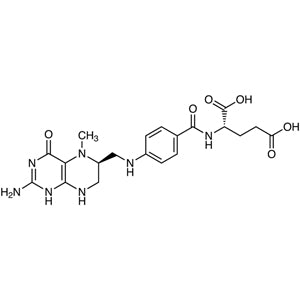
Levomefolic Acid (TCI L0335), with CAS number 31690-09-2, is a vital biochemical compound widely used in scientific research. It is an active form of folic acid, a key member of the B-complex vitamins essential for cellular metabolism. In laboratory settings, this compound plays a crucial role in biochemical studies and enzymatic reactions, serving as a substrate or building block for various synthetic processes. Its importance extends to research focused on DNA synthesis, cell growth, and metabolic pathways. Due to its high purity and chemical stability, it is a reliable material for precise and accurate experiments.
The compound's high purity and chemical stability make it a preferred choice for researchers. Its solubility in organic solvents such as ethyl acetate and acetone allows for easy handling and integration into diverse experimental protocols. Additionally, its ability to interact with enzymes and proteins makes it highly suitable for biochemical investigations. The compound’s consistent performance and reliability ensure that it meets the high standards required in modern scientific research. Its chemical properties are well-documented and make it a trusted reagent in both academic and industrial laboratories.
In Indonesian laboratories, Levomefolic Acid is commonly used in biochemical and molecular biology research. It is particularly relevant in studies involving folate metabolism, DNA synthesis, and cellular processes. Researchers in Indonesia rely on this compound for its accuracy and consistency, making it an essential component in various scientific investigations. Its application is widespread across different research fields, contributing to the advancement of scientific knowledge in the region.
- Biochemical Research – Levomefolic Acid is ideal for enzyme kinetics studies due to its role as a substrate in enzymatic reactions.
- DNA Synthesis Studies – Its involvement in folate metabolism makes it essential for experiments related to DNA replication and repair.
- Cell Growth Analysis – The compound supports studies on cellular proliferation and metabolic pathways in cultured cells.
- Metabolic Pathway Investigations – Its use in metabolic studies helps researchers understand the role of folate in biological processes.
- Enzymatic Reaction Testing – Its chemical stability and reactivity make it suitable for testing enzyme activity and substrate specificity.
| Brand | TCI |
|---|---|
| CAS number | 31690-09-2 |
| Molecular formula | — |
| Purity | — |
| Category | Life Science > Biochemicals and Reagents > Vitamins and Related Compounds |
| Pack sizes | As per supplier specifications |
| Physical form | Solid (as per standard product description) |
| Storage | Store in a cool, dry place away from light |
Levomefolic Acid should be stored in a cool, dry environment, away from direct sunlight and moisture. It is recommended to keep the compound in a sealed container to prevent exposure to air and humidity. Due to its chemical stability, it does not require refrigeration but should be protected from potential contaminants. In a laboratory setting, it is important to handle the compound with care, using appropriate personal protective equipment such as gloves and safety goggles. Proper labeling of storage containers is essential to ensure safe handling and prevent accidental misuse. The compound is generally stable under normal laboratory conditions, making it suitable for routine use in biochemical and molecular biology experiments.
—
Produk Terkait
-
2-Methyl-1,4-naphthoquinone TCI M0373
Regular price From Rp 1.829.100,00Regular price -
TTNPB TCI T3842
Regular price From Rp 3.419.850,00Regular price -
Tazarotene TCI T3108
Regular price Rp 1.510.950,00Regular price -
Bexarotene TCI B4798
Regular price Rp 5.034.750,00Regular price -
Benfotiamine TCI B4711
Regular price From Rp 1.696.800,00Regular price -
Alfacalcidol TCI A3125
Regular price From Rp 3.419.850,00Regular price -
Acitretin TCI A3097
Regular price From Rp 2.279.550,00Regular price -
AM580 TCI A3082
Regular price From Rp 2.016.000,00Regular price