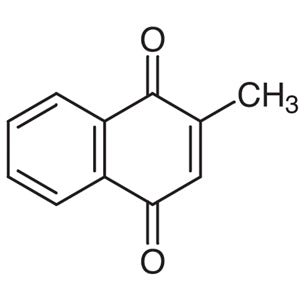
TCI M0373 2-Methyl-1,4-naphthoquinone is an aromatic quinone compound more widely known as menadione, or vitamin K3. Its core structure consists of a naphthoquinone skeleton bearing a methyl group, an arrangement that forms the active nucleus of the vitamin K family. In life science laboratories, this compound occupies an important position as both a biochemical reagent and a test substance, serving research that examines the role of vitamin K in biological systems as well as experiments that require a compound capable of inducing oxidative conditions within cells in a controlled manner.
The characteristic that makes this compound so widely selected is its pronounced redox behaviour. The quinone group can accept and release electrons, allowing it to participate in redox cycling and to generate reactive oxygen species within cellular systems. This property is precisely why the compound is so often employed as a tool for studying oxidative stress, cellular antioxidant responses, and mechanisms of cell death. Its yellow solid form makes weighing and the preparation of stock solutions straightforward, although the compound is sensitive to light, so protected storage is essential.
Its solubility is better in organic solvents than in water, a point that shapes how working solutions are prepared in practice. In Indonesian laboratories, this reagent is typically found in biochemistry, cell biology, and pharmacology work, where it supports studies of vitamin K function and controlled oxidative challenge in cell-based systems. Because it is supplied as a defined biochemical reagent under the TCI brand, it fits routine bench use in both academic research groups and institutional analytical facilities.
TCI brochures (PDF)
- Vitamins for Research and Experimental Use 2025-06-27 · p. 5
- Oxidative stress model studies, where the redox cycling of the quinone group generates reactive oxygen species in cells, providing a controlled and reproducible oxidative challenge for experimental designs.
- Vitamin K biological research, since the compound carries the methylated naphthoquinone nucleus that defines the vitamin K family and therefore serves as a representative test substance in such investigations.
- Cellular antioxidant response assays, because the compound reliably triggers the oxidative conditions researchers need to observe how cells mobilise and regulate their protective antioxidant machinery.
- Cell death mechanism investigations, where its ability to impose oxidative conditions within cells makes it a practical inducer for examining pathways leading to loss of cell viability.
- General biochemical reagent applications, as the yellow solid form permits accurate weighing and convenient preparation of stock solutions for a wide range of bench-scale biochemical procedures.
| Brand | TCI |
|---|---|
| CAS number | 58-27-5 |
| Molecular formula | — |
| Purity | — |
| Category | Life Science > Biochemicals and Reagents > Vitamins and Related Compounds |
| Pack sizes | available in the packaging options listed on this product page |
| Physical form | yellow solid |
| Storage | keep protected from light |
- Chemical identity: 2-Methyl-1,4-naphthoquinone (menadione, vitamin K3), an aromatic quinone
Store this reagent in a tightly closed container, protected from light, as the compound is light sensitive and its quality depends on shielded storage. Amber glass bottles or containers wrapped to exclude light are suitable, and the original manufacturer packaging should be retained whenever possible. Keep the material dry and well away from incompatible substances. Because the compound dissolves more readily in organic solvents than in water, prepare stock solutions with this in mind and label them clearly with the solvent used and the preparation date. Handle the solid inside a fume hood or a well-ventilated area, wearing gloves, safety glasses, and a laboratory coat, and avoid generating dust during weighing. Consult the manufacturer's safety data sheet before first use and follow institutional procedures for disposal of residues and contaminated consumables.
—
Produk Terkait
-
LevomefolicAcid TCI L0335
Regular price From Rp 3.287.550,00Regular price -
2-Amino-3-chloro-1,4-naphthoquinone TCI A1288
Regular price From Rp 1.060.500,00Regular price -
Sodium1,2-Naphthoquinone-4-sulfonate TCI N0043
Regular price From Rp 664.650,00Regular price -
1,4-Naphthoquinone TCI N0040
Regular price From Rp 637.350,00Regular price -
5-Hydroxy-1,4-naphthoquinone TCI H0286
Regular price From Rp 1.749.300,00Regular price -
2-Hydroxy-1,4-naphthoquinone TCI H0285
Regular price From Rp 1.538.250,00Regular price -
2,3-Dichloro-5-nitro-1,4-naphthoquinone TCI D2428
Regular price Rp 4.877.250,00Regular price -
2,3-Dichloro-5,8-dihydroxy-1,4-naphthoquinone TCI D2421
Regular price From Rp 3.498.600,00Regular price