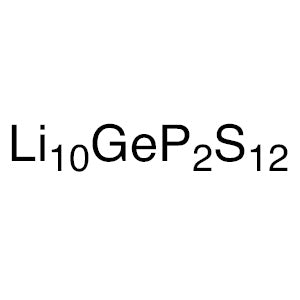
Lithium Germanium Phosphorus Sulfide (Li10GeP2S12) is a chemical compound widely used in scientific research, particularly in the fields of catalysis and inorganic chemistry. This material plays a crucial role in laboratory settings due to its unique reactivity and structural properties. It is commonly employed as a catalyst in electrochemical reactions and organic synthesis, enabling the development of more efficient chemical processes. Its versatility makes it a valuable asset for researchers aiming to explore new chemical pathways and material properties.
The properties that make Li10GeP2S12 a preferred choice include its high ionic conductivity and exceptional chemical stability. These characteristics allow for efficient ion transport, making it ideal for applications in energy storage devices. The compound’s crystalline structure facilitates the rapid movement of lithium ions, which is essential for the performance of batteries and supercapacitors. Additionally, its thermal stability ensures it remains effective under a wide range of experimental conditions, enhancing its usability in various laboratory environments.
In Indonesian laboratories, Li10GeP2S12 is frequently used in research related to energy and advanced materials. It is a key component in studies focused on developing high-capacity batteries and sustainable energy solutions. Many research institutions and universities in Indonesia incorporate this compound into their experiments to improve energy storage technologies and explore new applications in chemical engineering. Its reliability and performance make it a go-to material for scientific innovation in the region.
- Electrochemical research benefits from Li10GeP2S12 due to its high ionic conductivity and stability, enabling efficient ion transport in battery systems.
- Organic synthesis experiments utilize this compound as a catalyst, enhancing reaction rates and selectivity in complex chemical transformations.
- Energy storage development relies on Li10GeP2S12 for its ability to support high-capacity lithium-ion mobility, crucial for next-generation battery technologies.
- Material science studies employ this compound to investigate its structural and thermal properties, aiding in the design of advanced functional materials.
- Thermal stability testing uses Li10GeP2S12 to evaluate material performance under high-temperature conditions, ensuring reliability in extreme environments.
| Brand | TCI |
|---|---|
| CAS number | 1333081-96-1 |
| Molecular formula | — |
| Purity | — |
| Category | Chemistry > Catalysis and Inorganic Chemistry > Metallic Salts |
| Pack sizes | Available in standard laboratory quantities |
| Physical form | Solid powder |
| Storage | Store in a cool, dry place away from moisture and direct sunlight |
Li10GeP2S12 should be stored in a cool, dry environment to maintain its chemical stability and prevent degradation. It is recommended to use airtight containers to protect it from moisture and contaminants. Due to its reactivity, it should be handled in a well-ventilated laboratory setting, with appropriate personal protective equipment such as gloves and safety goggles. Avoid exposure to high temperatures and direct sunlight to preserve its structural integrity. Proper labeling and storage conditions are essential to ensure safe handling and long-term usability in laboratory applications.
—
Produk Terkait
-
LithiumSulfide TCI L0364
Regular price From Rp 2.491.650,00Regular price -
LithiumPhosphorodifluoridate TCI L0375
Regular price From Rp 1.829.100,00Regular price -
Tin(IV)Sulfide TCI T4244
Regular price From Rp 1.193.850,00Regular price -
Antimony(V)Sulfide TCI A3628
Regular price From Rp 1.035.300,00Regular price -
SodiumHydrogenSulfide TCI O0656
Regular price From Rp 1.273.650,00Regular price -
Lead(II)Sulfide TCI L0458
Regular price From Rp 1.220.100,00Regular price -
Silver(I)Sulfide TCI I1242
Regular price From Rp 1.590.750,00Regular price -
Cadmium(II)Sulfide TCI C3953
Regular price From Rp 1.220.100,00Regular price