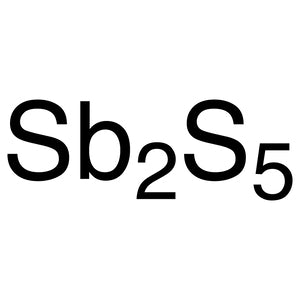
Antimony(V) Sulfide (Sb₂S₅) is an inorganic compound widely used in laboratory settings for its unique chemical properties and reactivity. As a key component in catalytic reactions and the synthesis of complex compounds, it plays a vital role in various chemical processes. This compound is particularly valued for its ability to participate in redox reactions, making it a versatile tool for researchers working in inorganic chemistry. Its applications span across multiple fields, including materials science and analytical chemistry, where its reactivity and stability are essential for achieving desired outcomes.
The chemical properties of Antimony(V) Sulfide make it a preferred choice in laboratory environments. It exhibits high reactivity, especially towards water and oxidizing agents, which allows it to be used in controlled chemical transformations. Its crystalline structure also contributes to its stability under certain conditions, ensuring consistent performance in experimental setups. These characteristics make it an ideal candidate for applications that require precise control over chemical reactions and the formation of complex compounds. Additionally, its ability to act as a catalyst in specific reactions enhances its utility in both research and industrial applications.
In Indonesian laboratories, Antimony(V) Sulfide is commonly used in chemical research, particularly in catalysis and the synthesis of inorganic compounds. It is a valuable resource for scientists and researchers seeking to explore redox reactions and develop new chemical compounds. Its availability through suppliers like AMI Scientific ensures that it remains a critical component in the chemical toolkit of Indonesian laboratories. Its role in advancing chemical research underscores its importance in both academic and industrial settings.
TCI brochures (PDF)
- Metallic Salts 2025-11-06 · p. 7
- Catalytic Reactions: Antimony(V) Sulfide is ideal for catalytic processes due to its ability to accelerate chemical reactions without being consumed, making it a valuable tool in synthetic chemistry.
- Redox Chemistry Studies: Its high reactivity towards oxidizing agents makes it suitable for experiments involving redox reactions, enabling the study of electron transfer mechanisms.
- Inorganic Compound Synthesis: The compound is frequently used in the synthesis of complex inorganic materials, where its unique chemical properties facilitate the formation of new compounds.
- Material Science Research: Its crystalline structure and reactivity make it useful in the development of new materials, particularly in the field of nanotechnology and advanced ceramics.
- Analytical Chemistry Applications: It is used in analytical techniques to detect and quantify specific compounds, leveraging its reactivity and chemical stability for accurate results.
| Brand | TCI |
|---|---|
| CAS number | 1315-04-4 |
| Molecular formula | — |
| Purity | — |
| Category | Chemistry > Catalysis and Inorganic Chemistry > Main-group Elements |
| Pack sizes | Available in various quantities as per supplier specifications |
| Physical form | Solid, crystalline |
| Storage | Store in a cool, dry place away from moisture and oxidizing agents |
Antimony(V) Sulfide should be stored in a cool, dry environment to maintain its chemical stability and prevent degradation. It is recommended to use airtight containers to protect it from moisture and oxidizing agents, which can affect its reactivity. Due to its high reactivity, it should be handled with care, using appropriate personal protective equipment such as gloves and safety goggles. It is important to avoid contact with water and strong oxidizers to prevent unintended chemical reactions. In laboratory settings, proper ventilation should be maintained to ensure safe handling and minimize exposure risks. Regular inspection of storage conditions is advised to ensure the compound remains in optimal condition for use.
—
Produk Terkait
-
Antimony(III)Bromide TCI A3588
Regular price From Rp 2.625.000,00Regular priceRp 1.835.400,00Sale price From Rp 2.625.000,00 -
Antimony(III)Fluoride TCI A3751
Regular price From Rp 1.035.300,00Regular priceRp 723.450,00Sale price From Rp 1.035.300,00 -
Tin(IV)Sulfide TCI T4244
Regular price From Rp 1.193.850,00Regular priceRp 834.750,00Sale price From Rp 1.193.850,00 -
SodiumHydrogenSulfide TCI O0656
Regular price From Rp 1.273.650,00Regular priceRp 890.400,00Sale price From Rp 1.273.650,00 -
Lead(II)Sulfide TCI L0458
Regular price From Rp 1.220.100,00Regular priceRp 852.600,00Sale price From Rp 1.220.100,00 -
LithiumSulfide TCI L0364
Regular price From Rp 2.491.650,00Regular priceRp 1.741.950,00Sale price From Rp 2.491.650,00 -
Cadmium(II)Sulfide TCI C3953
Regular price From Rp 1.220.100,00Regular priceRp 852.600,00Sale price From Rp 1.220.100,00 -
Bismuth(III)Sulfide TCI B6649
Regular price From Rp 2.332.050,00Regular priceRp 1.630.650,00Sale price From Rp 2.332.050,00