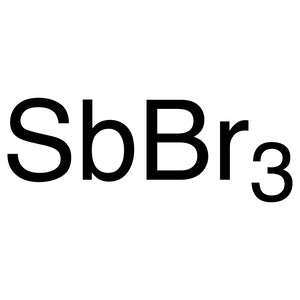
Antimony(III) Bromide (SbBr₃), with CAS number 7789-61-9, is a chemical compound widely used in laboratory settings for its reactivity and versatility. It belongs to the category of inorganic compounds and is commonly applied in catalytic processes and synthetic reactions. This compound plays a crucial role in organic and inorganic chemistry by facilitating various chemical transformations, including substitution reactions and the formation of complex compounds. Its ability to interact with different ions and molecules makes it an essential reagent in many experimental procedures.
The reactivity and chemical stability of Antimony(III) Bromide under specific conditions make it a preferred choice for laboratory applications. It is known for its capacity to participate in a wide range of chemical reactions, contributing to the synthesis of new compounds and the modification of molecular structures. Its chemical properties allow it to act as both a catalyst and a reagent, making it a valuable tool in both research and educational settings. The compound’s ability to form complexes with various ligands further enhances its utility in advanced chemical processes.
In Indonesian laboratories, Antimony(III) Bromide is frequently used in inorganic chemistry and catalysis research. It is a popular choice for experiments involving the synthesis of new compounds and the study of molecular structures. Its availability in the local market ensures that researchers and students have access to this essential reagent for their work. The compound’s versatility and effectiveness make it a reliable component in various experimental setups.
TCI brochures (PDF)
- Metallic Salts 2025-11-06 · p. 5
- Inorganic synthesis reactions benefit from Antimony(III) Bromide's ability to act as a reagent and catalyst, enabling the formation of complex compounds.
- Catalytic processes in organic chemistry often utilize this compound due to its reactivity and capacity to facilitate molecular transformations.
- Molecular structure modification experiments rely on its capacity to interact with various ions and molecules, aiding in the creation of new chemical structures.
- Laboratory research on complex compound formation benefits from its role in substitution and coordination reactions.
- Educational experiments in chemistry use this compound to demonstrate reactivity and chemical interaction principles in a controlled environment.
| Brand | TCI |
|---|---|
| CAS number | 7789-61-9 |
| Molecular formula | — |
| Purity | — |
| Category | Chemistry > Catalysis and Inorganic Chemistry > Main-group Elements |
| Pack sizes | Available in standard laboratory quantities |
| Physical form | Solid |
| Storage | Store in a cool, dry place away from moisture and light |
Antimony(III) Bromide should be stored in a cool, dry environment to maintain its chemical stability. It is recommended to keep the compound in a sealed container to prevent exposure to moisture and air. Due to its reactivity, it is important to handle the material with care, using appropriate personal protective equipment such as gloves and safety goggles. Storage should be away from incompatible substances to avoid any potential chemical interactions. Proper labeling of containers is essential to ensure safe handling and prevent accidental exposure. Regular monitoring of storage conditions helps maintain the integrity and effectiveness of the compound in laboratory applications.
—
Produk Terkait
-
Antimony(V)Sulfide TCI A3628
Regular price From Rp 1.035.300,00Regular priceRp 723.450,00Sale price From Rp 1.035.300,00 -
Antimony(III)Fluoride TCI A3751
Regular price From Rp 1.035.300,00Regular priceRp 723.450,00Sale price From Rp 1.035.300,00 -
ZincBromide TCI Z0013
Regular price From Rp 610.050,00Regular priceRp 426.300,00Sale price From Rp 610.050,00 -
StrontiumBromide TCI T4155
Regular price From Rp 2.359.350,00Regular priceRp 1.649.550,00Sale price From Rp 2.359.350,00 -
Tin(II)Bromide[forPerovskiteprecursor] TCI T3573
Regular price From Rp 1.565.550,00Regular priceRp 1.094.100,00Sale price From Rp 1.565.550,00 -
AluminumBromideAnhydrous TCI A2692
Regular price From Rp 743.400,00Regular priceRp 519.750,00Sale price From Rp 743.400,00 -
PotassiumBromide TCI P1747
Regular price Rp 477.750,00Regular priceRp 333.900,00Sale price Rp 477.750,00 -
LithiumBromide TCI L0210
Regular price Rp 689.850,00Regular priceRp 481.950,00Sale price Rp 689.850,00