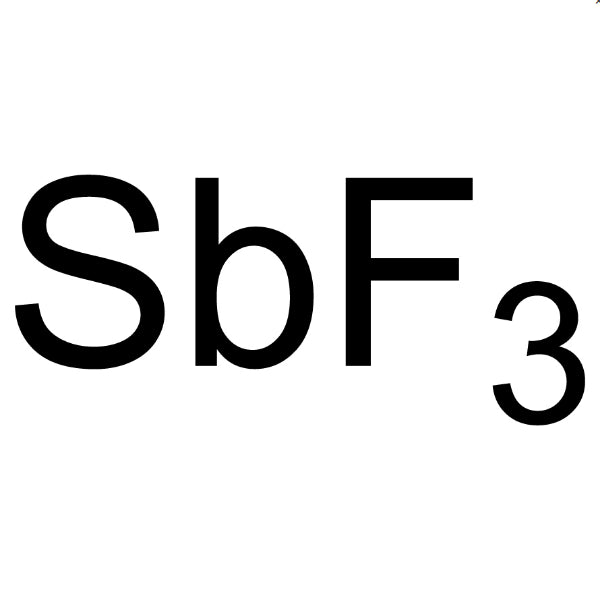
Antimony(III) Fluoride (ASF₃) is a chemical compound widely used in laboratory settings for its reactivity and catalytic properties. It plays a crucial role in various chemical reactions and catalytic processes, particularly in the synthesis of organic and inorganic compounds. Its ability to accelerate reactions under reactive conditions makes it an essential tool for chemists working in research and development. This compound is especially valuable in the study of main-group element reactivity and its applications in catalysis.
The unique molecular structure and high chemical reactivity of Antimony(III) Fluoride make it a preferred choice for many laboratory applications. It is soluble in organic solvents and can form complexes with various ions and molecules, which enhances its utility in substitution reactions, hydrolysis, and catalytic processes. These properties enable it to be used in a wide range of chemical transformations, making it a versatile reagent for both academic and industrial research.
In Indonesian laboratories, Antimony(III) Fluoride is commonly used in chemical research, particularly in catalysis and the study of elemental reactivity. It is frequently found in chemistry laboratories, material research facilities, and academic institutions. Its role in accelerating chemical reactions and facilitating the synthesis of new compounds makes it an important component in the chemical research landscape of Indonesia.
- Catalytic Reactions: Antimony(III) Fluoride is ideal for catalytic processes due to its high reactivity and ability to accelerate chemical transformations.
- Organic Synthesis: It is used in the synthesis of organic compounds where reactive conditions are required to facilitate complex molecular structures.
- Inorganic Chemistry Studies: Its role in studying main-group element reactivity makes it a key reagent for inorganic chemistry research.
- Hydrolysis Reactions: The compound’s ability to interact with various molecules makes it suitable for hydrolysis processes in chemical analysis.
- Material Science Research: It is employed in the development of new materials due to its unique chemical properties and reactivity.
| Brand | TCI |
|---|---|
| CAS number | 7783-56-4 |
| Molecular formula | — |
| Purity | — |
| Category | Chemistry > Catalysis and Inorganic Chemistry > Main-group Elements |
| Pack sizes | Available in various sizes as per supplier specifications |
| Physical form | Solid or liquid, depending on the specific product formulation |
| Storage | Requires storage in a cool, dry, and well-ventilated area away from moisture and incompatible substances. |
Antimony(III) Fluoride should be stored in a cool, dry, and well-ventilated area, away from moisture and incompatible substances. It is recommended to use sealed containers made of materials resistant to chemical attack, such as glass or polyethylene. Due to its high reactivity, it should be handled with care, using appropriate personal protective equipment. Laboratory personnel should ensure proper ventilation when working with this compound to minimize exposure. It is important to avoid contact with water and other reactive materials to prevent unintended chemical reactions. Proper storage and handling are essential to maintain the compound's stability and ensure safe laboratory practices.
—
Produk Terkait
-
Antimony(V)Sulfide TCI A3628
Regular price From Rp 1.035.300,00Regular priceRp 723.450,00Sale price From Rp 1.035.300,00 -
Antimony(III)Bromide TCI A3588
Regular price From Rp 2.625.000,00Regular priceRp 1.835.400,00Sale price From Rp 2.625.000,00 -
Zinc(II)Fluoride TCI Z0050
Regular price From Rp 903.000,00Regular priceRp 631.050,00Sale price From Rp 903.000,00 -
StrontiumFluoride TCI T4027
Regular price From Rp 743.400,00Regular priceRp 519.750,00Sale price From Rp 743.400,00 -
Aluminum(III)Fluoride TCI A3470
Regular price From Rp 1.220.100,00Regular priceRp 852.600,00Sale price From Rp 1.220.100,00 -
MagnesiumFluoride TCI M3395
Regular price From Rp 1.565.550,00Regular priceRp 1.094.100,00Sale price From Rp 1.565.550,00 -
Lead(II)Fluoride TCI L0424
Regular price From Rp 557.550,00Regular priceRp 389.550,00Sale price From Rp 557.550,00 -
Indium(III)Fluoride TCI I1160
Regular price From Rp 2.889.600,00Regular priceRp 2.020.200,00Sale price From Rp 2.889.600,00