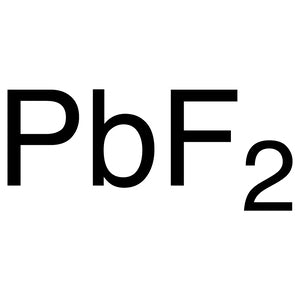
Lead(II) Fluoride is a chemical compound widely used in laboratory settings, particularly in catalysis and inorganic chemistry. It plays a crucial role in various chemical reactions by acting as a catalyst or reagent in the synthesis of complex compounds. Its unique chemical properties make it a valuable tool for researchers aiming to explore molecular interactions and chemical behavior. This compound is especially relevant in the study of main-group elements and their reactivity in different chemical environments.
One of the key reasons Lead(II) Fluoride is preferred in laboratory applications is its high melting and boiling points, which make it suitable for reactions requiring elevated temperatures. Additionally, it exhibits a stable chemical structure under controlled conditions, allowing for predictable and reproducible results. Its ability to dissolve in specific solvents also enhances its versatility in experimental procedures. These properties contribute to its effectiveness in both synthetic and analytical chemistry.
In Indonesian laboratories, Lead(II) Fluoride is commonly used in chemical research, particularly in catalytic processes and inorganic synthesis. It is frequently found in university and research laboratory settings where scientists investigate the reactivity of heavy metals and their compounds. Its role in understanding molecular interactions and chemical behavior makes it an essential component in various scientific studies.
TCI brochures (PDF)
- Metallic Salts 2025-11-06 · p. 2
- Catalytic Reactions: Lead(II) Fluoride is used in catalytic processes due to its ability to facilitate chemical reactions under controlled conditions.
- Inorganic Synthesis: It serves as a reagent in the synthesis of inorganic compounds, offering stability and reactivity in high-temperature environments.
- Molecular Interaction Studies: Researchers use it to study molecular interactions and chemical behavior, particularly in the context of heavy metal compounds.
- Analytical Chemistry: Its unique properties make it useful in analytical techniques that require precise chemical reactions and controlled environments.
- Material Science Research: It is employed in the development of new materials, where its chemical stability and reactivity are essential for experimental outcomes.
| Brand | TCI |
|---|---|
| CAS number | 7783-46-2 |
| Molecular formula | — |
| Purity | — |
| Category | Chemistry > Catalysis and Inorganic Chemistry > Main-group Elements |
| Pack sizes | Available in various quantities as per standard laboratory supply |
| Physical form | Solid |
| Storage | Store in a cool, dry place away from moisture and direct sunlight |
Lead(II) Fluoride should be stored in a cool, dry environment to maintain its chemical stability. It is recommended to keep it in airtight containers to prevent exposure to moisture, which can affect its reactivity. Due to its chemical nature, it should be handled with care, using appropriate personal protective equipment such as gloves and safety goggles. It is important to ensure that it is stored separately from incompatible materials to avoid any potential chemical interactions. In laboratory settings, proper ventilation should be maintained to minimize inhalation risks. Regular inspection of storage conditions is advised to ensure the compound remains in optimal condition for use.
—
Product Categories
Produk Terkait
-
MagnesiumFluoride TCI M3395
Regular price From Rp 1.565.550,00Regular priceRp 1.094.100,00Sale price From Rp 1.565.550,00 -
CalciumFluoride TCI C3745
Regular price From Rp 689.850,00Regular priceRp 481.950,00Sale price From Rp 689.850,00 -
CesiumFluoride TCI C2204
Regular price From Rp 1.803.900,00Regular priceRp 1.261.050,00Sale price From Rp 1.803.900,00 -
Zinc(II)Fluoride TCI Z0050
Regular price From Rp 903.000,00Regular priceRp 631.050,00Sale price From Rp 903.000,00 -
StrontiumFluoride TCI T4027
Regular price From Rp 743.400,00Regular priceRp 519.750,00Sale price From Rp 743.400,00 -
Aluminum(III)Fluoride TCI A3470
Regular price From Rp 1.220.100,00Regular priceRp 852.600,00Sale price From Rp 1.220.100,00 -
LithiumFluoride TCI L0211
Regular price From Rp 1.565.550,00Regular priceRp 1.094.100,00Sale price From Rp 1.565.550,00 -
Indium(III)Fluoride TCI I1160
Regular price From Rp 2.889.600,00Regular priceRp 2.020.200,00Sale price From Rp 2.889.600,00