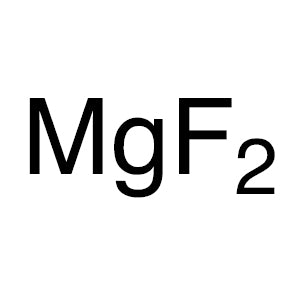
Magnesium Fluoride (MgF₂) is an inorganic compound widely used in laboratory settings for its unique chemical and optical properties. As a key component in catalytic and inorganic chemistry, it plays a vital role in various chemical reactions, especially those requiring a stable and inert environment. Its crystalline structure and optical characteristics make it indispensable in advanced research and industrial applications. MgF₂ is particularly valued for its ability to withstand high temperatures and resist chemical degradation, making it a reliable material for demanding laboratory conditions.
The properties of Magnesium Fluoride that make it a preferred choice include its high melting point, chemical inertness, and excellent optical transparency. These characteristics allow it to be used in applications where thermal stability and optical clarity are essential. Additionally, its low solubility in water and resistance to many acids and bases ensure that it remains stable under a wide range of experimental conditions. This stability is crucial for maintaining the integrity of chemical processes and ensuring consistent results in laboratory experiments.
In Indonesian laboratories, Magnesium Fluoride is commonly used in chemical and material research, as well as in the development of optical and electronic devices. Its role in academic and industrial research is significant, particularly in fields such as spectroscopy, material science, and semiconductor technology. The compound's versatility and reliability make it a valuable resource for scientists and researchers in Indonesia.
TCI brochures (PDF)
- Metallic Salts 2025-11-06 · p. 2
- Used in optical lens manufacturing due to its high transparency and refractive index, making it ideal for precision optical components.
- Applied in semiconductor processing for its thermal stability and chemical inertness, supporting high-temperature fabrication techniques.
- Utilized in spectroscopy experiments for its low absorption of ultraviolet and visible light, enhancing spectral analysis accuracy.
- Employed in catalytic reactions where a stable and inert environment is required, ensuring consistent reaction outcomes.
- Applied in material science research for its ability to withstand extreme conditions, facilitating the study of high-performance materials.
| Brand | TCI |
|---|---|
| CAS number | 7783-40-6 |
| Molecular formula | — |
| Purity | — |
| Category | Chemistry > Catalysis and Inorganic Chemistry > Main-group Elements |
| Pack sizes | Available in various quantities as per standard laboratory supply options |
| Physical form | White crystalline powder |
| Storage | Store in a cool, dry place away from moisture and direct sunlight |
Magnesium Fluoride should be stored in a cool, dry environment to prevent moisture absorption, which can affect its stability. It is recommended to use airtight containers made of glass or inert materials to maintain its chemical integrity. Due to its inert nature, it generally does not react with common laboratory chemicals, but care should be taken to avoid exposure to strong acids or bases. Proper labeling and secure storage are essential to ensure safe handling and prevent accidental contamination. Always follow standard laboratory safety protocols when working with this compound to maintain a safe and controlled experimental environment.
—
Product Categories
- Catalysis and Inorganic ChemistryMain-group Elements [Catalysis and Inorganic Chemistry]Magnesium [Catalysis and Inorganic Chemistry]
- Catalysis and Inorganic ChemistryMetallic Salts [Catalysis and Inorganic Chemistry]Fluoride Salts [Metallic Salts]
- Synthetic ReagentsInorganic Salts [Synthetic Reagents]
Produk Terkait
-
Lead(II)Fluoride TCI L0424
Regular price From Rp 557.550,00Regular priceRp 389.550,00Sale price From Rp 557.550,00 -
CalciumFluoride TCI C3745
Regular price From Rp 689.850,00Regular priceRp 481.950,00Sale price From Rp 689.850,00 -
CesiumFluoride TCI C2204
Regular price From Rp 1.803.900,00Regular priceRp 1.261.050,00Sale price From Rp 1.803.900,00 -
Zinc(II)Fluoride TCI Z0050
Regular price From Rp 903.000,00Regular priceRp 631.050,00Sale price From Rp 903.000,00 -
StrontiumFluoride TCI T4027
Regular price From Rp 743.400,00Regular priceRp 519.750,00Sale price From Rp 743.400,00 -
Aluminum(III)Fluoride TCI A3470
Regular price From Rp 1.220.100,00Regular priceRp 852.600,00Sale price From Rp 1.220.100,00 -
LithiumFluoride TCI L0211
Regular price From Rp 1.565.550,00Regular priceRp 1.094.100,00Sale price From Rp 1.565.550,00 -
Indium(III)Fluoride TCI I1160
Regular price From Rp 2.889.600,00Regular priceRp 2.020.200,00Sale price From Rp 2.889.600,00