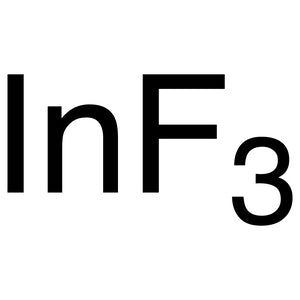
Indium(III) Fluoride (InF₃) is a chemical compound widely used in laboratory settings for its catalytic properties and role in inorganic chemistry. As a main-group element compound, it plays a significant part in various chemical reactions and synthesis processes. It is commonly employed in catalytic reactions and as a reagent in the preparation of complex compounds. Its ability to participate in metal-based catalytic systems makes it a valuable tool for chemists working in diverse research fields. InF₃ is particularly useful in reactions involving metal fluorides and in the development of new materials.
One of the key properties that make InF₃ a preferred choice is its chemical stability under controlled conditions, although it is highly reactive towards water and hydroxides. This reactivity allows it to be an effective catalyst in certain reaction mechanisms where metal-based participation is required. Additionally, its physical form—typically a white or yellow solid—makes it easy to handle and measure in laboratory environments. The solubility of InF₃ varies depending on the solvent used, which adds to its versatility in different chemical applications.
In Indonesian laboratories, InF₃ is commonly used in inorganic chemistry research, especially in the study of complex compound structures and catalytic reactions. It is also utilized in the development of new materials, such as in the creation of electronic materials. Due to its reactivity and catalytic properties, InF₃ remains a key component in various chemical processes and research projects conducted in the region.
TCI brochures (PDF)
- Metallic Salts 2025-11-06 · p. 2
- Inorganic Chemistry Research – InF₃ is used to study the synthesis and properties of complex inorganic compounds due to its reactivity and catalytic properties.
- Catalytic Reaction Development – It serves as a catalyst in metal-based reactions, enabling the efficient production of desired chemical products.
- Material Science Investigations – InF₃ is employed in the development of new electronic materials, contributing to advancements in semiconductor and conductive material research.
- Fluoride Compound Synthesis – Its role in reactions involving metal fluorides makes it essential for the preparation of various fluoride-based compounds.
- Structural Analysis Studies – InF₃ is used in the analysis of complex compound structures, aiding in the understanding of molecular bonding and reactivity.
| Brand | TCI |
|---|---|
| CAS number | 7783-52-0 |
| Molecular formula | — |
| Purity | — |
| Category | Chemistry > Catalysis and Inorganic Chemistry > Main-group Elements |
| Pack sizes | Available in various quantities as per standard laboratory supply |
| Physical form | Solid, typically white or yellow in color |
| Storage | Store in a dry, cool place away from moisture and incompatible substances |
InF₃ should be stored in a dry, cool environment to prevent moisture exposure, which can lead to decomposition or reactivity. It is recommended to use airtight containers made of materials that are chemically inert, such as glass or stainless steel, to avoid any reaction with the container. Due to its reactivity with water and hydroxides, it should be kept away from moisture sources and incompatible substances. In laboratory settings, proper personal protective equipment, including gloves and safety goggles, should be worn when handling InF₃. The compound should not be stored near acids or bases, as these can cause hazardous reactions. Regular monitoring of storage conditions is essential to maintain the integrity and safety of the material.
—
Produk Terkait
-
Indium(III)Oxide TCI I1150
Regular price From Rp 2.306.850,00Regular priceRp 1.612.800,00Sale price From Rp 2.306.850,00 -
Indium(III)Hydroxide TCI I1147
Regular price From Rp 1.351.350,00Regular priceRp 960.750,00Sale price From Rp 1.351.350,00 -
Tris(2,4-pentanedionato)indium(III) TCI I0020
Regular price Rp 3.472.350,00Regular priceRp 2.427.600,00Sale price Rp 3.472.350,00 -
Zinc(II)Fluoride TCI Z0050
Regular price From Rp 903.000,00Regular priceRp 631.050,00Sale price From Rp 903.000,00 -
StrontiumFluoride TCI T4027
Regular price From Rp 743.400,00Regular priceRp 519.750,00Sale price From Rp 743.400,00 -
Aluminum(III)Fluoride TCI A3470
Regular price From Rp 1.220.100,00Regular priceRp 852.600,00Sale price From Rp 1.220.100,00 -
MagnesiumFluoride TCI M3395
Regular price From Rp 1.565.550,00Regular priceRp 1.094.100,00Sale price From Rp 1.565.550,00 -
Lead(II)Fluoride TCI L0424
Regular price From Rp 557.550,00Regular priceRp 389.550,00Sale price From Rp 557.550,00