

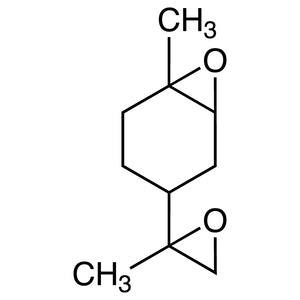
Limonene Dioxide (mixture of isomers), with CAS number 96-08-2, is a chemical compound widely used in laboratory settings for organic synthesis reactions. It serves as a versatile reagent or auxiliary material in the creation of complex chemical structures. This compound is particularly valuable for its ability to participate in oxidation and substitution reactions, making it an essential tool for chemists working on synthetic pathways. Its role extends beyond mere reactivity, as it is also used to form specific aromatic compounds that are crucial in various research applications.
Limonene Dioxide is valued for its chemical stability under controlled conditions, although it is sensitive to exposure to air and light. These properties make it a preferred choice for laboratories requiring precise control over reaction environments. Its reactivity allows it to be a key player in the formation of new compounds through oxidation or substitution mechanisms. Additionally, its availability and effectiveness in a range of chemical processes make it a reliable option for both academic and industrial research. The compound’s unique chemical profile supports its use in a variety of experimental setups, enhancing its utility in chemical synthesis.
In Indonesian laboratories, Limonene Dioxide is commonly used in organic chemistry research and the synthesis of pharmacological compounds. Its application is particularly relevant in the development of new drugs and materials, where its reactivity and structural versatility are highly beneficial. Due to its relative ease of availability and effectiveness in various chemical reactions, it remains a popular choice among researchers in Indonesia. Its use is often integrated into broader research initiatives aimed at advancing chemical knowledge and practical applications.
Related TCI products
- TCI V0195 106-87-6 3-(Oxiran-2-yl)-7-oxabicyclo[410]heptane (mixture of isomers)
- TCI O0590 2886-89-7 1,2:5,6-Diepoxyhexahydroindan (mixture of isomers)
- TCI M3665 41088-52-2 Methyl 7-Oxabicyclo[410]heptane-3-carboxylate (mixture of isomers)
- TCI E1611 2386-87-0 (7-Oxabicyclo[410]heptan-3-yl)methyl 7-Oxabicyclo[410]heptane-3-carboxylate (mixture of isomers)
- TCI D5961 55553-81-6 5,12-Dioxahexacyclo[7.6.1.0~2,8~.0~4,6~.0~10,15~.0~11,13~]hexadecane (mixture of isomers)
- TCI D5960 37777-17-6 Dodecahydro-2,6:3,5-dimethano-2H-oxireno[3',4']cyclopenta[1',2':6,7]naphth[2,3-b]oxirene (mixture of isomers)
- Organic synthesis for the creation of aromatic compounds due to its reactivity and structural versatility.
- Oxidation reactions where Limonene Dioxide acts as an effective oxidizing agent for functional group modification.
- Substitution reactions to introduce specific functional groups into organic molecules for further chemical transformations.
- Pharmaceutical research for the synthesis of drug compounds that require precise chemical modifications.
- Material science applications in the development of new polymers and chemical intermediates.
| Brand | TCI |
|---|---|
| CAS number | 96-08-2 |
| Molecular formula | — |
| Purity | — |
| Category | Chemistry > Building Blocks > Non-Heterocyclic Building Blocks |
| Pack sizes | Available in various quantities as per supplier specifications |
| Physical form | Liquid |
| Storage | Store in a cool, dark place away from air and light |
Limonene Dioxide should be stored in a cool, dark environment to maintain its chemical stability and prevent degradation. It is recommended to use sealed containers to minimize exposure to air and light, which can affect its reactivity and shelf life. In laboratory settings, it is important to handle this compound with care, ensuring proper ventilation to manage its characteristic aroma. Storage should be in a secure location away from incompatible materials to prevent accidental reactions. Regular monitoring of storage conditions is advised to ensure the compound remains effective for its intended applications. Proper handling and storage practices are essential to maintain the integrity and utility of Limonene Dioxide in chemical research.
—
Produk Terkait
-
3-(Oxiran-2-yl)-7-oxabicyclo[410]heptane(mixtureofisomers) TCI V0195
Regular price From Rp 3.870.300,00Regular price -
1,2:5,6-Diepoxyhexahydroindan(mixtureofisomers) TCI O0590
Regular price From Rp 2.411.850,00Regular price -
Methyl7-Oxabicyclo[410]heptane-3-carboxylate(mixtureofisomers) TCI M3665
Regular price From Rp 1.220.100,00Regular price -
(7-Oxabicyclo[410]heptan-3-yl)methyl7-Oxabicyclo[410]heptane-3-carboxylate(mixtureofisomers) TCI E1611
Regular price Rp 980.700,00Regular price -
5,12-Dioxahexacyclo[7.6.1.0~2,8~.0~4,6~.0~10,15~.0~11,13~]hexadecane(mixtureofisomers) TCI D5961
Regular price From Rp 2.650.200,00Regular price -
Dodecahydro-2,6:3,5-dimethano-2H-oxireno[3',4']cyclopenta[1',2':6,7]naphth[2,3-b]oxirene(mixtureofisomers) TCI D5960
Regular price From Rp 2.889.600,00Regular price -
4,4'-Bicyclohexanol(mixtureofisomers) TCI B1621
Regular price From Rp 1.565.550,00Regular price -
2,2,4,4-Tetramethyl-1,3-cyclobutanediol(mixtureofisomers) TCI T0145
Regular price From Rp 2.227.050,00Regular price
![106-87-6 3-(Oxiran-2-yl)-7-oxabicyclo[4.1.0]heptane (mixture of isomers) - AMI Scientific](http://amiscientific.com/cdn/shop/files/TCI2510V0195.jpg?v=1767145750&width=533)

![41088-52-2 Methyl 7-Oxabicyclo[4.1.0]heptane-3-carboxylate (mixture of isomers) - AMI Scientific](http://amiscientific.com/cdn/shop/files/TCI2510M3665.jpg?v=1767128633&width=533)
![(7-Oxabicyclo[4.1.0]heptan-3-yl)methyl 7-Oxabicyclo[4.1.0]heptane-3-carboxylate (mixture of isomers) (CAS 2386-87-0) - TCI E1611 - AMI Scientific](http://amiscientific.com/cdn/shop/files/TCI2510E1611.jpg?v=1767113123&width=533)
![5,12-Dioxahexacyclo[7.6.1.0~2,8~.0~4,6~.0~10,15~.0~11,13~]hexadecane (mixture of isomers) (CAS 55553-81-6) - TCI D5961 - AMI Scientific](http://amiscientific.com/cdn/shop/files/TCI2510D5961.jpg?v=1767109486&width=533)
![Dodecahydro-2,6:3,5-dimethano-2H-oxireno[3',4']cyclopenta[1',2':6,7]naphth[2,3-b]oxirene (mixture of isomers) (CAS 37777-17-6) - TCI D5960 - AMI Scientific](http://amiscientific.com/cdn/shop/files/TCI2510D5960.jpg?v=1767109482&width=533)

