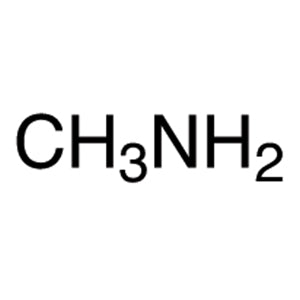
TCI M0137 Methylamine (ca 40% in Water, ca 12mol/L) is an aqueous solution of methylamine, the simplest primary amine. Pure methylamine is a gas at room temperature, so the solution form is much more practical to handle in routine laboratory work. Chemists use methylamine as a nucleophile and as a source of the N-methyl group in many syntheses. Typical examples are amide formation, imine formation, and the preparation of secondary amines by reductive amination. The labelled concentration of about 40%, or about 12 mol/L, lets researchers quickly work out how much reagent each reaction needs.
Methylamine is chosen for its high nucleophilic reactivity and small molecular size, which let it react efficiently with esters, acyl chlorides, aldehydes, ketones, and alkyl halides. Because it is supplied as an aqueous solution, it has a relatively well-defined concentration, stores safely in a tightly closed bottle, and is easy to measure with a pipette. These features make it a convenient way to introduce a methylamino group without the specialised equipment needed for handling gases. The solution is strongly basic, has a pungent ammonia-like odour, and is flammable and corrosive, so it must be handled with appropriate care.
In Indonesian laboratories, this reagent is typically used by university research groups, pharmaceutical and fine-chemical R&D teams, and synthetic chemistry laboratories that need a dependable primary amine source for small-scale preparations. The product is listed under glycoscience, where simple amines like this one can be used to derivatise or modify carbonyl and ester groups on carbohydrate derivatives. Its concentration is stated on the label, so it also suits teaching laboratories and method development work where reagent amounts must be calculated quickly and reproduced consistently.
TCI brochures (PDF)
- Safely Handleable Volatile Solutions 2024-05-02 · p. 1
- Colloidal Quantum Dot (QD) Research Reagents 2026-05-21 · p. 6
- Reagents for Glyco Chemistry & Biology 5th Edition · p. 143
Related TCI products
- TCI M2324 74-89-5 Methylamine (ca. 9% in Isopropyl Alcohol, ca. 2mol/L)
- TCI M2323 74-89-5 Methylamine (ca. 9% in Ethanol, ca. 2mol/L)
- TCI M2108 74-89-5 Methylamine (ca. 7% in Tetrahydrofuran, ca. 2mol/L)
- TCI M1016 74-89-5 Methylamine (40% in Methanol, ca. 9.8mol/L)
- TCI T1685 2052-49-5 Tetrabutylammonium Hydroxide (40% in Water)
- TCI T3614 75-50-3 Trimethylamine (ca. 8% in Toluene, ca. 1mol/L)
- Amide formation: methylamine reacts readily with esters and acyl chlorides to give N-methyl amides, and the stated concentration makes stoichiometric calculation simple.
- Reductive amination: the reagent serves as a compact nucleophilic nitrogen source that condenses with aldehydes and ketones, which can then be reduced to secondary N-methyl amines.
- Imine synthesis: its small size and high nucleophilicity allow efficient condensation with carbonyl compounds to form imines for further synthetic steps in research laboratories.
- N-alkylation reactions: methylamine reacts efficiently with alkyl halides, so it is a practical way to introduce a methylamino group into organic intermediates.
- Glycoscience derivatisation: simple amines such as this one can be used to modify carbonyl and ester groups on carbohydrate derivatives in chemical biology research.
| Brand | TCI (product code M0137) |
|---|---|
| CAS number | 74-89-5 |
| Molecular formula | — |
| Purity | — |
| Category | Chemistry > Chemical Biology > Glycoscience |
| Pack sizes | please refer to the available options on the product page |
| Physical form | aqueous solution, ca 40% in water (ca 12 mol/L) |
| Storage | keep the container tightly closed in a cool, well-ventilated area away from ignition sources |
Store the bottle tightly closed in its original container, in a cool, dry, well-ventilated place away from heat, sparks, open flames, and other ignition sources. Keep it separate from acids and oxidising agents. The solution is strongly basic, flammable, and corrosive, and it releases a pungent ammonia-like odour, so open and dispense it only inside a fume hood. Wear chemical-resistant gloves, safety goggles, and a laboratory coat. Measure volumes with a suitable pipette, reseal the bottle promptly after use to limit vapour loss and keep the concentration stable, and follow the supplier's Safety Data Sheet and local regulations for spill response and waste disposal.
—
Product Categories
Produk Terkait
-
Methylamine(ca.9%inIsopropylAlcohol,ca.2mol/L) TCI M2324
Regular price From Rp 769.650,00Regular priceRp 537.600,00Sale price From Rp 769.650,00 -
Methylamine(ca.9%inEthanol,ca.2mol/L) TCI M2323
Regular price Rp 795.900,00Regular priceRp 556.500,00Sale price Rp 795.900,00 -
Methylamine(ca.7%inTetrahydrofuran,ca.2mol/L) TCI M2108
Regular price From Rp 903.000,00Regular priceRp 631.050,00Sale price From Rp 903.000,00 -
Methylamine(40%inMethanol,ca.9.8mol/L) TCI M1016
Regular price From Rp 637.350,00Regular priceRp 445.200,00Sale price From Rp 637.350,00 -
TetrabutylammoniumHydroxide(40%inWater) TCI T1685
Regular price From Rp 1.246.350,00Regular priceRp 887.250,00Sale price From Rp 1.246.350,00 -
Trimethylamine(ca.8%inToluene,ca.1mol/L) TCI T3614
Regular price Rp 1.087.800,00Regular priceRp 760.200,00Sale price Rp 1.087.800,00 -
Trimethylamine(ca.25%inIsopropylAlcohol,ca.3mol/L) TCI T2893
Regular price From Rp 717.150,00Regular priceRp 500.850,00Sale price From Rp 717.150,00 -
Dimethylamine(ca.11%inIsopropylAlcohol,ca.2mol/L) TCI D4198
Regular price From Rp 717.150,00Regular priceRp 500.850,00Sale price From Rp 717.150,00