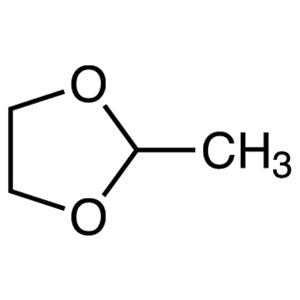
TCI M0210 2-Methyl-1,3-dioxolane is a five-membered cyclic acetal that is formally the product of protecting acetaldehyde with ethylene glycol. The compound is supplied as a clear liquid and occupies a classic role in the organic chemist's reagent cabinet: it serves simultaneously as a masked carbonyl equivalent and as a moderately polar ether solvent. Because the dioxolane ring is easily formed and just as easily reopened, laboratories rely on it to study acetalization equilibria, to test the activity of acid catalysts, and to prepare intermediates in multi-step synthetic sequences.
The principal reason for choosing this compound is its good stability under basic and reductive conditions, paired with the ease with which it hydrolyzes in the presence of aqueous acid. That combination of properties gives the synthetic chemist clear control over timing: a carbonyl group can be hidden away during harsh reaction steps and then restored at exactly the right moment. As a liquid with a relatively low boiling point, the compound is also readily separated by distillation, so purification of the final product is not complicated by residual solvent that resists evaporation from the reaction mixture.
Organic synthesis laboratories in Indonesia, both in university settings and in industrial research and development, encounter this reagent in work that requires protecting group strategy. It appears in graduate-level synthetic training, in catalysis studies where acid-mediated acetal formation and cleavage serve as a convenient model reaction, and in preparative work where a volatile, moderately polar ether medium is preferred over higher-boiling alternatives.
Related TCI products
- TCI T2575 1193-11-9 2,2,4-Trimethyl-1,3-dioxolane
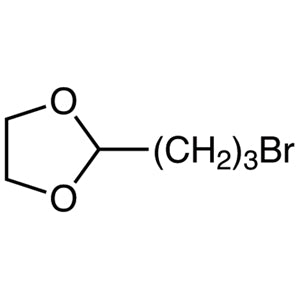
- TCI B3463 62563-07-9 2-(3-Bromopropyl)-1,3-dioxolane
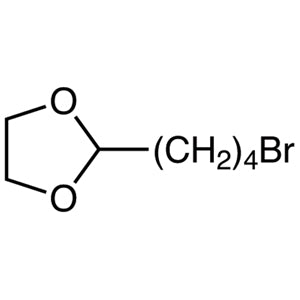
- TCI B2128 87227-41-6 2-(4-Bromobutyl)-1,3-dioxolane
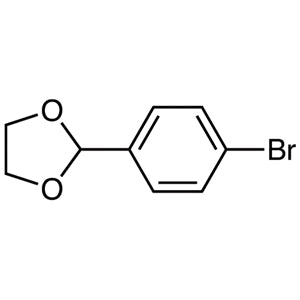
- TCI B2100 10602-01-4 2-(4-Bromophenyl)-1,3-dioxolane
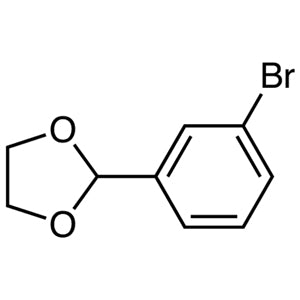
- TCI B2098 17789-14-9 2-(3-Bromophenyl)-1,3-dioxolane
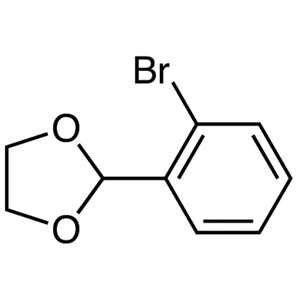
- TCI B2084 34824-58-3 2-(2-Bromophenyl)-1,3-dioxolane
- Carbonyl protection strategy: the dioxolane ring masks an aldehyde function through basic and reductive steps, then is removed cleanly by aqueous acid when the carbonyl is needed again.
- Acetalization equilibrium studies: because the ring both forms and reopens readily, the compound is a convenient model substrate for measuring the position and rate of acetal equilibria.
- Acid catalyst screening: hydrolysis of this cyclic acetal under aqueous acidic conditions provides a straightforward and reproducible test reaction for evaluating the activity of acid catalysts.
- Multi-step synthetic intermediates: laboratories use the compound to prepare intermediates in staged syntheses where a carbonyl group must remain latent across several transformations.
- Moderately polar ether solvent: its ether character and relatively low boiling point suit reactions needing a polar aprotic medium that can be stripped off easily by distillation.
| Brand | TCI |
|---|---|
| CAS number | 497-26-7 |
| Molecular formula | — |
| Purity | — |
| Category | Chemistry > Building Blocks > Non-Heterocyclic Building Blocks |
| Pack sizes | available in standard TCI research-scale packaging; please confirm the current pack options when ordering |
| Physical form | clear liquid |
| Storage | keep tightly closed in a cool, well-ventilated place away from acids and ignition sources |
Store the container tightly closed in a cool, dry, well-ventilated area, away from heat, sparks, open flame, and other ignition sources. Keep it separated from acids and from strong oxidizing agents, since aqueous acid promotes hydrolysis of the acetal ring and will degrade the material. Use the original manufacturer bottle or a compatible glass container with a tight-sealing cap; avoid transferring into containers that are not rated for volatile organic liquids. Handle all transfers and reactions inside a fume hood, wear safety glasses, nitrile gloves, and a laboratory coat, and ground equipment where static discharge is a concern. Consult the manufacturer's safety data sheet before first use.
—
Produk Terkait
-
2,2,4-Trimethyl-1,3-dioxolane TCI T2575
Regular price Rp 1.803.900,00Regular price -
2-(3-Bromopropyl)-1,3-dioxolane TCI B3463
Regular price From Rp 1.856.400,00Regular price -
2-(4-Bromobutyl)-1,3-dioxolane TCI B2128
Regular price From Rp 4.373.250,00Regular price -
2-(4-Bromophenyl)-1,3-dioxolane TCI B2100
Regular price From Rp 5.407.500,00Regular price -
2-(3-Bromophenyl)-1,3-dioxolane TCI B2098
Regular price From Rp 1.035.300,00Regular price -
2-(2-Bromophenyl)-1,3-dioxolane TCI B2084
Regular price From Rp 1.087.800,00Regular price -
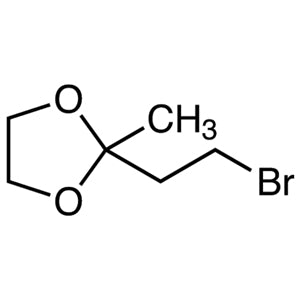
2-(2-Bromoethyl)-2-methyl-1,3-dioxolane TCI B1598
Regular price From Rp 5.407.500,00Regular price -
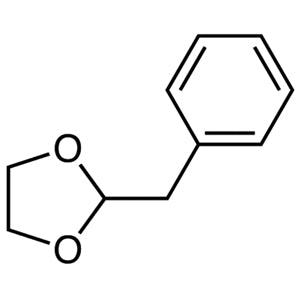
2-Benzyl-1,3-dioxolane TCI B1404
Regular price Rp 1.696.800,00Regular price