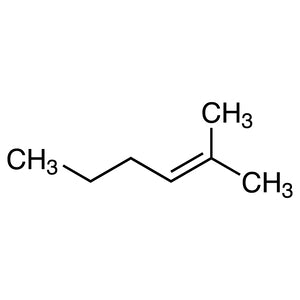
2-Methyl-2-hexene is an organic compound widely used in laboratory settings for constructing complex molecular structures. As a building block in chemical synthesis, it serves as a fundamental component in the development of various chemical compounds. Its versatility makes it a valuable resource for chemists seeking to explore different reaction pathways. This compound is commonly utilized in academic and industrial research, supporting a wide range of chemical processes. Its role in organic synthesis is particularly significant due to its ability to participate in multiple reaction types, including addition, substitution, and polymerization.
The compound’s non-polar nature and relatively low boiling point make it ideal for reactions requiring controlled temperature conditions. Its volatility allows for efficient handling in processes that involve distillation or vapor-phase reactions. Additionally, its simple hydrocarbon chain provides high reactivity, facilitating the synthesis of more complex molecules. These properties ensure that 2-Methyl-2-hexene remains a reliable and effective choice for laboratory applications. The compound’s chemical stability and predictable behavior further enhance its utility in both research and educational environments.
In Indonesian laboratories, 2-Methyl-2-hexene is extensively used in chemical research, particularly in organic synthesis and the development of new chemical materials. It is also commonly found in higher education institutions and industrial research settings due to its broad applicability and reliable chemical properties. Its presence in these environments underscores its importance as a foundational reagent in modern chemical experimentation and innovation.
- Organic synthesis applications benefit from 2-Methyl-2-hexene due to its reactivity and ability to participate in various reaction types, making it ideal for constructing complex molecular structures.
- It is widely used in polymerization processes because of its hydrocarbon chain structure, which supports the formation of long-chain polymers under controlled conditions.
- In academic research, this compound is essential for teaching and experimentation, providing students with hands-on experience in chemical synthesis techniques.
- Industrial research laboratories utilize it for developing new chemical materials, leveraging its stability and predictable chemical behavior in large-scale processes.
- Its volatility and non-polar nature make it suitable for distillation and vapor-phase reactions, where precise temperature control is required for optimal results.
| Brand | TCI |
|---|---|
| CAS number | 2738-19-4 |
| Molecular formula | — |
| Purity | — |
| Category | Chemistry > Building Blocks > Non-Heterocyclic Building Blocks |
| Pack sizes | Available in various quantities as per supplier specifications |
| Physical form | Liquid |
| Storage | Store in a cool, dry place away from direct sunlight and incompatible materials |
2-Methyl-2-hexene should be stored in a cool, dry environment to maintain its chemical stability. It is recommended to use sealed containers made of materials compatible with organic solvents to prevent evaporation and contamination. Due to its volatility, it should be kept away from heat sources and open flames to minimize the risk of vapor ignition. Proper ventilation is essential when handling this compound to ensure safe working conditions. Laboratory personnel should wear appropriate personal protective equipment, including gloves and safety goggles, to protect against potential skin or eye contact. Regular monitoring of storage conditions is advised to ensure the compound remains in optimal condition for use in chemical experiments.
—
Produk Terkait
-
3,5,5-Trimethyl-1-hexene TCI T0779
Regular price Rp 4.982.250,00Regular price -
2,4,4-Trimethyl-1-hexene TCI T0778
Regular price Rp 3.896.550,00Regular price -
2-Methyl-1-hexene TCI M0525
Regular price From Rp 1.510.950,00Regular price -
5-Methyl-1-hexene TCI M0303
Regular price Rp 4.133.850,00Regular price -
4-Methyl-1-hexene TCI M0302
Regular price Rp 5.778.150,00Regular price -
3-Methyl-1-hexene TCI M0301
Regular price Rp 8.506.050,00Regular price -
2-Hexene(cis-andtrans-mixture) TCI H1009
Regular price Rp 2.359.350,00Regular price -
3-Hexene(cis-andtrans-mixture) TCI H0656
Regular price Rp 4.664.100,00Regular price