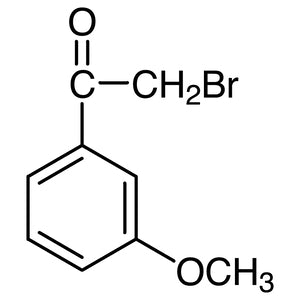
3'-Methoxyphenacyl Bromide is a chemical compound widely used in organic reactions, particularly in the synthesis of heterocyclic and aromatic compounds. As a halogenated aromatic compound, it plays a crucial role in laboratory settings as a building block for the creation of complex molecules. Its high reactivity makes it a valuable reagent in various synthetic pathways, enabling the formation of new chemical structures through nucleophilic substitution reactions. This compound is commonly employed in both research and industrial chemical development, supporting the advancement of pharmaceutical and material sciences.
One of the key properties that make 3'-Methoxyphenacyl Bromide a preferred choice is its stability and solubility in organic solvents such as ethyl acetate and chloroform. These characteristics facilitate efficient separation and isolation during laboratory procedures. Additionally, its non-polar nature allows it to be used in reactions that require specific reaction conditions. The compound's ability to participate in nucleophilic substitution reactions further enhances its utility in synthetic chemistry, making it a versatile reagent in the hands of chemists.
In Indonesian laboratories, 3'-Methoxyphenacyl Bromide is frequently used in organic chemistry research, especially in the development of new compounds and the study of reaction mechanisms. Its availability and chemical properties make it a standard component in many chemical synthesis processes. Laboratories in Indonesia rely on this compound for its reliability and effectiveness in creating complex molecular structures, contributing to both academic and industrial research efforts.
Related TCI products
- TCI A5505 5000-65-7 3'-Methoxyphenacyl Bromide [for HPLC Labeling]
- TCI B0633 135-73-9 2-Bromo-4'-phenylacetophenone
- TCI M1004 2632-13-5 4'-Methoxyphenacyl Bromide
- TCI A5508 70-11-1 Phenacyl Bromide [for HPLC Labeling]
- TCI A5501 99-73-0 4-Bromophenacyl Bromide [for HPLC Labeling]
- TCI B0949 17683-09-9 1-Benzyl-3-p-tolyltriazene [for Esterification]
- Organic synthesis of heterocyclic compounds due to its reactivity and nucleophilic substitution capabilities.
- Preparation of aromatic derivatives through halogenation and substitution reactions in chemical research.
- Development of pharmaceutical intermediates in drug synthesis processes requiring aromatic building blocks.
- Use in analytical chemistry for testing reactivity and solubility properties of halogenated compounds.
- Support in material science research for the creation of complex organic polymers and functional materials.
| Brand | TCI |
|---|---|
| CAS number | 5000-65-7 |
| Molecular formula | — |
| Purity | — |
| Category | Chemistry > Building Blocks > Non-Heterocyclic Building Blocks |
| Pack sizes | Available in various quantities as per standard chemical supply practices |
| Physical form | Solid or liquid depending on the specific product formulation |
| Storage | Store in a cool, dry place away from light and moisture |
3'-Methoxyphenacyl Bromide should be stored in a cool, dry environment, away from direct light and moisture to maintain its chemical integrity. It is recommended to use airtight containers made of glass or high-density polyethylene to prevent contamination and degradation. Due to its reactivity, it should be handled with appropriate personal protective equipment, including gloves and safety goggles. In laboratory settings, it should be stored separately from incompatible substances such as strong bases or reducing agents. Regular monitoring of storage conditions ensures the compound remains stable and suitable for use in chemical reactions. Proper labeling and storage practices help minimize risks and ensure safe handling in the laboratory environment.
—
Product Categories
Produk Terkait
-
3'-MethoxyphenacylBromide[forHPLCLabeling] TCI A5505
Regular price Rp 2.757.300,00Regular price -
2-Bromo-4'-phenylacetophenone TCI B0633
Regular price From Rp 1.008.000,00Regular price -
4'-MethoxyphenacylBromide TCI M1004
Regular price From Rp 955.500,00Regular price -
PhenacylBromide[forHPLCLabeling] TCI A5508
Regular price Rp 1.565.550,00Regular price -
4-BromophenacylBromide[forHPLCLabeling] TCI A5501
Regular price Rp 2.279.550,00Regular price -
1-Benzyl-3-p-tolyltriazene[forEsterification] TCI B0949
Regular price Rp 1.246.350,00Regular price -
BenzoylChloride TCI B0105
Regular price Rp 505.050,00Regular price -
Salicylaldehyde TCI S0004
Regular price From Rp 689.850,00Regular price
![5000-65-7 3'-Methoxyphenacyl Bromide [for HPLC Labeling] - AMI Scientific](http://amiscientific.com/cdn/shop/files/TCI2510A5505.jpg?v=1769179457&width=533)


![70-11-1 Phenacyl Bromide [for HPLC Labeling] - AMI Scientific](http://amiscientific.com/cdn/shop/files/TCI2510A5508.jpg?v=1769141517&width=533)
![99-73-0 4-Bromophenacyl Bromide [for HPLC Labeling] - AMI Scientific](http://amiscientific.com/cdn/shop/files/TCI2510A5501.jpg?v=1769141514&width=533)
![17683-09-9 1-Benzyl-3-p-tolyltriazene [for Esterification] - AMI Scientific](http://amiscientific.com/cdn/shop/files/TCI2510B0949.jpg?v=1767086363&width=533)