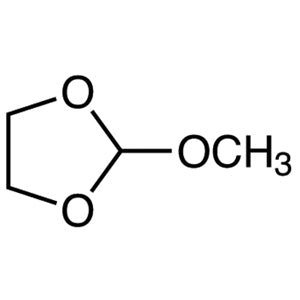
2-Methoxy-1,3-dioxolane is a chemical compound widely used as a building block in the synthesis of complex organic compounds. It is a versatile reagent that plays a crucial role in various chemical reactions within the laboratory. Its unique structure allows it to participate in substitution, addition, and other types of chemical reactions, making it an essential component in synthetic chemistry. This compound is commonly found in research settings where the development of new materials, pharmaceuticals, or industrial chemicals is required.
The compound is known for its stability and reactivity, which make it a preferred choice for chemists. It exhibits non-polar characteristics and is soluble in organic solvents such as ethylamine, acetone, and ethanol. Additionally, its ability to form hydrogen bonds enables it to interact effectively with other molecules, enhancing its utility in specific chemical reactions. These properties contribute to its widespread use in both academic and industrial research environments.
In Indonesian laboratories, 2-Methoxy-1,3-dioxolane is frequently utilized in organic chemistry research, particularly in the development of pharmaceutical compounds and functional materials. Its reliability and compatibility with various reagents make it a go-to compound for researchers aiming to achieve precise chemical outcomes. The compound's stability under controlled laboratory conditions further supports its application in diverse chemical processes.
Related TCI products
- TCI T2575 1193-11-9 2,2,4-Trimethyl-1,3-dioxolane
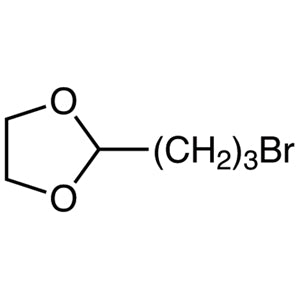
- TCI B3463 62563-07-9 2-(3-Bromopropyl)-1,3-dioxolane
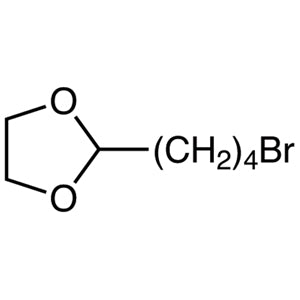
- TCI B2128 87227-41-6 2-(4-Bromobutyl)-1,3-dioxolane
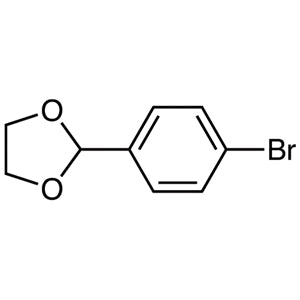
- TCI B2100 10602-01-4 2-(4-Bromophenyl)-1,3-dioxolane
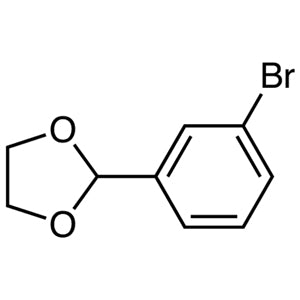
- TCI B2098 17789-14-9 2-(3-Bromophenyl)-1,3-dioxolane
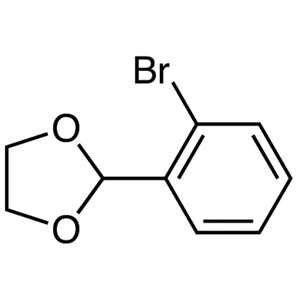
- TCI B2084 34824-58-3 2-(2-Bromophenyl)-1,3-dioxolane
- Organic synthesis is a key application where this compound is used to build complex molecules through various reaction mechanisms.
- Pharmaceutical research benefits from its ability to participate in reactions that lead to the formation of drug-like compounds.
- Material science applications leverage its chemical properties to develop new polymers and functional materials.
- Analytical chemistry uses it as a standard reference in chromatographic and spectroscopic analyses.
- Industrial chemical production incorporates it in the synthesis of intermediate compounds for commercial applications.
| Brand | TCI |
|---|---|
| CAS number | 19693-75-5 |
| Molecular formula | — |
| Purity | — |
| Category | Chemistry > Building Blocks > Non-Heterocyclic Building Blocks |
| Pack sizes | Available in various quantities as per standard laboratory supply |
| Physical form | Liquid |
| Storage | Store in a cool, dry place away from light and incompatible substances |
This compound should be stored in a cool, dry place, away from direct sunlight and incompatible materials. It is recommended to use airtight containers to prevent contamination and maintain its chemical integrity. Due to its reactivity, it should be handled with care, using appropriate personal protective equipment such as gloves and safety goggles. In laboratory settings, it should be kept in a well-ventilated area to minimize exposure. Regular monitoring of storage conditions ensures the compound remains stable and suitable for use in chemical experiments. Proper labeling of containers is essential for safe handling and to prevent accidental misuse.
—
Produk Terkait
-
2,2,4-Trimethyl-1,3-dioxolane TCI T2575
Regular price Rp 1.803.900,00Regular price -
2-(3-Bromopropyl)-1,3-dioxolane TCI B3463
Regular price From Rp 1.856.400,00Regular price -
2-(4-Bromobutyl)-1,3-dioxolane TCI B2128
Regular price From Rp 4.373.250,00Regular price -
2-(4-Bromophenyl)-1,3-dioxolane TCI B2100
Regular price From Rp 5.407.500,00Regular price -
2-(3-Bromophenyl)-1,3-dioxolane TCI B2098
Regular price From Rp 1.035.300,00Regular price -
2-(2-Bromophenyl)-1,3-dioxolane TCI B2084
Regular price From Rp 1.087.800,00Regular price -
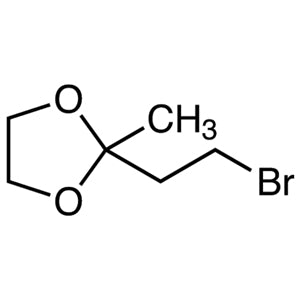
2-(2-Bromoethyl)-2-methyl-1,3-dioxolane TCI B1598
Regular price From Rp 5.407.500,00Regular price -
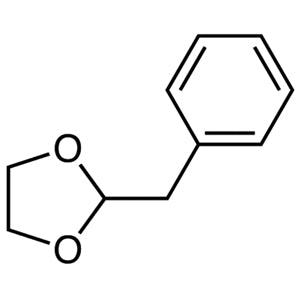
2-Benzyl-1,3-dioxolane TCI B1404
Regular price Rp 1.696.800,00Regular price