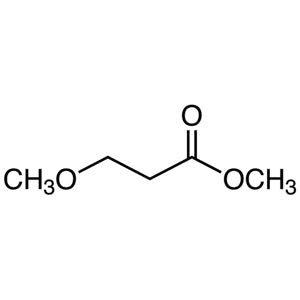
TCI M0962 Methyl 3-Methoxypropionate is the methyl ester of 3-methoxypropionic acid, a small molecule that carries both an ester group and an ether group on a three-carbon chain. This combination of two oxygenated functional groups gives the compound a dual character: it serves as a synthetic intermediate and at the same time as a polar solvent with a relatively mild odour. In the laboratory the material is used to introduce an oxygenated propionate fragment into target molecules, and also as a reaction medium or auxiliary solvent in formulation and coating work.
The properties that make it a preferred choice include the controlled reactivity of the ester group and the methoxy group, which adds polarity without introducing a new reactive centre. The ester group can be hydrolysed to the acid, transesterified, converted to an amide, or reduced to the alcohol, while the beta-alkoxy chain influences the acidity of the alpha protons and opens the way to certain elimination or addition reactions. Because it is a liquid at room temperature, the compound is easy to measure out, to mix, and to evaporate again during purification steps.
Its ability to dissolve a range of resins and polymers also makes it a practical choice in Indonesian laboratories that handle both synthesis and formulation work. Research groups, university teaching laboratories, and industrial development units typically keep this kind of bifunctional building block on hand because a single bottle serves two roles at once — reagent and solvent — which simplifies inventory planning and makes it a sensible item to stock for routine bench work.
Related TCI products
- Synthetic intermediate preparation — the ester group provides a controlled handle for hydrolysis, transesterification, amidation, or reduction, allowing chemists to build target molecules step by step.
- Introduction of oxygenated propionate fragments — the three-carbon chain bearing both ester and ether oxygen can be carried intact into a larger target molecule during multi-step synthesis.
- Polar reaction medium — the compound dissolves a range of polar and moderately polar reagents while its relatively mild odour makes extended bench work in a fume hood more comfortable.
- Coating and formulation work — its capacity to dissolve various resins and polymers makes it suitable as an auxiliary solvent when preparing trial coating formulations at laboratory scale.
- Alpha-functionalisation studies — the beta-alkoxy substituent influences the acidity of the alpha protons, making this substrate useful for investigating elimination and addition reactions.
| Brand | TCI |
|---|---|
| CAS number | 3852-09-3 |
| Molecular formula | — |
| Purity | — |
| Category | Chemistry > Building Blocks > Non-Heterocyclic Building Blocks |
| Pack sizes | available in the catalogue pack sizes offered for this TCI catalogue number |
| Physical form | liquid at room temperature |
| Storage | keep in a tightly closed container, away from heat and direct sunlight |
Store the container tightly closed in a cool, dry, and well-ventilated area, away from heat sources, open flames, and direct sunlight. Keep the material in its original supplier packaging or in a chemically compatible glass or approved solvent container with a secure closure, since ester solvents may attack some plastics over time. Handle inside a fume hood and wear safety goggles, gloves, and a laboratory coat. Avoid inhalation of vapour and contact with skin and eyes. Transfer and weigh the liquid away from ignition sources, close the container immediately after use to limit evaporation, and consult the manufacturer's safety data sheet for full handling guidance before first use.
—
Produk Terkait
-
Ethyl3-Methoxypropionate TCI M1001
Regular price From Rp 1.140.300,00Regular price -
Ethyl3-Ethoxypropionate TCI E0319
Regular price From Rp 584.850,00Regular price -
3-EthoxypropionicAcid TCI E0053
Regular price From Rp 1.246.350,00Regular price -
Methyl2,2-Dimethoxypropionate TCI D2382
Regular price Rp 6.465.900,00Regular price -
Ethyl3,3-Diethoxypropionate TCI D1962
Regular price From Rp 2.650.200,00Regular price -
Methyl3,3-Dimethoxypropionate TCI D1858
Regular price Rp 2.041.200,00Regular price -
2-Chloro-3-methoxypropionicAcid TCI C1688
Regular price From Rp 2.174.550,00Regular price -
4'-Methoxypropiophenone TCI M1719
Regular price Rp 1.510.950,00Regular price