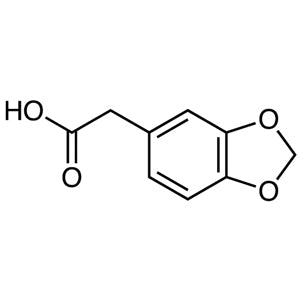
3,4-Methylenedioxyphenylacetic Acid with CAS number 2861-28-1 is an aromatic building block from TCI that combines a benzene ring bearing a methylenedioxy group with an acetic acid side chain. The methylenedioxy ring is a structural motif frequently encountered in natural product compounds, particularly among the alkaloid and lignan classes, which makes this material a valuable starting compound for researchers who want to construct molecular frameworks resembling natural products. In the laboratory, its role is to supply a ready-to-use aromatic core together with a functional group that can be readily transformed further.
The property that makes it a preferred choice is the flexibility of its carboxylic acid group, which can be converted into amides, esters, acid chlorides, alcohols, or aldehydes through standard organic chemistry reactions. The methylenedioxy ring itself is electron-rich, so the aromatic ring readily undergoes the electrophilic substitution and cyclization reactions that are key to forming isoquinoline frameworks. The methylenedioxy bridge is also relatively stable under common reaction conditions, so it does not interfere with other stages of a synthesis. Its solid form simplifies analytical weighing, long-term storage, and repurification.
In Indonesian laboratories, this material is typically used in synthetic organic chemistry research groups at universities and research institutes, as well as in natural product and medicinal chemistry programs that build analogues of plant-derived compounds. It is also drawn on by laboratories preparing reference materials and intermediates for further characterization work. Because it is a stable solid, it suits laboratory conditions where materials are weighed out in small portions across multiple experiments over an extended period.
Related TCI products
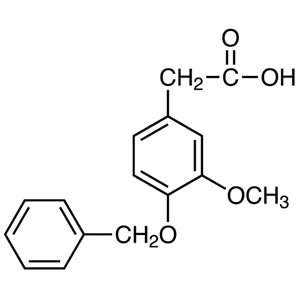
- TCI B4800 29973-91-9 4-Benzyloxy-3-methoxyphenylacetic Acid
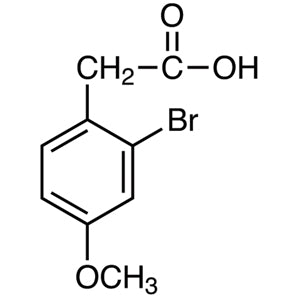
- TCI B4737 66916-99-2 2-Bromo-4-methoxyphenylacetic Acid
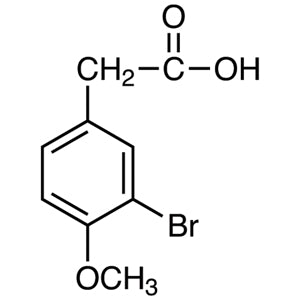
- TCI B4677 774-81-2 3-Bromo-4-methoxyphenylacetic Acid
- TCI A1356 28657-75-2 6'-Amino-3',4'-(methylenedioxy)acetophenone
- TCI M1923 4439-02-5 3,4-Methylenedioxyphenylacetonitrile
- TCI M1378 7797-83-3 2,3-(Methylenedioxy)benzaldehyde
- Natural product synthesis — the methylenedioxy motif appears widely in alkaloids and lignans, so this compound provides a ready-made aromatic core for building natural-product-like molecular frameworks.
- Isoquinoline framework construction — the electron-rich aromatic ring readily undergoes the cyclization reactions that are key to forming isoquinoline skeletons in multi-step synthetic routes.
- Amide and ester preparation — the carboxylic acid side chain converts cleanly to amides and esters using standard organic chemistry couplings, supporting the preparation of derivative libraries.
- Medicinal chemistry intermediates — its combination of a stable aromatic core and a transformable functional group suits research groups preparing analogue series for structure-activity investigations.
- Functional group transformation studies — the acid group can be carried through to acid chlorides, alcohols, or aldehydes, making it useful for teaching and developing standard conversion methods.
| Brand | TCI |
|---|---|
| CAS number | 2861-28-1 |
| Molecular formula | — |
| Purity | — |
| Category | TCI |
| Pack sizes | available in the catalogue pack sizes offered by TCI for this item |
| Physical form | solid |
| Storage | store in a closed container in a cool, dry place away from moisture |
Store this material in its original tightly closed container in a cool, dry, well-ventilated area, protected from moisture and direct sunlight. Glass bottles or the supplier's original packaging are suitable containers; keep the closure sealed between uses to limit moisture uptake by the solid. Handle the compound in a fume hood using standard laboratory personal protective equipment, including safety glasses, gloves, and a laboratory coat. Avoid generating dust during weighing, and use clean, dry spatulas to prevent contamination of the stock. Label all secondary containers clearly, and consult the supplier's safety data sheet before first use and before any new procedure.
—
Produk Terkait
-
4-Benzyloxy-3-methoxyphenylaceticAcid TCI B4800
Regular price Rp 2.518.950,00Regular price -
2-Bromo-4-methoxyphenylaceticAcid TCI B4737
Regular price From Rp 848.400,00Regular price -
3-Bromo-4-methoxyphenylaceticAcid TCI B4677
Regular price From Rp 689.850,00Regular price -
6'-Amino-3',4'-(methylenedioxy)acetophenone TCI A1356
Regular price Rp 2.782.500,00Regular price -
3,4-Methylenedioxyphenylacetonitrile TCI M1923
Regular price From Rp 1.829.100,00Regular price -
2,3-(Methylenedioxy)benzaldehyde TCI M1378
Regular price From Rp 2.439.150,00Regular price -
4-MethoxyphenylaceticAnhydride TCI M0968
Regular price Rp 1.565.550,00Regular price -
3',4'-(Methylenedioxy)acetophenone TCI M0874
Regular price Rp 3.312.750,00Regular price