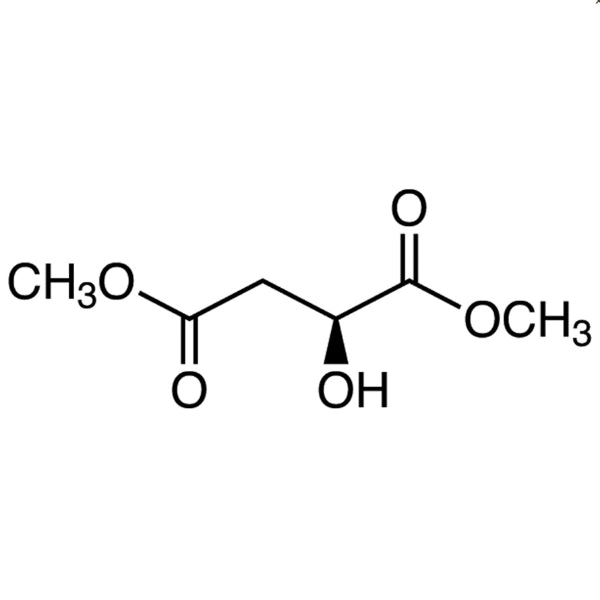
Dimethyl L-(-)-Malate is a chiral chemical compound widely used in asymmetric synthesis to construct complex molecular structures. This compound plays a crucial role in organic chemistry research, particularly in the development of bioactive compounds with specific stereochemical configurations. Its chiral nature makes it essential for creating molecules with defined optical properties, which is vital in pharmaceutical and materials science applications. In the laboratory, it serves as a key building block for synthesizing compounds with precise stereochemistry, enabling researchers to achieve high selectivity in chemical reactions.
One of the main reasons for its popularity is its chemical stability and ability to participate in asymmetric reactions. The compound’s chiral structure allows for the formation of enantiomerically pure products, which is highly desirable in drug development and advanced chemical research. Its reactivity and compatibility with various synthetic methodologies make it a preferred choice for chemists working on complex molecule synthesis. Additionally, its predictable behavior under controlled conditions enhances its utility in both academic and industrial settings.
In Indonesian laboratories, Dimethyl L-(-)-Malate is commonly used in pure and applied chemistry research. It is a staple in pharmaceutical development, material science, and biochemistry studies. Many research institutions and universities rely on this compound for asymmetric synthesis projects, drug discovery, and the creation of functional materials with specific optical properties. Its versatility and reliability make it an essential tool for scientists in Indonesia.
TCI brochures (PDF)
- Chiral Building Blocks 2025-04-14 · p. 10
Related TCI products
- Asymmetric Synthesis: This compound is ideal for creating chiral molecules with defined stereochemistry, essential for drug development and advanced chemical research.
- Pharmaceutical Research: Its chiral structure enables the synthesis of bioactive compounds with specific optical properties, crucial for developing new medications.
- Material Science: Used in the creation of functional materials with unique optical and structural characteristics, supporting innovation in advanced materials.
- Organic Chemistry Studies: Widely used in academic research for exploring stereochemical control and reaction mechanisms in complex molecule synthesis.
- Biochemistry Applications: Facilitates the development of compounds with specific biological activities, supporting research in enzyme interactions and molecular recognition.
| Brand | TCI |
|---|---|
| CAS number | 617-55-0 |
| Molecular formula | — |
| Purity | — |
| Category | Chemistry > Asymmetric Synthesis > Chiral Building Blocks |
| Pack sizes | Available in various quantities as per supplier specifications |
| Physical form | Solid (as per standard product description) |
| Storage | Store in a cool, dry place away from light and moisture |
Dimethyl L-(-)-Malate should be stored in a cool, dry place, away from direct sunlight and moisture to maintain its chemical stability. It is recommended to use airtight containers to prevent exposure to air and humidity, which could affect its integrity. In a laboratory setting, it should be handled with care to avoid contamination, and appropriate personal protective equipment should be worn when working with the compound. Due to its chiral nature, it is important to ensure that the compound remains uncontaminated to preserve its optical properties. Proper storage conditions help maintain its effectiveness in synthetic processes and ensure consistent results in research applications.
—
Produk Terkait
-
DimethylD-(+)-Malate TCI M1347
Regular price From Rp 3.075.450,00Regular price -
DiethylD-(+)-Malate TCI M1351
Regular price From Rp 1.326.150,00Regular price -
DiethylL-(-)-Malate TCI M1348
Regular price From Rp 769.650,00Regular price -
DimethylDL-Malate TCI M0025
Regular price Rp 2.041.200,00Regular price -
DimethylD-(-)-Tartrate TCI T1659
Regular price From Rp 584.850,00Regular price -
tert-Butyl(4R,6S)-6-(Hydroxymethyl)-2,2-dimethyl-1,3-dioxane-4-acetate TCI B4214
Regular price Rp 2.650.200,00Regular price -
tert-Butyl2-[(4R,6R)-6-(2-Aminoethyl)-2,2-dimethyl-1,3-dioxan-4-yl]acetate TCI B3702
Regular price From Rp 477.750,00Regular price -
tert-Butyl(4R,6R)-6-Cyanomethyl-2,2-dimethyl-1,3-dioxane-4-acetate TCI B3642
Regular price Rp 2.411.850,00Regular price



![125995-13-3 tert-Butyl 2-[(4R,6R)-6-(2-Aminoethyl)-2,2-dimethyl-1,3-dioxan-4-yl]acetate - AMI Scientific](http://amiscientific.com/cdn/shop/files/TCI2510B3702_705847bc-29c8-4b1a-a9b8-9f4767f456f2.jpg?v=1767433734&width=533)
![125995-13-3 tert-Butyl 2-[(4R,6R)-6-(2-Aminoethyl)-2,2-dimethyl-1,3-dioxan-4-yl]acetate - AMI Scientific](http://amiscientific.com/cdn/shop/files/TCI2510B3702.jpg?v=1772179478&width=533)