

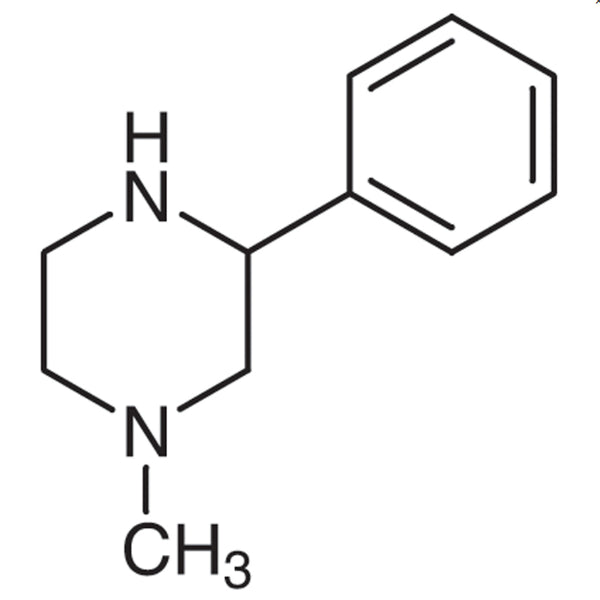
1-Methyl-3-phenylpiperazine is a versatile chemical compound widely used in laboratory settings for the synthesis of heterocyclic compounds. As a building block in organic chemistry, it plays a crucial role in the development of bioactive molecules. Its unique structure, combining a piperazine ring with methyl and phenyl groups, makes it a valuable tool for researchers aiming to create complex molecular structures. This compound is particularly useful in pharmaceutical and biochemical research due to its ability to participate in various chemical reactions.
The chemical properties of 1-Methyl-3-phenylpiperazine, including its stability and reactivity, make it a preferred choice for synthetic chemists. It exhibits good solubility in common organic solvents, which facilitates its use in a wide range of reaction conditions. The compound's ability to react with different functional groups allows for the synthesis of diverse derivatives, enhancing its utility in laboratory applications. Its chemical versatility and predictable behavior under different reaction conditions contribute to its popularity among researchers.
In Indonesian laboratories, 1-Methyl-3-phenylpiperazine is commonly used in chemical, pharmaceutical, and biochemical research. It is a key component in experiments aimed at developing new drugs and understanding molecular interactions. Many research institutions and universities rely on this compound for its role in synthesizing bioactive compounds. Its application spans various scientific disciplines, making it an essential reagent in modern laboratory practices.
- Pharmaceutical research utilizes this compound for the synthesis of bioactive molecules due to its structural versatility and reactivity.
- Biochemical studies benefit from its ability to participate in various chemical reactions, aiding in the development of new therapeutic agents.
- Organic synthesis applications rely on its stability and solubility, making it ideal for complex molecule construction.
- Academic research institutions use it as a foundational building block for teaching and experimental purposes.
- Drug discovery projects incorporate it to explore new molecular structures with potential pharmacological activity.
| Brand | TCI |
|---|---|
| CAS number | 5271-27-2 |
| Molecular formula | — |
| Purity | — |
| Category | Chemistry > Building Blocks > Heterocyclic Building Blocks |
| Pack sizes | Available in various quantities as per supplier specifications |
| Physical form | Solid, crystalline powder |
| Storage | Store in a cool, dry place away from light and moisture |
This compound should be stored in a cool, dry place, away from direct light and moisture to maintain its chemical integrity. It is recommended to use airtight containers to prevent exposure to air and humidity. Due to its reactivity, it should be handled in a well-ventilated area, preferably under a fume hood, to ensure safety. Proper personal protective equipment, such as gloves and safety goggles, should be worn when handling this material. Avoid contact with skin and eyes, and ensure that spillage is cleaned up promptly using appropriate safety procedures. Its use should be limited to controlled laboratory environments to minimize risks associated with chemical exposure.
—
Produk Terkait
-
1-Phenylpiperazine TCI P0980
Regular price Rp 1.749.300,00Regular price -
1-Piperonylpiperazine TCI P1041
Regular price From Rp 1.140.300,00Regular price -
1-Butylpiperazine TCI B4078
Regular price From Rp 1.565.550,00Regular price -
1-Allylpiperazine TCI A3172
Regular price From Rp 2.518.950,00Regular price -
1-Ethylpiperazine TCI E0355
Regular price From Rp 637.350,00Regular price -
tert-Butyl3-Ethylpiperazine-1-carboxylate TCI D6422
Regular price From Rp 1.485.750,00Regular price -
1-Isopropylpiperazine TCI I0745
Regular price From Rp 1.724.100,00Regular price -
1-Benzhydrylpiperazine TCI B3760
Regular price From Rp 1.008.000,00Regular price


