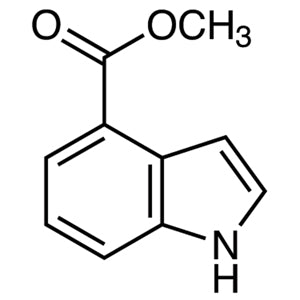
Methyl Indole-4-carboxylate is the methyl ester of indole-4-carboxylic acid, consisting of an indole framework bearing an ester group at the 4-position of the benzene ring. The compound serves as a heterocyclic building block that offers researchers two working handles at once: an ester group that can be converted into a wide range of derivatives, and an indole pyrrole ring that remains reactive for further functionalisation. Installing a carboxylate group at the 4-position through direct synthesis is notoriously difficult because of positional selectivity problems, so having this starting material readily available saves considerable time and effort in the laboratory.
The characteristic that makes this compound an attractive choice is the placement of the ester away from the reactive centre of the pyrrole ring. With the electron-withdrawing group located on the benzene ring, the C-3 position of the indole remains relatively electron-rich and ready to undergo formylation, Mannich reactions, or acylation, while the indole nitrogen can still be protected or alkylated as required. The ester group itself is ready to be hydrolysed to the acid, coupled into an amide, reduced to an alcohol, or used as a ring-closure point. This combination makes it an efficient branching node in a synthetic route.
In Indonesian laboratories, this building block is typically used in university and institutional research groups working on organic synthesis, medicinal chemistry, and natural product analogue preparation. It is handled at the bench scale for multi-step route development, where a reliable 4-substituted indole starting material removes an otherwise troublesome selectivity step. Research teams preparing candidate compound libraries and method development studies find it a practical entry point into substituted indole chemistry.
Related TCI products
- Medicinal chemistry scaffold preparation: the indole core is a recurring motif in bioactive compounds, and the 4-ester handle allows rapid diversification into amides and acids for structure-activity studies.
- Heterocyclic route development: the compound acts as a branching node where the ester and the pyrrole ring can be elaborated independently, letting chemists design convergent multi-step sequences without protecting-group conflicts.
- C-3 functionalisation studies: because the electron-withdrawing ester sits on the benzene ring, the C-3 position stays electron-rich and suitable for formylation, Mannich reactions, or acylation experiments.
- Amide coupling and library synthesis: hydrolysis of the ester to the free acid provides a coupling partner for generating sets of indole-4-carboxamide derivatives in parallel research workflows.
- Ring-closure and fused-system construction: the ester serves as a cyclisation point for building fused heterocyclic systems, giving access to polycyclic frameworks that are difficult to assemble by direct methods.
| Brand | TCI |
|---|---|
| CAS number | 39830-66-5 |
| Molecular formula | — |
| Purity | — |
| Category | Chemistry > Building Blocks > Heterocyclic Building Blocks |
| Pack sizes | available in standard TCI research-scale packaging; please refer to the pack size options listed for this item |
| Physical form | — |
| Storage | store in a cool, dry place in the tightly closed original container |
- Product code: M1773
Store the container tightly closed in a cool, dry, well-ventilated area away from direct sunlight, heat sources, and strong oxidising agents. Keep the material in its original supplier packaging or in a chemically compatible, clearly labelled amber glass container to limit exposure to light and moisture. Handle inside a fume hood using standard personal protective equipment, including nitrile gloves, safety goggles, and a laboratory coat. Avoid generating dust, avoid inhalation and skin contact, and weigh out quantities carefully before resealing. Always consult the manufacturer safety data sheet before use, and dispose of residues and contaminated materials in accordance with applicable laboratory chemical waste procedures.
—
Produk Terkait
-
MethylIndole-6-carboxylate TCI M2042
Regular price From Rp 717.150,00Regular price -
MethylIndole-2-carboxylate TCI M1749
Regular price From Rp 1.353.450,00Regular price -
EthylIndole-2-carboxylate TCI I0585
Regular price From Rp 2.041.200,00Regular price -
MethylIndole-5-carboxylate TCI I0545
Regular price From Rp 1.115.100,00Regular price -
MethylIndole-3-carboxylate TCI I0491
Regular price From Rp 1.035.300,00Regular price -
Ethyl5-Methoxy-1H-indole-2-carboxylate TCI E1534
Regular price Rp 1.167.600,00Regular price -
EthylIndole-3-carboxylate TCI E0955
Regular price From Rp 584.850,00Regular price -
tert-Butyl3-Formyl-1H-indole-1-carboxylate TCI D6036
Regular price From Rp 1.749.300,00Regular price