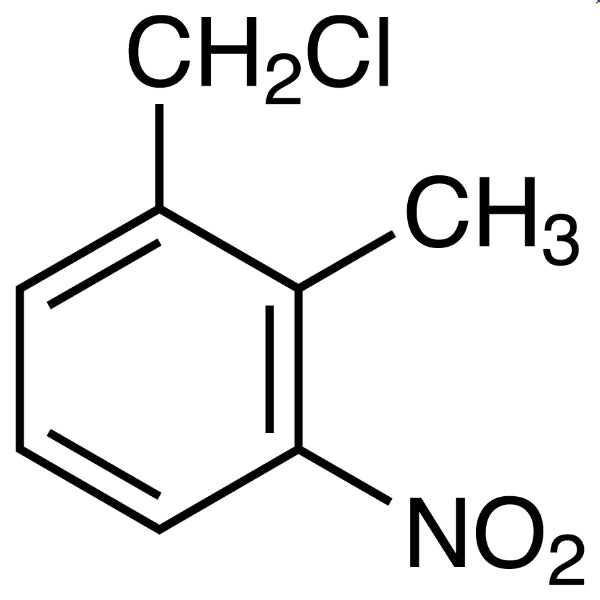
TCI M1816 2-Methyl-3-nitrobenzyl Chloride is a substituted aromatic compound that carries three important functional groups at once: a highly reactive benzylic chloride, an electron-withdrawing nitro group, and a methyl group on the benzene ring. In the laboratory, this material serves as an alkylating reagent and as a non-heterocyclic building block, allowing researchers to attach a substituted benzyl fragment to nucleophiles such as amines, alcohols, thiols, and carbon anions. Its specific substitution pattern at the two and three positions makes it a deliberate choice when spatial arrangement and the direction of subsequent reactions must be tightly controlled.
The property that drives its selection is the high reactivity of the benzylic chloride toward nucleophilic substitution, which means alkylation reactions often proceed under relatively mild conditions without requiring complicated catalysts. The nitro group adds double value: beyond activating the ring toward certain reaction patterns, it can be reduced to an aromatic amine at a later stage, opening a route toward ring closure and the construction of heterocyclic systems. A consequence of that same reactivity is sensitivity to moisture and lachrymatory character, both of which shape how the material must be handled at the bench.
In Indonesian laboratories, this building block is typically used in synthetic organic chemistry groups at universities and research institutes, as well as in pharmaceutical and fine-chemical development work where a defined benzyl fragment must be introduced into a larger molecular framework. It is generally purchased in modest research quantities for method development, multi-step synthesis routes, and the preparation of intermediates that will later be elaborated into more complex targets.
- Nucleophilic alkylation of amines: the benzylic chloride reacts readily with primary and secondary amines to install the substituted benzyl group under relatively mild laboratory conditions.
- Ether and thioether synthesis: alcohols and thiols can be benzylated using this reagent, giving access to substituted benzyl ethers and sulfides without complicated catalytic systems.
- Carbon–carbon bond formation: stabilized carbon anions attack the reactive benzylic position, allowing researchers to extend carbon skeletons with a defined nitro-substituted aryl fragment.
- Precursor to aromatic amines: the nitro group can be reduced at a later synthetic stage, converting the material into an aniline derivative for further transformation.
- Heterocycle construction routes: after nitro reduction, the resulting amine enables ring-closure strategies that build heterocyclic systems from this non-heterocyclic starting building block.
| Brand | TCI |
|---|---|
| CAS number | 60468-54-4 |
| Molecular formula | — |
| Purity | — |
| Category | Chemistry > Building Blocks > Non-Heterocyclic Building Blocks |
| Pack sizes | available in standard TCI research pack sizes; please confirm the currently listed option when ordering. |
| Physical form | — |
| Storage | keep in a tightly closed container, protected from moisture. |
- Product code: M1816
Store the container tightly closed in a cool, dry, and well-ventilated area, away from moisture, since the benzylic chloride is sensitive to hydrolysis. Original supplier packaging or a comparable tightly sealed glass container with a chemically resistant closure is appropriate; avoid leaving the material open to laboratory air. Because the compound is a lachrymator, all weighing and transfer operations should be carried out inside a functioning fume hood, using safety goggles, suitable chemical-resistant gloves, and a laboratory coat. Keep the material away from strong nucleophiles and incompatible reagents, label all working solutions clearly, and follow your institution's standard procedures for the disposal of halogenated and nitroaromatic organic waste.
—
Produk Terkait
-
2-NitrobenzylChloride TCI N0182
Regular price From Rp 1.644.300,00Regular price -
3-NitrobenzylChloride TCI C0709
Regular price From Rp 1.035.300,00Regular price -
4-NitrobenzylChloride TCI C0229
Regular price From Rp 1.060.500,00Regular price -
4-NitrobenzylAcetate TCI A0039
Regular price From Rp 1.298.850,00Regular price -
4-NitrobenzylAcetoacetate TCI N0875
Regular price From Rp 584.850,00Regular price -
2-NitrobenzylCyanide TCI N0781
Regular price Rp 1.829.100,00Regular price -
2-NitrobenzylBromide TCI N0404
Regular price From Rp 1.060.500,00Regular price -
4-NitrobenzylCyanide TCI N0229
Regular price From Rp 928.200,00Regular price