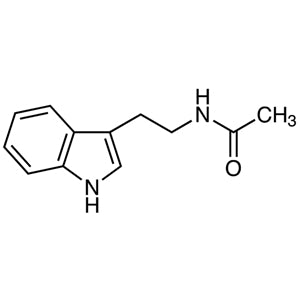
2-Methyltryptamine with CAS number 2731-06-8 is a tryptamine derivative carrying a methyl group at the two position of the indole ring together with an ethylamine side chain at the three position. The compound is classified as a heterocyclic building block because it supplies a complete indole framework already equipped with a primary amine side chain that is ready for modification. The tryptamine skeleton is the core structure of many natural products and indole alkaloids, which makes this compound an efficient starting material for laboratories studying alkaloid synthesis and the development of indole-based bioactive molecules.
The characteristic that makes this material a frequent choice is the combination of a highly reactive primary amine with an electron-rich indole ring. The primary amine is readily acylated, alkylated, sulfonylated, or condensed with aldehydes to form imines that can subsequently be reduced or cyclised. The methyl group at the two position exerts an important influence: that position becomes blocked, so Pictet-Spengler cyclisation and related transformations proceed with a selectivity pattern different from that of ordinary tryptamine. Researchers exploit precisely this difference to direct synthetic routes toward the target frameworks they intend to build.
In Indonesian laboratories, this building block is typically used in university and institutional research settings where synthetic organic chemistry, natural product chemistry, and medicinal chemistry programmes are carried out. It suits groups preparing indole alkaloid analogues, exploring structure-activity relationships across tryptamine scaffolds, or generating intermediates for further functionalisation. Because the material arrives as a defined building block, working groups can begin their planned synthetic sequence directly rather than preparing the indole core themselves.
- Indole alkaloid synthesis: the complete tryptamine skeleton mirrors the core of many natural alkaloids, letting researchers enter a synthetic route several steps ahead of building the indole ring from scratch.
- Pictet-Spengler cyclisation studies: the methyl group blocking the two position gives a selectivity pattern distinct from plain tryptamine, making this compound valuable for investigating how substitution steers ring closure.
- Amide and sulfonamide library preparation: the primary amine is easily acylated or sulfonylated, so a single batch can generate a wide series of derivatives for screening within one working programme.
- Reductive amination chemistry: condensation of the primary amine with aldehydes forms imines that are reduced to secondary amines, providing a straightforward route to structurally varied tryptamine analogues.
- Medicinal chemistry scaffold development: the electron-rich indole ring plus a modifiable amine side chain supports the design of indole-based bioactive molecules and systematic structure-activity relationship investigations.
| Brand | TCI |
|---|---|
| CAS number | 2731-06-8 |
| Molecular formula | — |
| Purity | — |
| Category | Chemistry > Building Blocks > Heterocyclic Building Blocks |
| Pack sizes | available in the standard TCI research pack sizes; please confirm the size required when ordering |
| Physical form | — |
| Storage | keep in a tightly closed original container under the conditions stated on the manufacturer's label |
- Catalogue code: M2055
Store the container tightly closed in a cool, dry, well-ventilated area away from direct sunlight, heat sources, and incompatible materials such as strong oxidising agents and strong acids. Keep the material in its original supplier packaging wherever possible; if transfer is required, use clean, chemically compatible, well-sealed glass or suitable plastic containers that are clearly labelled with the compound name and CAS number. Handle the material in a fume hood using safety glasses, gloves, and a laboratory coat, and avoid generating dust or inhaling vapours. Close the container immediately after weighing to limit exposure to air and moisture. Consult the manufacturer's safety data sheet before first use and dispose of residues and contaminated materials in accordance with institutional chemical waste procedures.
—
Produk Terkait
-
TryptamineHydrochloride TCI A0300
Regular price Rp 557.550,00Regular priceRp 405.300,00Sale price Rp 557.550,00 -
Tryptamine TCI T0890
Regular price Rp 2.147.250,00Regular priceRp 1.517.250,00Sale price Rp 2.147.250,00 -
N-Acetyl-5-hydroxytryptamine TCI A1277
Regular price Rp 2.359.350,00Regular priceRp 1.665.300,00Sale price Rp 2.359.350,00 -
5-MethoxytryptamineHydrochloride TCI M3563
Regular price Rp 1.351.350,00Regular priceRp 960.750,00Sale price Rp 1.351.350,00 -
6-Methoxytryptamine TCI M3162
Regular price Rp 2.942.100,00Regular priceRp 2.072.700,00Sale price Rp 2.942.100,00 -
5-Methoxytryptamine TCI M0131
Regular price Rp 530.250,00Regular priceRp 386.400,00Sale price Rp 530.250,00 -
N-Acetyltryptamine TCI A2685
Regular price Rp 2.677.500,00Regular priceRp 1.887.900,00Sale price Rp 2.677.500,00