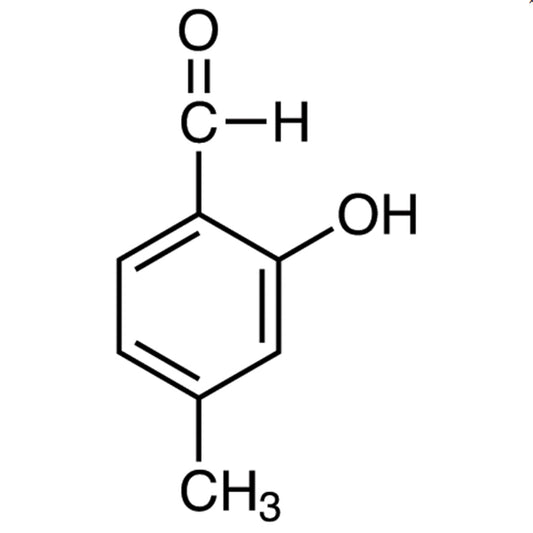
3-Methylsalicylaldehyde is a chemical compound widely used in organic synthesis reactions within laboratory settings. As a key building block in the field of chemistry, it serves as a fundamental component for the creation of more complex organic molecules. Its aromatic structure provides a versatile platform for various chemical transformations, making it an essential tool in synthetic chemistry. This compound is commonly found in research laboratories, where it plays a crucial role in the development of new compounds and materials. Its chemical stability under normal conditions allows for reliable use in multiple experimental setups.
The compound's reactivity, particularly due to its aldehyde functional group, makes it highly suitable for substitution and condensation reactions. Its ability to interact with a variety of reagents such as bases, acids, and alkali metals enhances its utility in synthetic processes. The sensitivity of 3-Methylsalicylaldehyde to moisture and air requires careful handling, but this reactivity is precisely what makes it a preferred choice for chemists. Its chemical versatility and structural simplicity contribute to its popularity in both academic and industrial research environments.
In Indonesian laboratories, 3-Methylsalicylaldehyde is frequently used in chemical research, especially in the synthesis of organic compounds. It is also commonly found in pharmaceutical studies, where it contributes to the development of new drugs and medicinal compounds. Its role in both academic and applied research highlights its importance in the scientific community. The compound's availability and chemical properties make it a valuable resource for researchers working in various fields of chemistry.
- Organic synthesis reactions benefit from 3-Methylsalicylaldehyde due to its reactivity and structural versatility, enabling the creation of complex organic molecules.
- Pharmaceutical research utilizes this compound as a building block for the development of new drugs and medicinal compounds, leveraging its chemical properties.
- Analytical chemistry applications often use it as a standard or reagent for the identification and quantification of related compounds in various samples.
- Material science studies incorporate it in the synthesis of functional materials, taking advantage of its aromatic structure and chemical reactivity.
- Environmental chemistry research may use it to study the behavior of aromatic compounds in different environmental conditions and their reactivity.
| Brand | TCI |
|---|---|
| CAS number | 824-42-0 |
| Molecular formula | — |
| Purity | — |
| Category | Chemistry > Building Blocks > Non-Heterocyclic Building Blocks |
| Pack sizes | Available in various quantities as per supplier specifications |
| Physical form | Solid or liquid, depending on the specific product variant |
| Storage | Requires storage in a dry, cool, and well-ventilated area away from moisture and air exposure |
3-Methylsalicylaldehyde should be stored in a dry, cool, and well-ventilated area to prevent moisture and air exposure, which can affect its stability. It is recommended to use airtight containers made of glass or high-density polyethylene to minimize contact with atmospheric moisture. Due to its reactivity, it should be handled with care using appropriate personal protective equipment such as gloves and safety goggles. The compound should be kept away from incompatible materials like strong oxidizing agents. Regular monitoring of storage conditions is essential to maintain its chemical integrity and ensure safe usage in laboratory settings. Proper labeling and storage practices help prevent accidental exposure and ensure compliance with safety standards in chemical handling.
—
Produk Terkait
-
4-Methylsalicylaldehyde TCI M2431
Regular price From Rp 2.439.150,00Regular price -
5-Methylsalicylaldehyde TCI M1676
Regular price From Rp 848.400,00Regular price -
Salicylaldehyde TCI S0275
Regular price From Rp 584.850,00Regular price -
Salicylaldehyde TCI S0004
Regular price From Rp 689.850,00Regular price -
3,6-Dimethylsalicylaldehyde TCI D4507
Regular price From Rp 3.551.100,00Regular price -
Methyl4-Methylsalicylate TCI M1584
Regular price From Rp 1.193.850,00Regular price -
Methyl5-Methylsalicylate TCI M1353
Regular price Rp 1.776.600,00Regular price -
Ethyl6-Methylsalicylate TCI M1283
Regular price From Rp 5.672.100,00Regular price