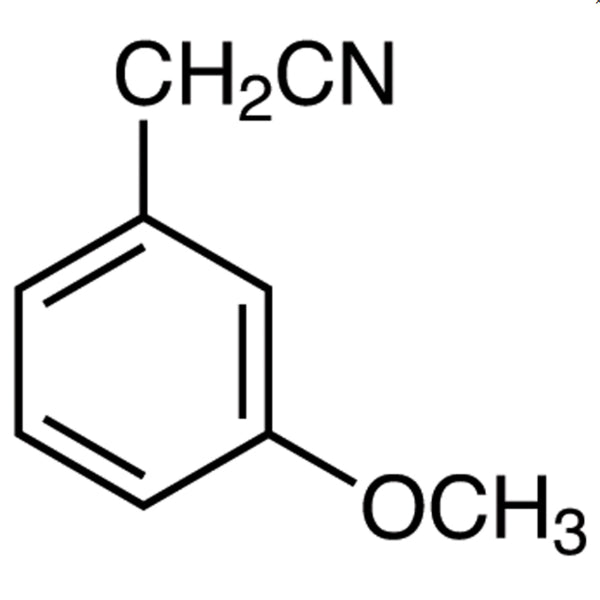

TCI M2331 3-Methoxyphenylacetonitrile is an aromatic nitrile compound built from a benzene ring bearing a methoxy group at the meta position, combined with an acetonitrile side chain, that is, the –CH₂CN group. In organic synthesis laboratories, this material belongs to the family of classic and highly versatile building blocks, because its nitrile group can be converted into a wide range of other functional groups, while the adjacent benzylic position is sufficiently acidic to be readily deprotonated and alkylated. This combination of two reactive sites within one simple molecule is precisely what makes it appear so often as a starting material in synthetic routes toward active compounds.
The characteristic that drives its widespread use is the transformational flexibility of the nitrile group. The nitrile can be reduced to a primary amine to give phenylethylamine derivatives, hydrolysed to phenylacetic acid or the corresponding amide, or reacted with organometallic reagents to form ketones. The benzylic protons situated between the aromatic ring and the nitrile group can be removed by a strong base, so that the resulting carbanion is ready to react with alkyl halides, allowing chain extension to be carried out in a directed manner. The methoxy group at the meta position acts as a supporting substituent that shapes the electronic character of the ring.
In Indonesian laboratories, this building block is typically encountered in organic synthesis work at universities and research institutions, in medicinal chemistry groups developing candidate active compounds, and in analytical or process development settings that require a reliable intermediate. It is normally handled at the bench in standard glassware under controlled conditions, drawn from a branded catalogue product so that the same material can be reordered consistently across repeated experimental campaigns.
Related TCI products
- Synthesis of phenylethylamine derivatives, where the nitrile group is reduced to a primary amine, giving direct access to an amine scaffold used across many medicinal chemistry programmes.
- Preparation of substituted phenylacetic acids and amides through hydrolysis of the nitrile, a route valued because it proceeds on a simple, well-understood functional group.
- Benzylic alkylation reactions, in which strong base deprotonates the position between the ring and the nitrile to form a carbanion that reacts cleanly with alkyl halides.
- Ketone formation via reaction with organometallic reagents, exploiting the nitrile as a carbonyl precursor and allowing carbon–carbon bonds to be constructed in a controlled way.
- Multi-step synthetic route development toward active compounds, where two independent reactive sites on one small molecule let chemists diversify intermediates without redesigning the starting material.
| Brand | TCI (Tokyo Chemical Industry) |
|---|---|
| CAS number | 19924-43-7 |
| Molecular formula | — |
| Purity | — |
| Category | Chemistry > Building Blocks > Non-Heterocyclic Building Blocks |
| Pack sizes | available in the standard catalogue pack sizes offered by TCI for this item; storage as indicated on the manufacturer's label |
| Physical form | — |
| Storage | — |
- Catalogue number: M2331
- Chemical name: 3-Methoxyphenylacetonitrile
Store the container tightly closed in a cool, dry, well-ventilated area away from direct sunlight, heat sources, and incompatible materials, following the storage conditions stated on the manufacturer's label and safety data sheet. Keep the material in its original supplier container, or in a chemically compatible sealed container that is clearly labelled with the substance name and CAS number. Handle inside a fume hood using nitrile gloves, safety goggles, and a laboratory coat, and avoid inhalation of vapours or contact with skin and eyes. Nitrile compounds should be transferred with clean, dry equipment, and any residue or waste must be collected as chemical waste in accordance with institutional disposal procedures rather than discharged to the drain.
—
Produk Terkait
-
4-Methoxyphenylacetonitrile TCI M0856
Regular price From Rp 823.200,00Regular price -
2-Methoxyphenylacetonitrile TCI M0855
Regular price Rp 875.700,00Regular price -
3,4,5-Trimethoxyphenylacetonitrile TCI T1927
Regular price From Rp 1.590.750,00Regular price -
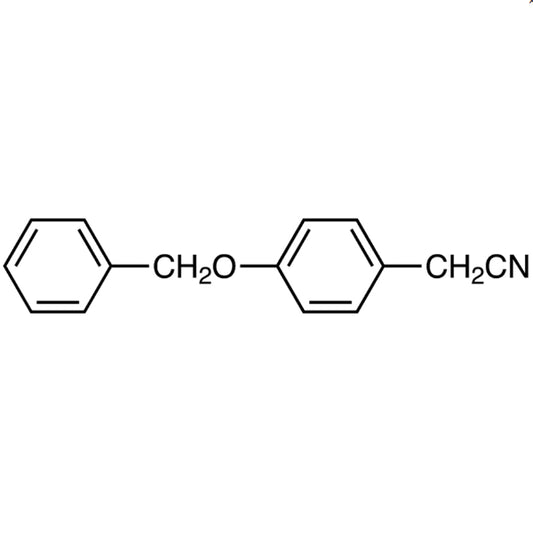
4-Benzyloxyphenylacetonitrile TCI B4734
Regular price From Rp 1.115.100,00Regular price -
3-Benzyloxyphenylacetonitrile TCI B4229
Regular price Rp 7.154.700,00Regular price -
Phenylacetonitrile TCI P0128
Regular price From Rp 477.750,00Regular price -
3,5-Dimethoxyphenylacetonitrile TCI D5186
Regular price From Rp 1.193.850,00Regular price -
4-Biphenylacetonitrile TCI B1545
Regular price From Rp 3.446.100,00Regular price