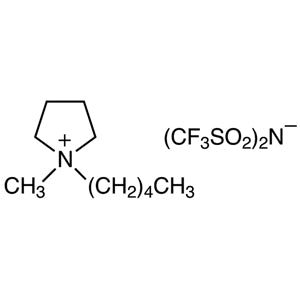
TCI M3118 1-Methyl-1-pentylpyrrolidinium Bis(trifluoromethanesulfonyl)imide is a pyrrolidinium-based ionic liquid pairing the bis(trifluoromethanesulfonyl)imide anion with a cation carrying a pentyl alkyl chain. In the laboratory it serves as a non-volatile solvent, a research electrolyte, and a reaction medium for syntheses that demand high thermal stability. Because the material is already a liquid at room temperature, it can be used directly without any prior melting step, and its ionic character creates a solvation environment markedly different from that of conventional molecular solvents such as acetonitrile or dichloromethane.
The property that makes this grade attractive is the pentyl chain, which is shorter than that of the corresponding octyl derivatives. As a result, this ionic liquid generally exhibits lower viscosity and higher ionic conductivity than its longer-chain relatives. That combination is highly valued in electrochemical research, because ion transport proceeds more freely inside a test cell. The saturated pyrrolidinium cation provides good resistance to reduction, while the NTf2 anion contributes oxidative stability together with hydrophobic behaviour, giving the material a useful working window for demanding experiments.
In Indonesian laboratories, the 1 g and 5 g pack sizes let researchers carry out preliminary screening before committing to larger-scale work. These quantities suit university research groups, government research institutes, and industrial R&D units that need a well-defined ionic liquid for method development rather than production volumes. Small packs also fit projects where the compound is evaluated alongside other candidate electrolytes, keeping unused material to a minimum while still supplying enough for repeated trials.
- Electrochemical cell studies: the low viscosity and high ionic conductivity of the pentyl-chain cation allow smoother ion transport inside test cells during measurement.
- Research electrolyte formulation: the wide stability offered by a reduction-resistant pyrrolidinium cation and an oxidation-resistant NTf2 anion suits demanding electrolyte investigations.
- High-temperature reaction medium: its non-volatile nature makes it a suitable medium for syntheses that require sustained thermal stability without solvent loss.
- Alternative solvation studies: the ionic environment differs strongly from molecular solvents such as acetonitrile or dichloromethane, enabling comparative solubility and reactivity work.
- Hydrophobic-phase separation work: the hydrophobic character contributed by the NTf2 anion supports experiments that rely on limited miscibility with aqueous phases.
| Brand | TCI |
|---|---|
| CAS number | 380497-17-6 |
| Molecular formula | — |
| Purity | — |
| Category | Chemistry > Specialty Synthesis > Ionic Liquids [Specialty Synthesis] |
| Pack sizes | 1 g and 5 g |
| Physical form | liquid at room temperature; ready to use without prior melting |
| Storage | keep in a tightly closed original container, protected from moisture |
Store the material in its tightly closed original container in a cool, dry place away from direct sunlight and sources of heat. Glass containers with chemically resistant closures are appropriate, and the bottle should be reclosed promptly after each withdrawal because the compound can pick up atmospheric moisture, which affects electrochemical measurements. Handle inside a fume hood while wearing safety glasses, gloves, and a laboratory coat. Use clean, dry syringes or pipettes to transfer the liquid, avoid contact with skin and eyes, and dispose of residues through the laboratory's chemical waste procedure.
—
Produk Terkait
-
TCI B5774 5,10-Bis(4,4,5,5-tetramethyl-1,3,2-dioxaborolan-2-yl)naphtho[1,2-c:5,6-c']bis([1,2,5]oxadiazole)
Regular price Rp 10.255.350,00Regular price -
Dihydroiodide TCI B6569
Regular price From Rp 1.936.200,00Regular price -
Trifluoromethanesulfonate TCI B7003
Regular price From Rp 1.936.200,00Regular price
![5,10-Bis(4,4,5,5-tetramethyl-1,3,2-dioxaborolan-2-yl)naphtho[1,2-c:5,6-c']bis([1,2,5]oxadiazole) - TCI B5774 - AMI Scientific](http://amiscientific.com/cdn/shop/files/TCI2510B5774.jpg?v=1769180228&width=533)